


Presidents Feel Pressure in Trump’s Second Term

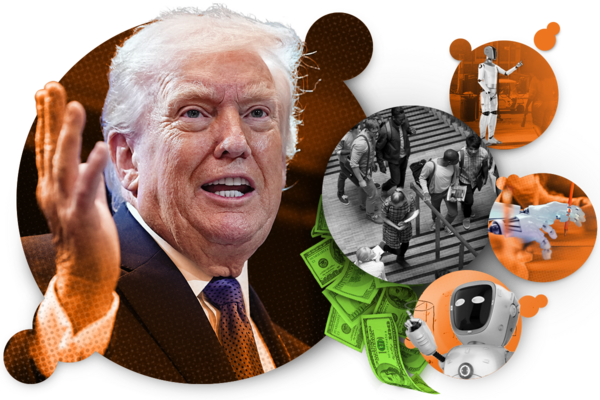
Year one of Trump 2.0 brought a flurry of policy changes as the federal government sought to eliminate diversity, equity and inclusion practices; restrict the flow of research funding to institutions accused of insufficiently addressing antisemitism; overhaul student financial aid; and shock the college accreditation system, among other policy goals.
More on the Survey
On Tuesday, April 14, at 2 p.m. Eastern, Inside Higher Ed will present a free webcast to discuss the results of the survey. Please register here—and plan on bringing your own questions about academic leadership in 2026.
Inside Higher Ed’s 2026 Survey of College and University Presidents was conducted with Hanover Research. Some 430 presidents from public and mostly private nonprofit institutions, two-year and four-year, responded. The margin of error is four percentage points.
A copy of the free report can be downloaded here.
This independent leadership survey was made possible by support from Liaison and Jenzabar.
But Trump-related policy whiplash is just one of many challenges leaders are juggling, according to Inside Higher Ed’s 2026 Survey of College and University Presidents, conducted with Hanover Research and released today. Survey data shows college presidents are navigating a volatile mix of political pressure, financial uncertainty and rapid technological advancement as artificial intelligence use continues to expand in and outside the classroom—a change some leaders are embracing despite outstanding concerns.
This year’s survey included responses from 430 leaders across a mix of two- and four-year institutions, including public, private nonprofit and a small number of private for-profit colleges. The survey is now in its 16th year.
Political Pressure
Survey respondents are somewhat mixed on how much Trump 2.0 has affected their campuses. More than half of presidents (59 percent) said that the administration has had no impact, negative or positive, on academic freedom at their institution. And just under half (49 percent) said that the administration has negatively affected their college’s ability to carry out its mission, while another 43 percent indicated no impact.
But college presidents overwhelmingly agreed that the policy moves of the Trump administration have had far-reaching, negative consequences for higher education as a whole. They take an especially bleak view of the regulatory environment, with 81 percent saying that the administration has had a negative effect. Even more—87 percent—say that the Trump administration has harmed the financial outlook for higher education. Some 63 percent of respondents also said that the Trump administration has had a negative effect on their own institution’s finances.
A small number of presidents split with their peers on the above questions, with 8 percent finding that Trump has had a positive impact on the regulatory environment, 4 percent arguing that the current administration has improved the financial outlook for the sector and 7 percent indicating that the financial outlook at their institution has improved thanks to Trump 2.0.
James Herbert, president of the University of New England, told Inside Higher Ed that while many institutional leaders bristle at the federal government’s tactics, he believes that “there is a debate to be had about whether some of the goals of the administration are worthy or not.”
While a majority of respondents (62 percent) do not believe that the current federal policy environment is forcing change that will benefit the sector in the long run, some do. Just over a fifth of respondents, or 21 percent, agreed such changes may benefit higher education.
Some college leaders also co-signed Trump’s goals in the comments portion of the survey.
“We support the President’s policies,” wrote the leader of a private college in the Midwest.
Another president at a private Midwestern institution wrote that their university “has always been aligned with conservative priorities” and is “now finding greater public acceptance of such.”
Some 78 percent of presidents said that the Trump administration has negatively impacted the climate for free inquiry and civil dialogue across the sector. However, another 10 percent responded that it has had a positive impact in these areas.
A vast majority—86 percent—found that the current administration has had a negative effect on diversity, equity and inclusion across higher education. At the individual campus level, 66 percent of respondents indicated the administration has had a negative effect on DEI at their institutions. Many presidents also indicated that their institutions had made program adjustments due to recent executive orders or other federal actions, with 39 percent reporting changes to terminology in department names or descriptions and 12 percent reporting curriculum changes in politically sensitive areas.
Presidents in the survey indicated that they are responding to the new regulatory environment in various ways, most commonly (56 percent) through strategic compliance, defined as making changes necessary to remain compliant while protecting institutional values. Another 40 percent of respondents have quietly tweaked policies, introducing changes with little public discussion.
Just 5 percent reported responding to the regulatory environment via public advocacy, such as statements or campaigns about federal policy impacts. Another 2 percent indicated their institutions are in “active resistance” mode, challenging federal policies in court or through advocacy efforts.
Public Trust
Survey results also show concerns about public confidence in higher education.
Just over half of presidents—53 percent—said that the sector has been at least somewhat effective (versus not at all effective) in addressing such trust issues. But despite their concerns, presidents are split on taking action. More than half (51 percent) noted such efforts were underway, while 36 percent indicated they had not launched new initiatives in the last year to restore or build public trust. However, another 9 percent of respondents indicated they were planning to do so.
Teresa Valerio Parrot, principal of TVP Communications, a sector-focused public relations firm, expressed alarm that more colleges weren’t working on efforts to rebuild trust with the public.
“All of the sector is under pressure, and only 60 percent are doing something to help the industry as a whole and their institutions specifically to improve public trust in higher education,” she said. “Trust cascades into enrollment, it cascades into politics, it cascades into so many different areas, and for only 60 percent to either be addressing it or planning to address it suggests that 40 percent are missing an opportunity to help everybody, as well as their own campus.”
While student debt and related concerns about return on investment loom large for the public, most presidents believe their institutions are doing a good job explaining total cost of attendance and communicating their financial aid policies. Among respondents, 84 percent rated their institution’s transparency and clarity in communicating total costs as good or excellent, and another 70 percent indicated they had taken steps in the last year to improve transparency.
But college costs and the complexity of financial aid packages continue to bedevil consumers: Herbert, of the University of New England, said that while colleges make information about costs and financial aid available, that doesn’t always mean such details make sense to students and families.
“I think what the survey results reflect is the college presidents are saying, ‘We’re not hiding anything, we’re publishing it, we have a website that lays this out.’ But what’s being missed is that the public isn’t getting the message. So we have to take more responsibility for communicating that message in other ways that are accessible,” he said.
Compact Responses
Last year the Trump administration proposed its “Compact for Academic Excellence in Higher Education” to a small group of institutions, an agreement that would have required significant changes to various practices in exchange for preferential treatment on federal funding.
While no institution ultimately announced an agreement with the White House, the proposal was closely watched and hotly debated, with its critics arguing that signing the compact yielded too much power to the federal government. The Trump administration asked potential signatories to revise admissions and hiring practices, commit to a policy of institutional neutrality, freeze tuition for five years, restrict international student enrollment, suppress criticism of conservatives, and more.
More than three-quarters of respondents—79 percent—said they opposed the deal. But when Inside Higher Ed asked about specifics, some aspects of the compact were more palatable. For example, a slim majority (53 percent) agreed that employees should not express political views on behalf of the institution and approaching half (42 percent) want to clamp down on grade inflation.
But presidents sharply disagreed with the proposal in other areas. Respondents were most opposed to a proposal to freeze tuition for five years, with 82 percent expressing disapproval. Another 72 percent rejected calls to cap international student enrollment.
Finances
A strong majority of presidents—70 percent—are confident in their financial stability over the next 10 years. And another 83 percent are confident in their finances over the next five years. However, both numbers are down from last year’s survey, especially the longer-term view. Last year, 83 percent of survey respondents indicated they expected their institution to be stable over the next decade, meaning that number has dropped by 13 percentage points in just one year.
Valerio Parrot underscored what an eventful year it has been from one survey to the next, noting that federal research funding for higher education—once a sure thing—is no longer a guarantee, as some institutions learned when the Trump administration temporarily cut off the flow of such dollars last year. (Some institutions had those funds restored by courts, others by making concessions.)
“The last year under the Trump administration shifted funding for public and private institutions significantly, and there is this reality that grant dollars are not a given, funding for higher education from the public sector is not a given,” Valerio Parrot said.
Artificial Intelligence
Survey results show college leaders are split on artificial intelligence.
While 53 percent are optimistic about the growing impact of AI on higher education, another 36 percent are concerned. More than half (52 percent) said that AI literacy is not widespread on their campus, and the same share believe that the sector is not responding appropriately to nor prepared to handle the rise of AI. However, when asked about their own institution, just 29 percent said it is unprepared.
Herbert—who has a psychology background—suggested that presidents who are highly confident in their institution’s ability to handle AI but skeptical of the sector response are experiencing cognitive bias.
“Needless to say, AI is already having disruptive impacts, and we haven’t seen anything yet. The impacts are going to be very, very disruptive, and the timeline is unpredictable,” he told Inside Higher Ed. “Everybody has different ideas about what’s going to happen and no one has a crystal ball, so even the experts at the cutting edge of tech are debating amongst themselves about timelines and impacts.”
What is known, Herbert added, is that “things are moving fast and that you don’t have nearly the amount of time that you used to have to make adjustments.”
Most college leaders (67 percent) said the sector has been slightly or moderately effective in shaping national conversations about AI policy and ethics. But only 1 percent of respondents argued that the sector has been highly effective there.
Top uses of AI for institutions include virtual chat assistants and chatbots, administrative processes (such as scheduling and resource allocation), predictive analytics for student performance and trends, learning management systems, and admissions processes.
Only a small number of respondents indicated their institution is not using AI.
The Presidency
Despite the many pressures of the job, presidents overwhelmingly said they enjoy the work: 92 percent indicated that they enjoy being a college president.
“I was pleasantly surprised and pleased to see the number of presidents who want to be in their jobs and enjoy their jobs, and I hope that that really helps to uplift the ways that we talk about higher education in the coming year and also inspires presidents to fight for higher education,” Valerio Parrot said.
But that enthusiasm comes with caveats. Just over half of respondents (55 percent) said the modern college presidency is a job one person can reasonably handle, reflecting the growing complexity of the role amid heightened policy scrutiny, financial pressures and technological disruption. When asked about the hardest part of the job, a slight plurality of presidents pointed to financial constraints (21 percent), followed by enrollment challenges (15 percent).
Many presidents still expect to remain in their roles despite those challenges. A plurality of respondents—42 percent—said they hope to stay in their positions for at least five more years.
You may be interested
Iran threatens to shut down Persian Gulf shipping lanes as it launches new attacks
new admin - Mar 10, 2026Iran has threatened to shut down Persian Gulf shipping lanes. It comes as it steps up strikes on Gulf states…
City College of San Francisco to Close Downtown Center Campus
new admin - Mar 10, 2026[ad_1] City College of San Francisco is closing its Downtown Center campus this summer due to low enrollment and loss…

Man ‘couldn’t read shampoo label’ – then needed brain surgery
new admin - Mar 10, 2026Ollie Knight with mum Heidi (Image: Brain Tumour Research/SWNS)A man who believed he was experiencing "lockdown anxiety" was stunned to…