


Portland Community College Reels Amid Massive Strike

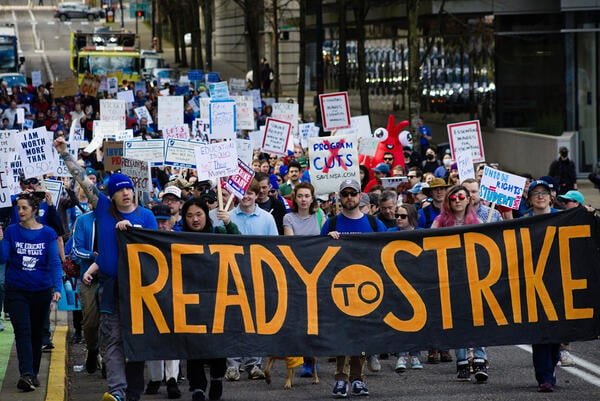
A faculty and staff strike at Portland Community College has stretched into a second week, shutting down classes and stalling final grades for the winter term.
Administrators and two unions at the college, the PCC Federation of Faculty and Academic Professionals and the PCC Federation of Classified Employees, were locked in negotiations for months until they hit a breaking point in mid-March. The main issue: Union leaders argue the administration is proposing meager wage increases that fail to account for inflation. College leaders say they can’t afford to pay more and keep the college financially healthy.
The vast majority of the 2,300 employees represented by both unions have gone on strike, according to college officials, though they don’t have an exact count. The college shut down its four campuses when the strike began on March 11 and announced it would move operations online to the extent possible. Faculty members on strike say most classes came to a halt, and final grades won’t be posted until the strike ends.
College leaders urged the unions to reach a deal in a memo ahead of bargaining on Monday, a week before the college transitions to its spring term on March 30.
“Right now, PCC still expects spring term to begin as scheduled,” the memo read. “However, the timing of a resolution is critical and the timeline for finalizing grades and resolving outstanding coursework for winter term has been significantly shortened.”
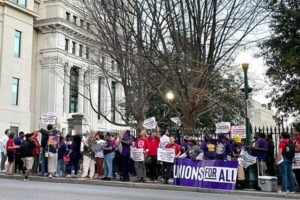
Students have taken to Reddit and other online forums to vent their anxieties and frustrations over the slow-moving negotiation process and to ask advice of their peers about how the strike might affect their academic progress. But students have also been showing up to the picket line in support of the unions, said Victoria Rau, vice president for communications for the PCC Federation of Faculty and Academic Professionals.
“There is a real outpouring of support from students,” Rau said. “It really means a lot. To put aside their own fears and anxieties about not getting final grades or spring quarter being stalled … to come out and say, ‘Our teachers deserve this. Our staff deserves this’—you really can’t, as an educator, ask for more than that.”
Outstanding Issues
The unions’ current contracts run through 2027, but faculty and staff began bargaining in May as part of a midterm reopener to negotiate wages for the coming two years.
College leaders argue the unions’ proposed cost-of-living adjustments aren’t financially feasible for the institution, citing rising costs, uncertain state and federal funding, and enrollment drops in the COVID-19 years. PCC president Adrien L. Bennings launched a fiscal sustainability framework and action plan in 2024 that sought to leave an end-of-year balance of at least 12 percent as a financial buffer. (The board is required to ensure a reserve of at least 9 percent.) The plan also involves more than $14 million in budget reductions for the 2025–27 budget cycle.
Administrators highlighted that the college cut management positions, vacant and otherwise, as part of budget reductions, and managers and confidential employees took a four-day furlough, amounting to a 1.5 percent salary reduction since July 2025.
But personnel costs are the college’s most substantial expense, said Vicky Lopez-Sanchez, vice president of student affairs.
“If we agree to an unstable COLA [cost of living adjustment], every dollar we commit beyond our current sustainable offer really has to be found elsewhere in the general fund,” Lopez-Sanchez said. “We want to be able to provide our faculty and staff with a fair increase that respects the cost of living, but also one that doesn’t dismantle the very resources that make PCC a safe and welcoming environment for our students.”
Howard Croom, associate vice president for people strategy, equity and culture, said in an email through a spokesperson that the college exceeded its revenue by $26 million last year. He said the college already cut almost $15 million but will have to cut another $21 million to right the ship. The college is working to offset a $37.7 million deficit for the 2025–27 biennium, based on its budgeted expenses and revenues, according to college officials.
Union leaders, however, are quick to point out that the president’s salary now stands at $344,754 annually, which included a 2.5 percent cost-of-living increase, and the number of managers has ballooned 29 percent since 2018. They also argue enrollment is up since the pandemic and state funding has increased.
Michelle DuBarry, executive vice president of the PCC Federation of Faculty and Academic Professionals, said higher ed experts in the union have analyzed the budget and find the austerity approach puzzling. She added that, in the past, the faculty union has been able to secure roughly $20 million over two years in such negotiations, whereas the administration’s most recent offer was closer to $9 million, “wildly out of line” with even the pandemic years.
“We know that they have money to pay a COLA that keeps up with inflation,” DuBarry said. “That’s all we’re asking for, and they’re offering us something that is far less than that at a time when our members, like many people, are struggling to afford basic things like housing and health care and food and transportation.”
As of Monday, the college offered a COLA of 2 percent in the first year and 3 percent in the second year to the PCC Federation of Faculty and Academic Professionals and no increase in the first year and 4 percent in the second year for the PCC Federation of Classified Employees.
The PCC Federation of Classified Employees and the college aren’t far apart in their proposals, said Justin Eslinger, contract action team chair for the classified union. The union and the college already reached agreement on health insurance caps months ago, among other issues. As of Monday, the union is calling for a 5 percent increase in the second year and a return-to-work plan that includes back pay for employees on strike and overtime pay for the extra hours they’ll need to work to prepare for the spring term. The college’s most recent proposal and the union’s are now less than a million dollars apart.
“We’re getting close and feeling like we’re at the point where we’ve moved as far as we feel like we can,” said Jeff Grider, president of the PCC Federation of Classified Employees. “We’re not yet at a point where we feel like if we had a tentative agreement that it would pass ratification.”
Ripple Effects on Students
College leaders say students are bearing the brunt of the strike.
Campus food pantries are closed, so administrators are directing students to community organizations for support, Lopez-Sanchez said. Student affairs management is stepping in to make sure resources like emergency aid continue to be available in the absence of staff. Student advising, financial aid and mental health services have all moved online.
The college is also offering students flexibility with course withdrawal and other academic deadlines while reassuring students that “their work is going to count,” even if it isn’t graded yet or their finals were delayed, she added.
Lopez-Sanchez also worries veteran students receiving federal benefits could be affected by the break in instruction. The college has committed to reimbursing students for any charges from Veterans Affairs, an estimated $350,000 for about 500 veteran students. She’s also concerned for the college’s roughly 350 international students, who need to maintain active student status in the spring for their student visas. She said the college is exploring whether these students might be able to take a vacation term or leave of absence or even transfer institutions, if necessary. Financial aid disbursements for students could also come late if the start of the spring term is delayed, affecting about half of the student body, she added.
Jennifer Ernst, the college’s vice president of academic affairs, said if the strike continues into the spring term, “that’s a really dynamic situation.”
“We are meeting daily to really run through scenarios and using some creativity,” she said. The college may delay the spring term by a week or at least push back the start of some classes, depending on when the strike ends. The goal is to “protect our students’ academic journey at this point, as much as we can.”
The unions and the administration are scheduled to be in mediation Monday and Tuesday.
“We are very eager for them to continue working … and coming to a consensus and an agreement,” Ernst said.
But some students put the blame squarely on the administration for not agreeing to the unions’ demands. The Associated Students of Portland Community College recently issued a vote of no confidence in the president. The two unions followed their lead and took votes of no confidence as well.
Students are “concerned about their school, concerned about their graduations,” student trustee Fareeha Nayebare said at a Board of Trustees meeting Thursday. There are “students like me that are concerned about whether or not they’re going to be attending school tomorrow, whether or not they are going to be in the United States attending school the next term.”
At the same time, “they still stand strong to support their instructors,” she added, “because we all know that behind every student that gets to that [graduation] podium and gets an A … is a strong instructor that gave up their time to work hard to make sure that student passes that class to get to another step of their life.” Students also feel “discomfort” with “having to pick sides” in the first place.
Rau, of the PCC Federation of Faculty and Academic Professionals, said union members didn’t want to put stress on their students.
“We’ve been trying to impress upon [administrators] that the timeliness of this matters,” she said. “We want to get back to work, and we want to make sure that our students have their grades. But being on strike, there’s nothing that we can do until they decide this is important enough to come back and reasonably talk to us.”
You may be interested

Gold medalists call on IOC to ban Iran over reported wrestler execution
new admin - Mar 24, 2026[ad_1] NEWYou can now listen to Fox News articles! Seven Olympians from multiple countries, including three gold medalists, have condemned…

Google’s Android Automotive is moving from the dashboard to the ‘brain’ of the car
new admin - Mar 24, 2026Google announced a new version of its Android Automotive open-source operating system for software-defined vehicles. Whereas previously Android Automotive operated…
As airport delays continue, can enrolling in TSA PreCheck save you time?
new admin - Mar 24, 2026As many travelers continue to face long security lines at major airports across the country, enrolling in TSA PreCheck remains one option…