



Partisan Divergence in Info Sources Affects Higher Ed Views

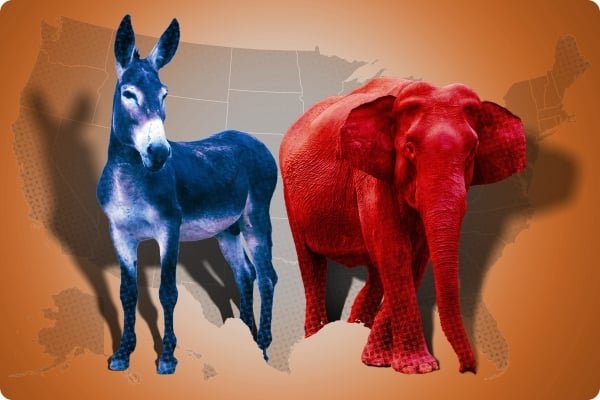
Research finds state lawmakers’ reliance on different information sources partly explains their stances.
Photo illustration by Justin Morrison/Inside Higher Ed | acambium64/iStock/Getty Images | FUTURE KIIID/pexels
Democratic state lawmakers’ reliance on different information sources than Republicans’ partly explains the parties’ diverging stances on controversial higher ed topics, researchers conclude in a newly published paper.
In an article published Saturday in The Journal of Higher Education, authors David R. Johnson of Georgia State University and Timothy L. O’Brien of the University of Wisconsin at Milwaukee wrote that they surveyed 941 lawmakers in 2021 regarding the sources, such as scientists and media, they rely on in policymaking and their stances on six issues. Those topics were charging in-state tuition to undocumented students, providing state financial aid to them, allowing concealed guns on campus, requiring higher ed employees and students to take ideological surveys, mandating formal adjudication for campus sexual assault, and providing legal counsel for those accused of sexual assault.
“Only one of the six policies we examined—providing legal counsel for individuals accused of sexual assault—demonstrated a direct relationship with partisan identity,” they wrote. “All other policy differences were driven by party differences in information consumption. Republicans’ positions on concealed weapons on college campuses, adjudication of sexual assault cases in court, and in-state tuition and state financial aid for undocumented students are rooted not only in the notion that universities are associated with the political left, but also in their low regard for legislative and technical expertise and high regard for religious authority.”
The authors wrote, “Democrats consider information from legislative leaders and members to be significantly more important. Democrats also assign significantly more weight than Republicans to information from state agencies, state interest groups, scientific experts, university leaders, and the news media. In fact, the only source of information significantly more important to Republicans than to Democrats is religious leaders.”
The authors did note, citing prior research, that “partisan differences in postsecondary policy preferences are related to a number of factors, both rational and nonrational, including self-interest, dynamics within political parties, core values, constituent pressure, ideological commitments to state versus market provision of education, and historically rooted inequalities related to race, gender, and class.”

You may be interested

Weijia Jiang: I was on stage last night with the president. This is what I saw.
new admin - Apr 26, 2026President Trump and CBS News' Weijia Jiang react as sounds of gunfire were heard at the White House Correspondents' Dinner,…

I’ve been a BBC film critic for 40 years – these are the rudest celebs | Films | Entertainment
new admin - Apr 26, 2026Tom Brook, journalist and film critic, is celebrating 50 years at the BBC (Image: BBC)It's happened to the best of…

Andrew Yang slams TKO Group over WrestleMania 42 ads and departures
new admin - Apr 26, 2026[ad_1] NEWYou can now listen to Fox News articles! Andrew Yang, a former Democrat presidential candidate and an American entrepreneur,…