

One secret Churchill’s female friend never revealed in wartime letters | Books | Entertainment

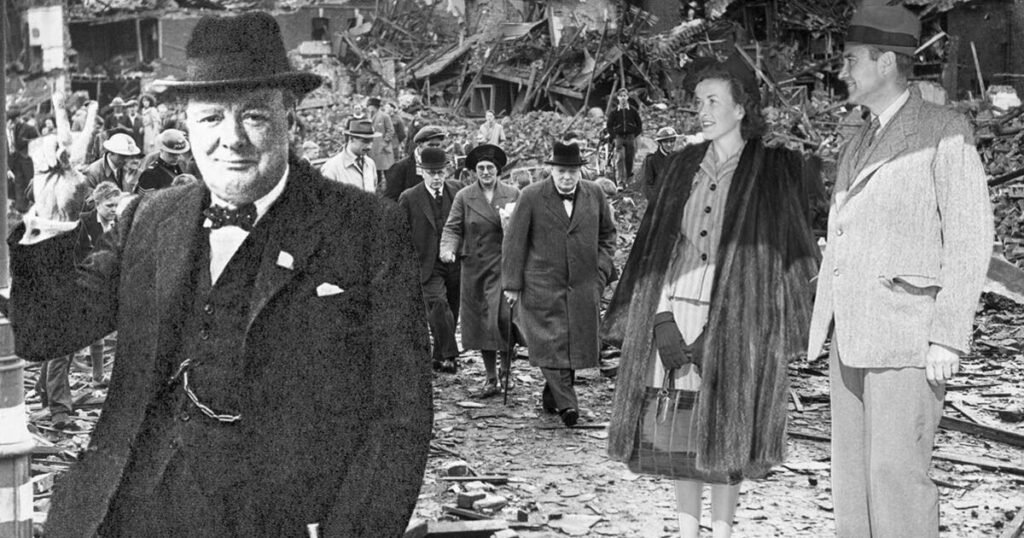

Kathleen Harriman, with father Averell, were in London at height of the Blitz (Image: Getty)
Kathleen Harriman jumped at the chance to accompany her father on his wartime mission to London. A wealthy American tycoon, Averell Harriman was US president Franklin Roosevelt’s special envoy to Britain.
“Ave” arrived in March 1941 and 23-year-old Kathy a couple of months later. Averell’s job was to expedite the supply of American aid to embattled Britain – material vital to the country’s survival against a Nazi war machine that had already defeated France and conquered continental Europe.
Kathy acted as Ave’s hostess, but her day job was as war correspondent for the US-based International News Service. Her father’s political connections gave her an easy entrée to elite social, political and military circles, including prime minister Winston Churchill and the flamboyant minister of supply, Lord Beaverbrook, proprietor of Britain’s biggest-selling newspaper the Daily Express. Kathy was a frequent visitor to Beaverbrook’s Surrey mansion, Cherkley Court, where she met the Express’s legendary editor Arthur Christiansen, who took her under his wing and published her first articles.
Another role model was Express journalist Hilde Marchant, Britain’s foremost female war correspondent. Intelligent, attractive and personable, Kathy was a huge political and social asset to Ave. But above all, she was a working reporter who witnessed air raids, visited bombed cities and munitions factories, toured military bases, interviewed allied leaders, and wrote stories about daily life on Britain’s home front. From London, and later from Moscow when her father became US ambassador to the Soviet Union, Kathy wrote hundreds of letters to family and friends.

With her father and Dwight Eisenhower in Moscow in 1945 (Image: Universal Images Group via Getty)
Often intimate and emotional, her correspondence was rarely only about herself. She wrote about the people she met, the circles she moved in and the historic events she witnessed. Kathy wrote many letters on the hoof – between assignments or social engagements – which gave her writing a spontaneous,visceral quality that kept it fresh.
The correspondence is surprisingly revealing, but there was one secret she kept: her best friend, Pamela Churchill, 21, the wife of PM Winston’s only son Randolph, was having an affair with her father. It was a discreet, unspoken-about relationship, but there are plenty of hints in Kathy’s letters, not least her observation that in wartime Britain age didn’t appear to matter in relations between the sexes. Kathy, whose main correspondent was her older sister Mary, who lived in New York, left London for Moscow in October 1943. She died aged 93 in New York in February 2011.
Late May 1941
“At the moment I am working for the Daily Express as well as I.N.S. [International News Service]. Spent last week travelling around with Hilde Marchant. She’s tiny, terribly efficient and terribly cold-blooded. Went down to the East End of London, the part by the docks where the poorer working class live. It’s far more horrible, for some reason, seeing tiny identical houses razed low, half bombed or burned, than large concrete buildings. [Beaverbrook] looks like a cartoon out of Punch. Small, baldish, big stomach and from there he tapers down to two very shiny yellow shoes.
“His idea of sport is to surround himself with intelligent men, then egg them on to argue and fight among themselves. Even his best friends are half scared of him because he’s got a fearful temper and no one seems to know when it will break. On top of all this he’s very kind, and is wonderful with children. For some reason he doesn’t seem to scare them.”
Kathy was a frequent visitor to Chequers, the PM’s country residence, and lunched and dined at 10 Downing Street on numerous occasions. She wrote many fascinating letters about her interactions with Churchill. In March 1942 she wrote a rather moving letter about visiting Churchill at home
“He took us around his garden – showed us the brick walls he’d laid, the ponds & swimming pool he’d built and talked about what he was going to do after the war. There at Chartwell, surrounded by his own things, the things he’s created himself, one almost feels sorry for him. He’s had to give up all his personal pleasures. The war’s tiring & ageing him terribly, but he never lets up.”
June 4, 1941
“Last weekend we went to Chequers. It’s rather a shock meeting someone you’ve seen so many times. The PM is much smaller than I expected and a lot less fat. He wears an RAF-blue, one-piece siren suit and looks rather like a kindly blue teddy bear. He expresses himself wonderfully – continually comes out with delightful statements. I’d expected an overpowering, rather terrifying man. He’s quite the opposite. Very gracious, has a wonderful smile and isn’t at all hard to talk to.”

Russian dictator Stalin gifted Kathy Harriman a horse, Boston (Image: Courtesy Geoff Roberts)
June 8, 1941
Kathy’s host in blitzed Plymouth was MP, Lady Astor – the first woman to take her seat in the House of Commons.
“I went down to Plymouth for two days the middle of last week and haven’t recovered yet. It’s so depressing and horrible that I don’t know how people can stay there. No house is untouched and block after block is absolutely laid low. The people are unbelievable. The Plymouth widows take their losses as a matter of course. They stay on living in half-roof-less houses & evacuate their children to the country.”
June 18, 1941
The Epsom Derby was run at Newmarket in 1941. Kathy was herself a highly skilled horsewoman and when she was in Moscow, Soviet dictator, Joseph Stalin, gifted her a veteran war horse.
“We saw the Derby – such as one can. The track is one straight, rather hilly so you can’t see the horses much of the time. They look like a growing furry caterpillar coming at you broadside, and you don’t figure out who’s ahead until almost thefinish. Actually, I didn’t care. The funny thing is that no one else did either. Life is unbelievably social. God only knows why. Every night next week is booked up already and the weekend hasn’t started.The only thing people seem scared about here is being lonely, so they date up way ahead of time.”
July 2, 1941
Kathy had first visited Britain in the 1920s and 1930s and was amazed how little the country had changed as result of the war.
“When I stop to think what an abnormal life I anticipated living, it makes me laugh. War or no war, England hasn’t changed. West Ham is the entrance to London by air. I saw a square mile of complete destruction & yet all the people register only contempt for the bombing. It changes, disorders their life momentarily only. Those who were evacuated to the country are coming back now in droves. The housing problem is terrific, but they aren’t happy in the country.”

Kathy met legendary Daily Express proprietor and wrote for the paper (Image: Mirrorpix via Getty)
July 19, 1941
“A weekend [at Chequers] is very different from anywhere else. Never for a moment is the war forgotten. Conferences all the time – secretaries running around – notes being passed around. Important people coming and going. Women are rather in the way. They leave right after dinner, and then aren’t expected to stay for too long when the men come out of the dining room, which sometimes isn’t until way after midnight.”
July 29, 1941
A story Kathy published about her visit to a plastic surgery hospital was much admired. “Imagine walking up to a guy and shaking hands with a fingerless stump. Badly burned fingers curl under and then grow together
“After a while they can be operated on and separated. If the operation is successful, they go back into the air force. I know one guy who has already – his hands are OK – his face isn’t. He still has to have a new set of false eyelids grafted on. It’s not easy talking to an earless, eye-lidless boy of about 21. You can’t let him realise what you feel.”
August 29, 1941
Kathy and Pam rented a country house, where they entertained politicians, journalists and RAF crew.
“The war hit us today. The sun was shining for the first time in almost weeks. We went for a walk and then saw an amusing movie in Dorking. We were in the best of spirits. We got home and found a message – ‘Wing Co. Gillan is missing’. He was shot down over France this morning. It seems hard to believe he won’t be coming over here anymore. It’s all rather depressing.”

Author Geoffrey Roberts has edited Kathleen Harriman’s letters from London for a new book (Image: Courtesy Geoff Roberts)

Wartime Letters, edited by Geoffrey Roberts and featuring Kathleen Harrimab’s letters is out now (Image: Yale University Press)
November 21, 1941
Kathy’s ability to mix with ordinary people, as well as the elite, was phenomenal.
“My Birmingham trip was a success. Practically the whole town turned out. A lunch was given in my honor. Speeches, press, photographers. God, I hated it. I spent most of my time at a light cruiser tank factory. Over a third of the workers are girls. In some of the quieter rooms music is played and the girls sing while they work. When I walked through, they sang American songs. [Back in] London I went to an airplane parts factory – to do the night shift. Of the 300 night shift workers about a hundred were girls. All the night shift workers liked their hours. It gives them more time to do their shopping, keep house etc.
“I was amazed to find that several were women with money – ‘who looks after your children?’ – ‘Oh, my nanny’ would be the answer. ‘My cook does all the shopping. I don’t keep house myself.’ One was the wife of an admiral. The funny thing is that no matter what a girl is doing, she thinks her job is interesting. Many of the girls were domestic servants. They get better money and like the feeling of being on their own. The general morale is terrific.”
December 8, 1941
Kathy was never happier than the day Japan attacked Pearl Harbour because it meant Britain and America were fighting allies. She was at Chequers celebrating her 24th birthday and drafted a letter but never sent it – figuring Churchill’s evident joy at this turn of events would not play well back home.
“I always hoped to be in London the night we got into the war. We heard the news of the bombing of Pearl Harbor just like everyone else – over the 9 o’clock news. Plans were made. Parliament called for tomorrow. Washington called. Winston was nervous – he smoked down an all-night cigar in a short hour – ‘I’m glad we’re together. The light that flickered. The light that gleamed. The light that shone.’ Perhaps he’ll use that in tomorrow’s speech. PM pacing, standing at different places – puffing a new cigar: ‘The 1st day of war is always exciting’.”
Churchill did use the lines recorded by Kathy, in his radio broadcast and in his speech to Parliament, before boarding a battleship to go and see Roosevelt.
Wartime Letters: London and Moscow 1941-1945 by Kathleen Harriman, edited by Geoffrey Roberts (Yale University Press, £30) is out now
You may be interested

World Cup tailgating ban stirs debate among American soccer fans
new admin - Apr 15, 2026[ad_1] NEWYou can now listen to Fox News articles! In just over two months, soccer fans will descend on stadiums…

Katy Perry Under Investigation Over Ruby Rose’s Sexual Assault Claims
new admin - Apr 15, 2026[ad_1] Police in Australia are investigating claims that Katy Perry sexually assaulted actress Ruby Rose during a night out at…

Adobe’s new AI Assistant marks a ‘fundamental shift’ in creative work
new admin - Apr 15, 2026Adobe is fully embracing AI tools that enable creators to edit their work using descriptive prompts, instead of manually using…