

Muna Talk New Album, Tour, and Politics in New Interview

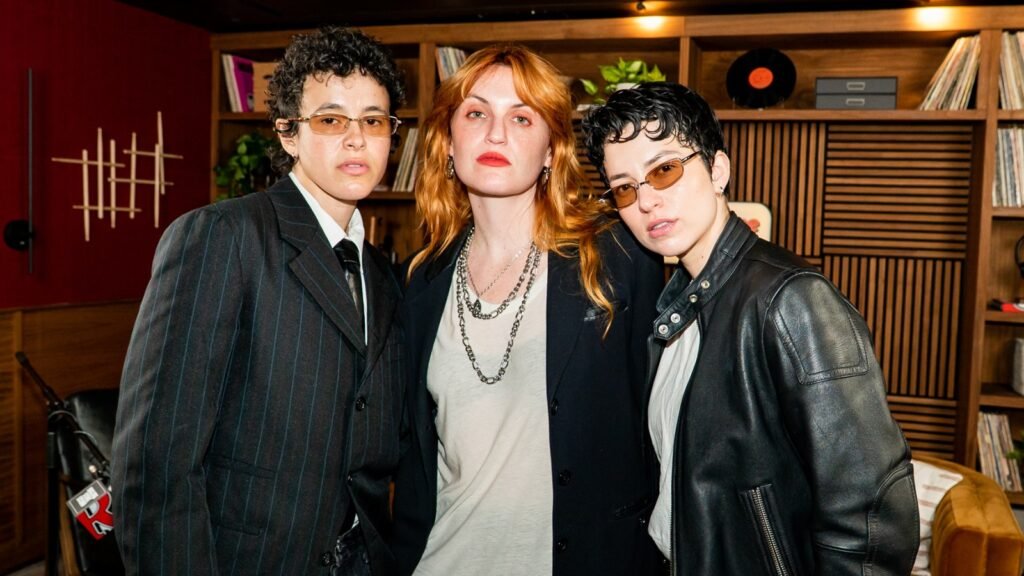
Muna is ready to bring the heat on tour — even if pyrotechnics are out of the question. “Our lighting guy is trying to sell us on pyro,” guitarist Naomi McPherson says. “He pulled me aside during rehearsal, so I was like, ‘We don’t have a fire budget. We can’t afford fire.’”
Even so, the band is aiming to showcase their new album, Dancing on the Wall, with unforgettable concerts for their upcoming Gets So Hot tour. “The shows in the fall are going to be the best shows you could ever see in your whole damn life,” guitarist Josette Maskin says, adding, “If you do not come to these shows, you are actually missing maybe some of the most important events that could ever happen in your life.”
McPherson, Maskin, and lead singer Katie Gavin sat down at the Rolling Stone Studio in New York and shared the plans behind their upcoming live shows, how their time on the Eras Tour influenced some of their setlist goals, and how the past four years shaped their latest release.
It’s been about a week that Dancing on the Wall has been out. What has the response from fans been like so far?
Gavin: This week has been really special because we have been playing shows the whole week. We did two shows in LA. The first one was on album release day and then the last two nights we’ve played in New York. We’re doing a run of shows at the Music Hall of Williamsburg. The New Yorkers had one week and they’ve already learned every word.
What’s been the most surprising thing to come out of those shows?
Maskin: How fast [fans] can learn. They really care to be singing with us. The people who were there are such diehard Muna fans that it does just feel like a return to coming home and seeing everybody.
Gavin: I’m surprised we haven’t smacked each other with our instruments … We did maybe 10 days of rehearsal, but to go in off the bat and play an album top to bottom, we were like, “Are we going to be feeling really rusty?” It was surprising how it felt like such a homecoming. We were just relieved. We were like, “Oh yeah, this is what we fucking love to do.”
Speaking of live shows… the Gets So Hot Tour kicks off this fall. It is one of the first tours that the band is embarking on since opening on the Eras Tour. What’s the biggest lesson from that experience that you guys hope to bring to the headlining Muna tour?
McPherson: We experienced that period of time as such a hysterical anomaly and glitch in the timeline of our lives. Us being on that stage, we were like, “this is nuts” because the scale of the shows is so massive. [But] if I had to say something, we’re going to try to incorporate as much of our music that people love as possible. We won’t be doing a marathon three-hour long [show]. We don’t have it in us.
Gavin: There is something really interesting about how that was such a huge production and yet she makes an effort to give people each night something special and intimate. We can sometimes struggle with that because we’re all such perfectionists in terms of arrangements of songs. Taylor, I really respect the way that she’ll just, and it speaks also to her comfortability with her instruments, if she knows that people want to hear a certain song, she’ll pull it out and just give the people what they want. We want to try and do that more.
Before the tour, the band is headlining All Things Go. What about that festival are you most excited for?
McPherson: We love All Things Go. We started calling All Things Go “Lesbo Palooza” because of the style of artists … I found it in an old article that was about shitty things people said about Lilith Fair, and I was like, “We need to make a festival called Lesbo Palooza because that’s awesome.”
Maskin: People better be ready. We came to F-U-C-K onstage.
It’s been four years since your last release. What happened in that time and how did it shape the record?
McPherson: Katie released a solo album. Us being the cheerleaders of Katie putting out her solo album helped pull into focus what the Muna sound really is at its core. From the beginning of the band, we’ve always been about making very emotional melodramatic synth-pop with a lot of energy and charge. We went back to listening to a lot of the stuff that was inspiring us when we first started out as a band. So a lot of New Wave. There’s a parallel to that era of music and the politics that surrounded it and what we’re experiencing now with regards to a very powerful right-wing resurgence. The idea of making a very high energy dance album is a sort of antidote to all of that.
Gavin: Our roles were all a little bit more loosely defined in some ways because we were all learning new skills. “Why Do I Get a Good Feeling” was me experimenting with a string part that Naomi had made and making my own drum and bass track over it and writing over that.
In terms of our life, we all turned 30 since the last time we put an album out. There’s a sense [that] we’ve all grown up a lot since we’ve been in the band so it’s like learning how to take care of yourself in different ways. I went on psychiatric medication, so this is my first album that I’ve written on Prozac. Some people are clocking that, like “it’s just not as deeply sad as I’m used to with Muna.” And I was like, “that might just be the meds.”
Do you guys find that being on the road and performing inspires you to start writing music or is that separate?
Maskin: This record, in the sense of its BPMs, is 100 percent influenced by the level of touring that we did two years ago. We want the shows to feel a certain way. We want there to be a certain level of catharsis. We want Muna shows to be a place where you work it out. You work out whatever you’re feeling and fast music gets you going.
Was there any fear about living up to the success of “Silk Chiffon” and your last record overall?
McPherson: You can’t help but react against what you’ve previously worked on, whether you’ve had success or not. With “Silk,” there of course is fear. This has been happening to us since the beginning of our career. We’re always like, “What if this is the best moment of our lives and then everything else after this sucks?” Since we toured with Harry Styles, we were like, “What if this is the peak?” You never know. We have to accept that, but what we are in control of is making music that we think is good. It would have been a very fear-based scarcity mentality thing to do to try to recreate “Silk Chiffon” another 11 times and see which one sticks.
Gavin: It’s funny, though, I went and saw the Indigo Girls in concert before we came to New York and Emily [Saliers] from the Indigo Girls was like, “Why did you write those lyrics in ‘Buzzkiller’ where you say ‘the band’s doing well, but I’m past my prime and everyone knows it?’” In some ways, that lyric is kind of about “Silk Chiffon” because I was contending with like, “Okay, well that was a peak. There’s no way that you get so lucky to even have that happen once. There’s no way that I’ll be able to achieve that again.” [Saliers] was like, “What the hell?” She’s in her sixties and I’m 33 and so that was humbling in terms of being like, “I really have a brain worm if I think that I’m too old to be doing this.”
You guys have said that compared to the last album, which was about queer joy, this is more about queer rage. Why was it important to highlight that?
McPherson: Of course, the music still sounds quite joyful and celebratory and ecstatic. We can’t avoid that, that’s just who we are and what we like to make. But I think we in the past four years … since the beginning of the genocide in Gaza and then Trump’s election and the ICE raids and cracking down on trans people’s rights to exist and bodily autonomy for women, just all types of horrible stuff has been happening and it would be really weird to make another song that’s like, “Fuck yeah, it’s time to have a good summer. Everybody get up and clap y’all hands.” The joy has been a little harder to come by the past couple of years. It wasn’t even possible to do too much of an extreme emphasis on the proliferation of joy.
Maskin: Those two things … They both coexist and feed on each other. If we were to just give you a capitalism pill and try to feed you an advertisement, it doesn’t take away your rage. The rage needs to be felt and needs to be expressed because we’re all feeling this. What is going on globally is something that we want our fans to know.
Gavin: We had to, in a way, express the queer rage so that we can keep the flame alive of the sacred thing that queer joy means to us.
You may be interested

The Fatal, Familiar Takedown of Jason Arday
new admin - Aug 17, 2026[ad_1] I did not know Jason Arday, the youngest Black professor ever hired at Cambridge University. I have never read…
Common food item you should 'never' throw in your household bin, according to waste expert
new admin - Aug 17, 2026He has explained the reason and what to do instead Source link

The Heated Discourse About Civil Discourse
new admin - Aug 17, 2026[ad_1] Proponents of what’s often called civil discourse education are pushing to expand this teaching—and mandate it—across entire campuses. Earlier…