


More Medical Schools, Examiners Back RFK Jr. Nutrition Push

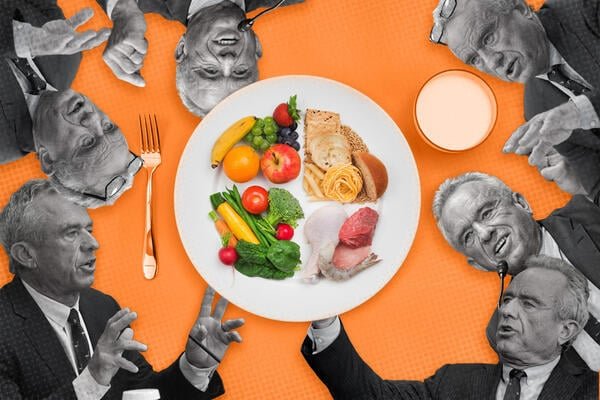
Seventy-three medical schools have now agreed to require at least 40 hours of nutrition education.
Photo illustration by Justin Morrison/Inside Higher Ed | Nathan Posner/Anadolu/Getty Images | Bill Clark/CQ-Roll Call, Inc/Getty Images | Jim Watson/AFP/Getty Images | Andrew Harnik/Getty Images | YinYang/E+/Getty Images
Starting next year, thousands of medical students will be learning a lot more about nutrition.
The Department of Health and Human Services announced Monday at a news conference that 19 more medical schools have agreed to require students to complete at least 40 hours of nutrition education, beginning next fall.
The announcement comes just three months after more than 50 medical schools pledged to do the same at the urging of the Trump administration, which has said more nutrition education is critical to advancing its so-called Make American Healthy Again agenda—a plan focused on addressing and preventing chronic illness through diet and lifestyle choices.
While the nearly 200 medical schools in the United States already require some form of nutrition education, exposure averages just 1.2 hours per year, research has found. But with Monday’s announcement, 73 physician training programs across 32 states will teach from a curriculum that includes substantially beefed-up nutrition-education components.
“This isn’t a minor training issue, it’s an institutional barrier to better health outcomes, and we have got the power to fix it here today,” Education Under Secretary Nicholas Kent said at the news conference. “Making America healthy again begins with education, and we are encouraged to see accreditors and institutions of higher education working together to better prepare current and future physicians for success.”
Eight medical accreditors, assessment bodies and boards have volunteered to focus more heavily on measuring nutritional education competencies. For instance, the National Board of Medical Examiners, which develops and manages assessments of student doctors, has agreed that about 15 percent of content across its three-step examination sequence will assess nutrition, HHS secretary Robert F. Kennedy Jr. said at the news conference.
“Nutrition will no longer sit at the margins of medical education. It will shape what students learn, what physicians master, what licensing boards assess and ultimately how patients receive care,” said Kennedy, who has drawn the ire of the medical experts for making false or misleading statements about fluoride, raw milk, food dyes and vaccines, among other claims. “Education drives practice, practice drives outcomes and outcomes determine the health of a nation. That’s why today’s commitments represent one of the most important course corrections in modern American medicine.”
Although some in the medical education community have long advocated for expanded nutrition education, it finally gained traction after the Trump administration took up the mantle last year.
Last June, Kennedy mentioned in passing that he was considering withholding federal funding for medical schools that don’t offer nutrition education. But that threat wasn’t included in the official directive he issued with Education Secretary Linda McMahon in August, which gave premed programs, medical schools, residencies, medical licensing exams, board certifications and continuing education organizations two weeks to submit plans for integrating comprehensive nutrition education and training into their curriculum.
But after medical schools pushed back, Kennedy’s tone softened. In January, he asked for their help in implementing expanded nutrition education in a letter that included 71 topics for medical schools to consider while developing their curricula. While some of those suggestions—such as learning about nutrient deficiencies and food allergies—align with the recommendations of medical experts, others, such as a focus on dietary supplements and wearable devices, don’t.
Although medical education experts have raised concerns that the Trump administration’s nutrition push could undermine medical schools’ autonomy, Kennedy insisted Monday that institutions will retain full control over their expanded nutrition-education expansion curricula.
“All of these organizations came forward voluntarily. There was no coercion or pressure from my agency,” he said, casting the nutrition-education pledges as an example of putting “tribalism” aside.
“Our objective is not to dictate what the nutrition curricula should be. These medical schools are some of the smartest people in the country. They are trying to do good science; they’re trying to do evidence-based medicine,” Kennedy said. “They’re going to come up with different recommendations and different strategies. That’s a good thing for our country.”
Still, some experts are worried.
“It is always a serious concern when politicians try to exert influence on any educational curricula,” David Seres, retired director of medical nutrition and professor of medicine in the Institute of Human Nutrition at Columbia University Medical Center, told Inside Higher Ed in an email after the news conference. “This concern remains despite the promises that the federal government has made that it will stay out of influencing medical school nutrition curricular content.”
Seres is also skeptical that the government is putting enough money behind its efforts.
Kennedy said Monday that HHS has launched a $2.1 million challenge led by the National Institutes of Health “to identify, reward and scale the most effective approaches for integrating nutrition into medical and nursing school education,” as the first phase of a $5 million initiative to develop courses, clinical training opportunities and research projects focused on nutrition science.
“The amount of money the government is devoting to this is tiny, given the amount of effort required to develop a new curriculum or competency testing, maintenance of curricula to insure they are up to date, and measurement of impact,” Seres said. “The sustainability of such an effort is highly questionable.”
You may be interested

SZA, Stevie Nicks and More
new admin - Aug 18, 2026[ad_1] Stella Lefty, who grew up in the suburbs of Chicago, has been going to Lollapalooza every summer since she…

How much interest can a $10,000 9-month CD earn right now?
new admin - Aug 18, 2026Putting $10,000 into a competitive 9-month CD now could generate hundreds in interest by account maturity. Andrii Yalanskyi/Getty Images Savers…

ABC sues the FCC over Trump and Carr’s campaign of threats
new admin - Aug 18, 2026ABC is suing the Federal Communications Commission over claims the agency “waged a retaliatory campaign” against its networks over the…