



Linda McMahon’s Trojan Horse (opinion)

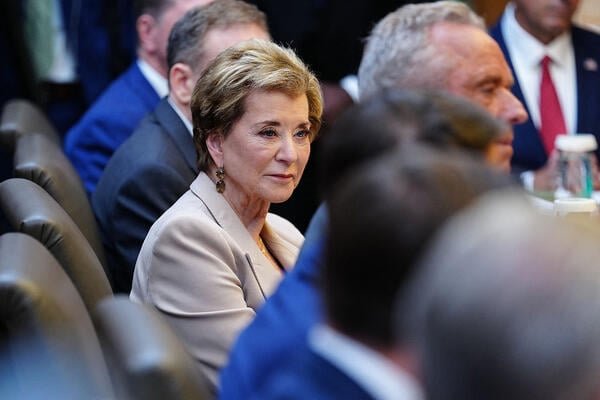
The recent open letter from Secretary of Education Linda McMahon to university presidents and boards—prepared in collaboration with a small group of higher education leaders—appears, at first glance, to be an olive branch. In place of the earlier “Compact for Excellence in Higher Education,” which was filled with threats and demands, the letter employs slightly less inflammatory rhetoric to request public answers to a set of questions in seven categories. A number of the problems within higher education cited in the letter, including rising costs and high attrition rates, are real and need to be addressed.
Yet make no mistake: The letter is not a genuine attempt to improve higher education, but a new strategy to further the goals of an administration that knows little and cares less about what colleges and universities actually do. It is a threat packaged as a gift and represents what The New York Times calls a “significant departure” from the compact only in the sense that it attempts to achieve through subtlety what it failed to accomplish through direct assault.
The Trump administration’s attack on universities has never really been about cost, grade inflation or accusations of antisemitism, but about the administration’s actual priorities: limiting forms of free expression that might jeopardize its consolidation of power, reducing immigration and opposing all forms of diversity initiatives, stoking the culture wars, and punishing people whose politics are perceived as progressive—all seasoned with a dollop of gratuitous cruelty. These priorities have not changed.
One of the first things to note about the letter is that it is not in fact directed at all leaders in American higher education, but at leaders of a small group of highly selective, wealthy research institutions. The call for transparent, merit-based admissions, whatever that actually means, is irrelevant to the majority of colleges and universities that practice open admissions or that are more worried about filling classes than about whom to exclude. The focus on research is irrelevant to the thousands of four-year and community colleges where almost no research is conducted. The administration cares little about the majority of American colleges because there is little to be gained in attacking them.
Most of the questions posed in the letter are in fact a reframing of Trump administration positions. The question about free speech and open inquiry refers to “violent protesters,” of which there have been very few, but is silent on the much more consequential attacks on open inquiry in states including Texas and Florida. The question about subordinating scholarly pursuits to political and social goals actually means that scholarship should only be subordinated to the goals of the administration. The call to “put Americans, and American interests, first” and to reject “malign foreign actors” requires little explication and also seems inconsistent with the call for purely merit-based admissions, unless one assumes that only Americans possess the relevant merit.
Then there is the disingenuousness. The call to reduce attrition rates comes from an administration that has attempted to gut hundreds of TRIO programs. The acknowledgment that “university-sponsored research can drive economic growth” comes from an administration that proposed “massive cuts” to the National Institutes of Health and the Centers for Disease Control and Prevention and that froze or threatened to freeze grants to major universities and medical centers.
While the letter, unlike the earlier compact, makes no explicit threats, comments from members of the administration have made clear that the penalties for non-cooperation remain. When asked whether responses to McMahon’s letter would affect the funding of particular universities, Jonathan Pidluzny, the Department of Education’s deputy chief of staff for strategy and implementation, said, “It would only be natural for the government to partner with the institutions that are most committed to gold-standard science, or that are most committed to merit-based hiring in the sciences.”
“Gold-standard science” for this administration does not mean work that is rigorously peer reviewed, but work that aligns with the priorities of the president. They have told us this, and they are telling us now that universities that fail to agree to such alignment will have only themselves to blame for a lack of funding. It would “only be natural.”
When reading McMahon’s letter, it is important to remember what the past 20 months have taught us about this administration. It never moderates its positions. It never negotiates in good faith. It only pauses when forced to do so by the courts, and then it tries alternative paths to achieve the same goals. It values neither cooperation nor compromise, but compliance. Tariffs are back, birthright citizenship remains under attack, the taking of Greenland is still on the table and ICE made a record number of arrests in July. From the start, the Trump administration has bet that its persistence in doing outrageous things can outlast our collective ability to be outraged.
Those who think that the people who believe that “the real world is governed by strength … governed by force … governed by power” are softening their attacks on higher education are either not paying attention or, more likely, choosing to ignore what they know to be true. Any information obtained in response to McMahon’s questions is more likely to be weaponized to target the usual suspects—elite universities, especially those in blue states—than as the beginning of a set of constructive dialogues.
While I disagree strongly with the leaders who have chosen collaboration with the Department of Education and with those who would make much of the slight softening of tone, I am not wholly without sympathy for their plight. Extortion, especially when practiced by an entity as formidable as the federal government, can be extremely effective. Fear and self-interest have motivated powerful actors across society since Donald Trump returned to office, and there is no reason to expect that some leaders within higher education would be any different. Perhaps some leaders genuinely believe, contrary to all precedent, that in this singular instance the administration will act in good faith and should be welcomed as a partner.
But given what we know, given all we have seen, I would think twice before opening the gates.
You may be interested

Native Group to Create Endowment With MacKenzie Scott Gift
new admin - Aug 11, 2026[ad_1] The Native Forward Scholars Fund, a major scholarship provider and support organization for Indigenous students, is turning a multimillion-dollar…

Russia is firing North Korean missiles at Ukraine, Zelenskyy claims, as more overnight attacks kill 9
new admin - Aug 11, 2026Ukrainian President Volodymyr Zelenskyy accused Russia of using North Korean ballistic missiles in its attacks, as another night of bombardment…

Students in Need More Likely to Miss Mental Health Support
new admin - Aug 11, 2026[ad_1] Students’ mental health can influence whether they persist and ultimately complete college, and most institutions offer robust mental health…