


Leadership Vision of the COLO to Shape Higher Ed Future?


It was three decades ago that my career in higher education took a turn. I was promoted to full professor and given the golden opportunity of my career to lead our campus in the use of the internet to enhance teaching and learning. Little did I know in 1997 just how significant this enhancement in the development and delivery of learning opportunities would become. It continues to expand while the rest of higher education modes in America are threatened by the realities of new federal regulations, shifting political priorities, return on investment value concerns, flagging funding and sluggish responsiveness to the priorities of learners and employers.
The then-new president of the University of Illinois system, James J. Stukel, saw the enormous potential of the internet in higher education. He assigned his new vice president of academic affairs, Sylvia Manning, to lead the charge to infuse the opportunities of the net across the Illinois campuses. In turn, she acquired the assistance of engineering professor Burks Oakley to help lead the implementation.
I was the beneficiary on the Springfield campus to receive release time and funding to create an Office of Technology-Enhanced Learning to foster use of the internet in classes as a source of new information, promote an opportunity for inter-institutional collaboration and encourage the delivery of credit classes online to students who lived around Illinois, the U.S. and the world. It began a career-long collaboration with Burks Oakley, one that lasts to this day as we share information and perspectives about online higher education.
It was a heady time when we launched the initiative. Just a few years earlier, the National Center for Supercomputing Applications on the Urbana campus released Mosaic, the first visual browser, which stimulated an explosion of growth for the World Wide Web. In 1997, we began in earnest the online learning initiative, bringing the university to the student rather than requiring the student to travel to the physical campus. This was a revolutionary democratization of access to higher learning, bringing professors, scholars and researchers to the global public at large.
At that time, only some 750,000 students were taking a course online. That was about 5 percent of total American university enrollments. Twenty years ago, the number had risen to nearly three and a half million students, or 20 percent of all students. Ten years ago, we rose above six million students, or 31 percent. Last academic year, some 11 million students, or nearly 55 percent of American college students, were taking one or more courses online.
Certainly, the COVID-19 pandemic shutdown of most campuses in spring 2020 accelerated the already established growth of online distance learning. With campuses generally closed across the country, we all scrambled to move campus-based classes to the internet. When campuses reopened following the shutdown, many students, faculty members and college departments recognized the advantages of the online delivery format, especially in professional programs. That added momentum to the already-established trend toward online delivery.
We are now on the cusp of a significant adjustment in the model of higher education. This comes in the context of significant defunding of college and university research grants, resulting in dropping federal revenues; current trends toward higher tuition and fees; eroding confidence in the return on investment of college degrees among consumers; and rapidly shrinking international student enrollments, due to significant cuts in the number of approved student visas. Yet, one of the few bright signs is the continuing surge in online learning enrollments, particularly for self-paced and professional certificate programs.
Also at this moment in the history of higher education, we are being introduced to agentic artificial intelligence. Over the past three years, most universities have worked out effective policies and best practices in using generative AI by students for classroom assignments, theses and dissertations. In many institutions, it is the chief online learning officer who is leading the planning for best uses of the technology to deliver the curriculum in the context of the many aforementioned challenges.
Legendary researcher and theorist Clayton Christensen embraced online learning as a prime example of disruptive innovation in education. I believe that, were he alive today, Christensen would have embraced artificial intelligence as another disruptive technology in our field. Certainly, it has already become that in the business realm. In the higher ed realm, we have utilized AI to power adaptive and personalized online learning models.
Sue Ebbers writes in “Adaptive and Personalized Learning Through AI: A Realistic Assessment of Value” that we must use both caution and judgment in embracing the enormous power and advantage of AI in higher education: “As this trend will inevitably go forward, may we balance the many amazing affordances that adaptive and personalized AI clearly deliver to learners with a healthy dose of caution and care.”
That measure of caution and care will come from those who have confronted analogous challenges while leading online learning through the formative and more recent years.
It is a natural extension of the current AI programming. Given the nature of the technology, applications are delivered online. Utilizing these emerging and developing technologies to make online delivery even more efficient and effective is a key challenge facing higher education. Without this, we are threatened with becoming less relevant and more expensive than we are now.
As we remake ourselves to meet the challenges discussed earlier, I see the potential of adaptive and personalized learning as the pathway to meeting societal and individual learner needs for depth of understanding, creativity and just-in-time workforce learning that is so pressing in today’s rapidly changing economy. Using AI technology to provide learning customized to the individual’s needs, we can ensure greater student satisfaction than we could ever do with the age-old model of teaching to a classroom filled with students of varying competencies and desired outcomes.
Who else within the institution’s administration has the combination of technological, pedagogical and innovative knowledge and experience to lead us into the future? The COLO’s knowledge of advanced technologies coupled with the experience of overseeing the application of the vast array of online technologies as they have evolved over the past 30 years is the combination we need to succeed. Our chief online learning officers bring credibility and sagacity to the table in leading us while making this critically important next step in enhancing online learning in higher education.
You may be interested

WOW star Kandi Krush left Olympic synchronized swimming and found wrestling
new admin - Aug 17, 2026[ad_1] NEWYou can now listen to Fox News articles! Kandi Krush is one of the most fearsome competitors on the…
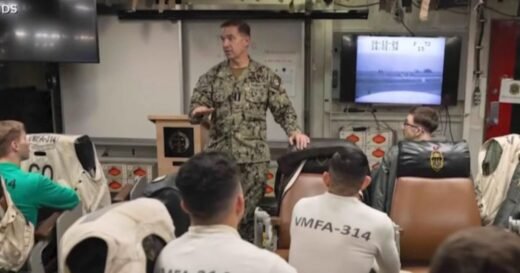
CENTCOM commander meets with troops on USS Abraham Lincoln as critics slam conditions
new admin - Aug 17, 2026Adm. Brad Cooper, the head of U.S. Central Command, met with troops aboard the USS Abraham Lincoln as concerns linger…

Charlotte Tilbury concealer 'doesn't crease' on mature skin and 'lasts all day'
new admin - Aug 17, 2026[ad_1] "This is the best concealer I have used. It covers up my dark rings and makes me look much…