



Judge temporarily blocks construction of Trump’s White House ballroom

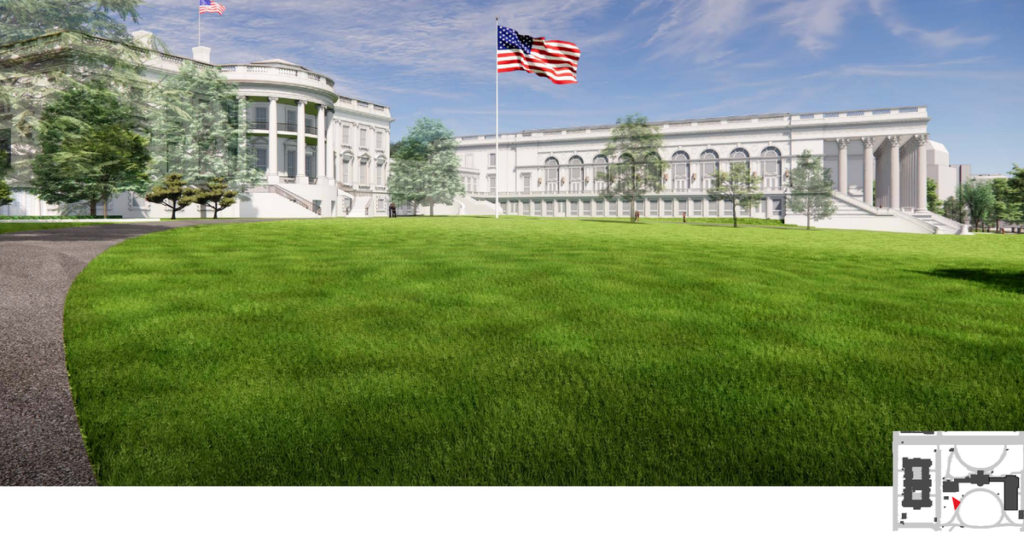
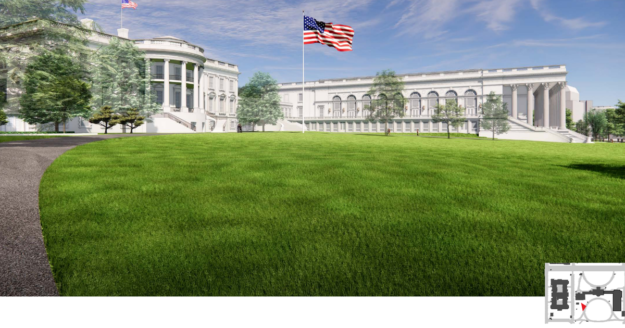
A federal judge has temporarily blocked the Trump administration’s construction of a 90,000-square-foot ballroom to replace the White House’s East Wing.
U.S. District Judge Richard Leon ruled that a legal challenge brought by a preservation group that sued to block President Trump’s construction project was likely to succeed on the merits, because “no statute” the government used to justify the construction “comes close to giving the President the authority he claims to have.”
The ruling takes effect in 14 days.
In December, the National Trust for Historic Preservation in the U.S. sued the administration for allegedly failing to adhere to federal guidelines prior to demolishing the East Wing and breaking ground on a ballroom. The Trust also questioned the $400 million project’s funding mechanism, which is largely from private donations.
The ballroom project came together quickly. Mr. Trump announced it last summer, and by September, the East Wing had been torn down, even though the president previously said the existing White House structure would remain intact. A panel of the U.S. Commission of Fine Arts, filled with allies of Mr. Trump, voted unanimously to approve the ballroom proposal last month. The National Park Service has said construction could wrap up by mid-2028.
The project has drawn controversy from congressional Democrats and preservation groups who argue that the Trump administration was making major changes to the White House without enough public input. The administration has defended the project, casting it as a useful addition to the complex and part of a long line of alterations to the White House.
In February, following the National Trust for Historic Preservation’s initial lawsuit, Leon ruled that the construction could continue temporarily. He found that the group’s legal challenge was not comprehensive enough to prove Mr. Trump lacked the authority to renovate the building with private funds and without congressional action.
Leon allowed the National Trust for Historic Preservation to again take its legal arguments for a preliminary injunction to court earlier this month, where he expressed skepticism of the Justice Department’s legal arguments defending the mechanism to pay for the ballroom.
During the hearing, the judge said that the Trump administration’s continued arguments that the ballroom was a legally allowable “alteration” to White House grounds was a “brazen interpretation of the laws of vocabulary.”
“This isn’t any national park,” Leon said. “This is an iconic symbol of this nation.”
Leon offered similar views in his opinion issued Tuesday.
“The President of the United States is the steward of the White House for future generations of First Families. He is not, however, the owner!” Leon wrote, adding that “the ballroom construction project must stop until Congress authorizes its completion.”
Leon ruled that three different federal laws give Congress, not the White House, authority over approving funding and alterations to federal property, and that the project must be authorized by federal lawmakers.
“Unfortunately for Defendants, unless and until Congress blesses this project through statutory authorization, construction has to stop! But here is the good news. It is not too late for Congress to authorize the continued construction of the ballroom project,” Leon wrote.
“The President may at any time go to Congress to obtain express authority to construct a ballroom and to do so with private funds. Indeed, Congress may even choose to appropriate funds for the ballroom, or at least decide that some other funding scheme is acceptable. Either way, Congress will thereby retain its authority over the nation’s property and its oversight over the Government’s spending,” the judge added.
Mr. Trump has claimed to have raised the $400 million he says is necessary for construction from private donors and major corporations like Lockheed Martin, Amazon and Microsoft, many which have business before the government.
The funds were collected by a nonprofit organization, handed off to the National Park Service and then deposited into an account controlled by the president that is normally used for minor White House repairs and maintenance, according to court records.
At a hearing in January, Leon repeatedly called the financial arrangement a “Rube Goldberg” machine, referring to the cartoonist and inventor who made complex contraptions to perform simple tasks. He raised the same concern in this week’s ruling.
“While its legality is not squarely at issue here, this funding mechanism is, to say the least, a far cry from affirmative congressional authorization,” Leon wrote Tuesday.
You may be interested

Tiger Woods was “sweating profusely” after Florida car crash, pleads not guilty to DUI
new admin - Mar 31, 2026Tiger Woods was "sweating profusely," his eyes were bloodshot and his pupils were "extremely dilated" following a car collision in…

NFL news: Jason Kelce rips Lions for asking Frank Ragnow to return signing bonus
new admin - Mar 31, 2026[ad_1] NEWYou can now listen to Fox News articles! The Detroit Lions forced retired Pro Bowl center Frank Ragnow to…

Stocks have the worst quarter since 2022 as Trump economy slips
new admin - Mar 31, 2026[ad_1] Stocks surged on Tuesday, with the S&P 500 closing up 2.9% while the Nasdaq rose 3.8% and the Dow…