


Judge rules Trump administration’s policy for “third-country” deportations is unlawful

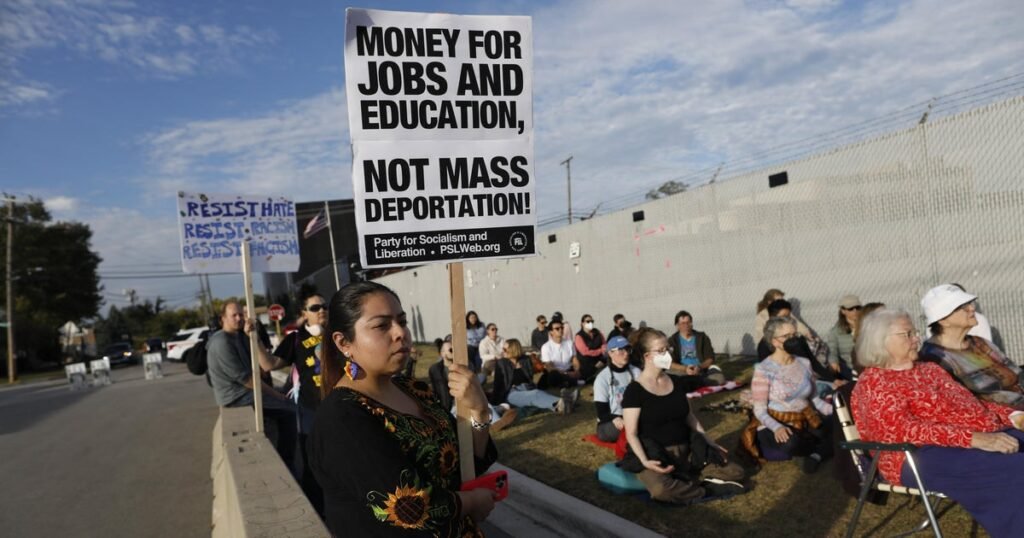
Washington — A federal judge ruled Wednesday that a Department of Homeland Security policy that allows immigration authorities to deport migrants to “third countries” that are not their own, without first giving them notice or the opportunity to object, is unlawful.
U.S. District Judge Brian Murphy in Massachusetts sided with a group of noncitizens who filed a class-action lawsuit against the Department of Homeland Security last year. He ruled that the Trump administration’s policy regarding third-country removals must be set aside.
Murphy paused his ruling for 15 days to give the Trump administration time to appeal.
Under the policy issued last March and reaffirmed last July, immigration officers did not need to give notice or an opportunity for migrants to contest their removal to third countries, so long as the government had received word from that country that deportees would not be persecuted or tortured. Third countries are those other than the ones designated on an immigrant’s order of removal.
As part of President Trump’s immigration agenda and mass deportation campaign, his administration had approached nations like Costa Rica, Panama and Rwanda about accepting migrants who are not their citizens. It also entered into an arrangement with the government of El Salvador to detain Venezuelan migrants at its notorious mega-prison known as CECOT.
The policy allowed for migrants to challenge their removal, but only in cases where they “affirmatively” state a fear. Immigration officers, the policy said, “will not affirmatively ask whether the alien is afraid of being removed to that country.” If the government determined that the migrant would “more likely than not” be persecuted or tortured in the country of removal, the government could then designate another country for deportation or refer the case to immigration court.
But Murphy ruled that the Trump administration’s third-country removal policy violates federal immigration law and migrants’ right to due process.
“This new policy — which purports to stand in for the protections Congress has mandated — fails to satisfy due process for a raft of reasons, not least of which is that nobody really knows anything about these purported ‘assurances.’ Whom do they cover? What do they cover? Why has the Government deemed them credible? How can anyone even know for certain that they exist?” Murphy wrote. “These are basic questions that the Constitution permits a person to ask before the Government takes away their last and only lifeline.”
The judge, appointed by President Joe Biden, said that under the Department of Homeland Security’s policy, migrants can be arrested and dropped off “in parts unknown” as long as the government does not know they would face violence upon their arrival in the third country.
“It is not fine, nor is it legal,” Murphy wrote. Citing federal immigration laws and protections from persecution or torture, he continued: “These are our laws, and it is with profound gratitude for the unbelievable luck of being born in the United States of America that this Court affirms these and our nation’s bedrock principle: that no ‘person’ in this country may be ‘deprived of life, liberty, or property, without due process of law.'”
The case before Murphy arose last March when four noncitizens filed a class-action lawsuit challenging the Trump administration’s policy. The dispute wound through the courts after Murphy issued a preliminary injunction in April. The injunction required federal immigration authorities to provide class members with written notice of the third country they may be deported to and a “meaningful opportunity” to raise fears of torture, persecution or death in that country.
The judge had also found that the Trump administration violated several of his orders starting last March, when the Defense Department deported at least six migrants to El Salvador and Mexico without providing them the required process.
Then, in May, Murphy ruled that the White House had violated his preliminary injunction after the Trump administration attempted to remove a group of men with criminal histories to war-torn South Sudan with less than 24 hours’ notice and no chance for them to raise fear-based claims.
The men, who were from Cuba, Laos, Mexico, Myanmar, South Sudan and Vietnam, were then held at a U.S. naval base in the small African country of Djibouti after Murphy ruled that the Trump administration’s attempt to send the men to South Sudan “unquestionably” violated his order. A U.S. immigration official revealed in a court filing that the migrants were being held in a conference room in a converted shipping container and detailed deplorable and dangerous conditions faced by personnel who were guarding the men.
The Trump administration filed emergency appeals all the way up to the Supreme Court seeking to lift Murphy’s order, and the high court said last June that immigration authorities could resume deportations to third countries while legal proceedings continued in the lower courts.
Several days later, the Supreme Court cleared the way for the Trump administration to deport the migrants held at the naval base in Djibouti to South Sudan.
You may be interested

Olympic news: Team USA’s OT win over Canada makes viewership history
new admin - Feb 25, 2026[ad_1] NEWYou can now listen to Fox News articles! The U.S. men’s hockey team did not just make history on…
Multiple killed after armed confrontation in Cuba’s waters
new admin - Feb 25, 2026IE 11 is not supported. For an optimal experience visit our site on another browser.Now PlayingCuban officials: Multiple killed after…

The Peace Corps is recruiting volunteers to sell AI to developing nations
new admin - Feb 25, 2026For more than six decades, the Peace Corps has represented itself as an agency focused on helping underserved communities around…