


Japan might try to win over Trump by buying Ford F-150 pickup trucks

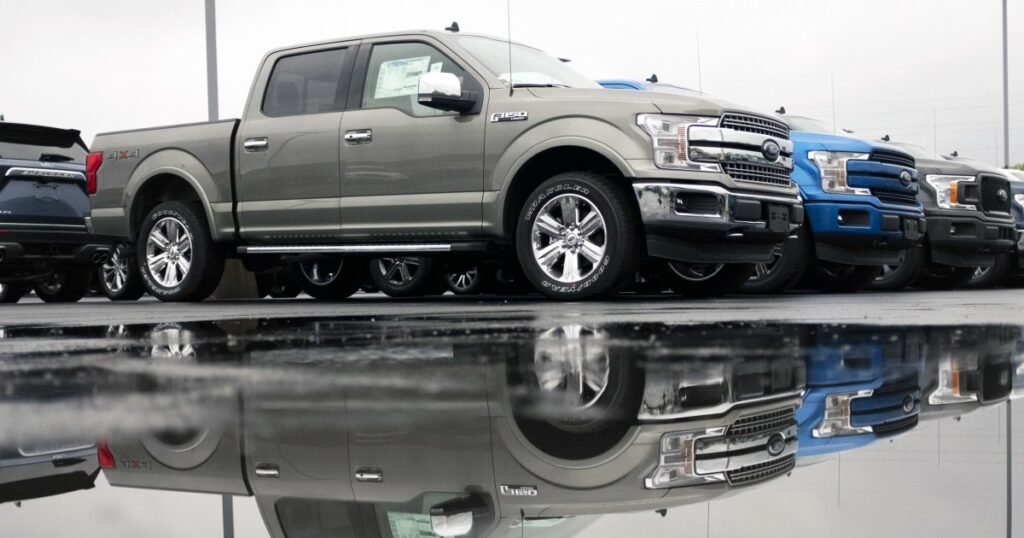
TOKYO — As Japan tries to placate President Donald Trump amid contentious trade talks, officials may be eyeing an icon of American manufacturing that has virtually no presence there: The Ford F-150 pickup truck.
Trump, who is visiting the key U.S. ally next week as part of his first trip to Asia since returning to office, has long criticized the lack of American vehicles sold in Japan, citing what he believes are non-tariff barriers.
Japanese auto brands such as Nissan, Honda, Mitsubishi and Subaru are ubiquitous in the United States, where Japan exported over 1.37 million vehicles last year, according to the Japan Automobile Manufacturers Association (JAMA). Cars are Japan’s top export to the U.S., though according to JAMA most Japanese cars sold there are actually assembled in North America.
By contrast, Japanese brands account for more than 90% of new cars sold in Japan, which imported fewer than 17,000 American vehicles last year, according to the Japan Automobile Importers Association.
The Trump administration has been pushing Japan to buy more American cars, including as part of a trade deal announced in July that imposed a 15% tariff on Japanese autos and auto parts. A joint statement on the agreement published last month said Japan would allow vehicles built and certified for safety in the U.S. to be sold in the country without additional testing.
In August, Trump suggested that there would soon be a market in Japan for American cars, specifically the Ford F-150.
“They’re taking the very beautiful Ford 150, which does very well and I’m sure will do very well there,” he told CNBC. The model has long been the best-selling vehicle in America, according to industry outlets.
Reuters reported this week that Ford F-150s were part of a purchase package being finalized to present to Trump during talks in Tokyo next week, citing two sources with knowledge of the preparations. It said the trucks might be used in Japan as snow plows.
Local media in Japan have also said the government is considering buying the trucks.
Japanese officials have not confirmed the reports, and the new trade minister, Ryosei Akazawa, was not asked about them at his first news conference on Friday.
Akazawa, who was previously Japan’s lead trade negotiator with the U.S., said earlier this month that while Trump’s frequent mentions of the Ford F-150 suggested they were a “favorite” of his, he did not have information to share on any potential purchases by the Japanese government.
Despite the advocacy by Trump, large, expensive American cars have long been a hard sell in Japan, where roads are typically smaller and narrower than their American counterparts.
“Fully-sized pickups simply wouldn’t fit on Japanese roads and into the standard pay parking lots,” Mike Smitka, a member of GERPISA, an international network dedicated to the global automobile industry, told NBC News.
Many of the vehicles sold in Japan are mini or “kei” cars that are far smaller and more fuel efficient than the ones produced by American automakers. They are required by law to be no more than about 11.2 feet long and 4.9 feet wide, compared with the F-150 which is typically more than 17 feet long and 6.6 feet wide.

European vehicles are also far more popular in Japan than American ones, accounting for more than 200,000 imports last year. The top-selling European car brand in Japan is Mercedes-Benz.
“Unlike European car companies, Ford and General Motors (GM) don’t have dedicated port facilities or dealerships,” Smitka said in emailed comments. “They’d be very expensive to import, expensive to market, and because there’s no network, expensive to service.”
Ford did not respond to an emailed request for comment. In 2016, the company said that it would close all operations in Japan, saying it had struggled to gain market share and saw “no reasonable path to profitability.”
“They don’t try to sell pickups because they understand the market,” Smitka said.
Arata Yamamoto reported from Tokyo, and Jay Ganglani from Hong Kong.
You may be interested

From Norfolk to the Outback via Tokyo – with a dash of Cold War spies | Books | Entertainment
new admin - Apr 17, 2026An Accidental Death by Peter Grainger, Paperback Original, £9.99Grainger has been memorably described as ‘creator of the greatest fictional sleuth…

AI “agents” can do your shopping. Should you let them?
new admin - Apr 17, 2026Artificial intelligence "agents" promise to do everything from tidying up your email like Marie Kondo declutters a closet, to buying…

M.I.A. Drops Seventh Studio Album ‘M.I.7’
new admin - Apr 17, 2026[ad_1] The new LP features seven songs written in seven countries, including Ethiopia, Egypt, and India M.I.A. has released her…