



Investigating the 61-pound machine that eats plastic and spits out bricks

As a kid, I went door to door collecting cans to earn some pocket change. Today, I still take pride in recycling. I slice cardboard boxes down to size each Sunday, and make sure every viable plastic container winds up in my family’s recycling bins. Sometimes I even pull cellophane windows out of paper envelopes, just in case it’ll save a tree someday.
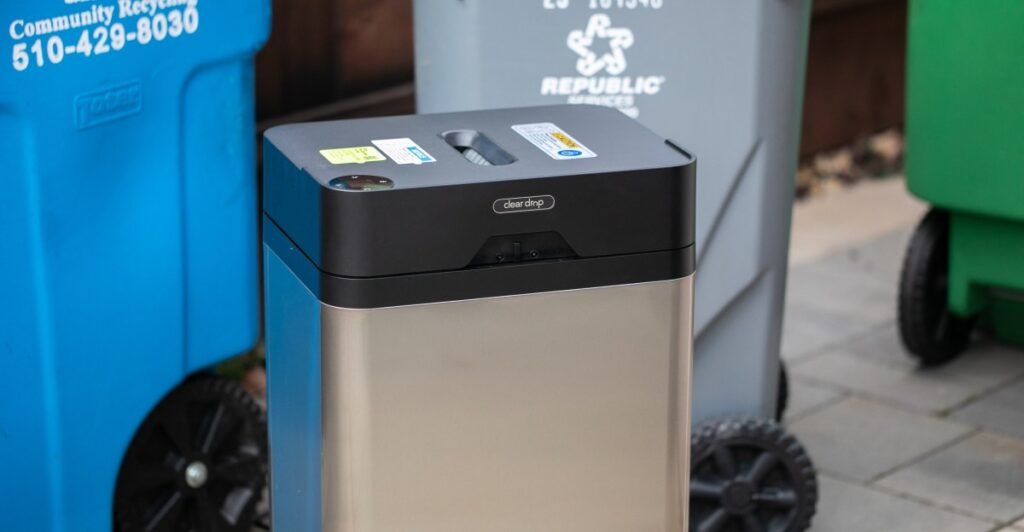
In other words: I’m nearly the perfect customer for Clear Drop’s Soft Plastic Compactor, a gadget that turns all your unrecyclable plastic shopping bags, mailers, food packaging, and bubble wrap into a 3-pound brick that doesn’t need to be trashed.
By bricking your plastic, the company claims it’ll no longer jam recycling equipment the way individual plastic bags often do. Just feed your plastics into this 61-pound bin and watch them magically disappear into its whirring slot. Wait for it to spit out a brick weeks later, drop it into a supplied bag, and let the US Postal Service whisk your guilt away.
If only it were that easy!
I’m Sean Hollister, and I’ve spent over a month with the Clear Drop system. My colleague, senior science reporter Justine Calma, has interrogated what happens to the bricks after that. Neither of us is fully convinced. The machine is clunky, the service pricey, and it may not even be a net positive for the environment.
Like Juicero, the ill-fated $700 juice squeezing machine where humans could squeeze the juice pouches with their bare hands instead, I fear they haven’t thought this trash-squeezing machine through. Justine and I worry these tools might even encourage people to consume more disposable plastic — like Ryan A, a “verified buyer” of the Clear Drop, suggested three months ago:

But unlike Juicero, this isn’t a solution in search of a problem. The problem exists. For a month, I really did have a way to keep plastic out of the landfill, and I feel guiltier than ever now I’m throwing that plastic back in the trash.

How Clear Drop worked for me
For $1,400 — one $200 down payment, then $50 a month for 24 months, nearly as much as I pay for garbage, recycling, and compost combined — a Clear Drop subscription buys you three things.
First, the machine: a 27-inch tall compactor with a pair of auto-sensing motorized rollers inside its top-mounted slot, a heating element in its belly, and a stainless steel design that fits in with today’s typical kitchen trash cans. When you’ve filled it with loose plastic, it’ll slowly raise its platform that squishes it into shape; when it can’t fit any more, it’ll melt the outside of that brick to glue all the pieces together.
Second, you get one prepaid mailer a month to ship your brick across the country, where partner Frankfort Plastics says it’ll get recycled into products like lawn edging and plastic lumber.
Third, it comes with a two-year “comprehensive protection plan” that should cover repairs and even full replacements so long as you haven’t abused it — Clear Drop tells us it’ll even cover return shipping of the machine. (There’s also a 30-day trial with a full refund.)
Once the two years are up, the compactor is yours to keep. But unless you can find a local recycler to take the bricks, you’ll have to start paying $15 to $20 per mailer, and you may be on your own for repairs. That gives me pause, partly because Clear Drop only has one public recycling partner in the entire country for this program, and partly because Clear Drop’s machine isn’t anywhere near as foolproof or repairable as I’d like.

At first, things went fairly well. I was pleased to find the compactor is a dumb gadget with no setup required, no Wi-Fi networks or firmware updates or apps to worry about. Just plug in a three-prong AC cable, then tap a couple touchpad buttons to choose between a child lock or fully automatic operation. I shoved in one plastic grocery bag after another, then snack wrappers and Ziplocs, working my way through every bit of disposable soft plastic in the house. I enjoyed feeding the machine, watching my plastics disappear.
What plastics can Clear Drop take?
While Sean spent some of his first days agonizing over which complicated plastics can go in the machine — Ziplocs with zipper handles? Potato chip bags with foil liners? Do I have to wash out cookie crumbs? — Clear Drop’s Matt Daly and Frankfort Plastics’ Sasi Noothalapati say it’s simpler than that. Recyclers like Frankfort can tolerate a certain percentage of contamination, and it has big magnets and other separation systems that can remove metal contaminants. “Even if an aluminum can gets into the block, it’s not a show killer for us,” says Noothalapati.
The main no-nos are PVC plastics, like pipes and vinyl fabric; celluloid, like in guitar picks; and polystyrene, like in disposable plastic cups and food trays.
Frankfort also says up to 2 percent paper contamination is okay, so we don’t have to worry about the impossible-to-remove labels on some plastic bags we get in the mail.
For a day or so, I worried what might happen if my kids stuck a hand into the opening, because thin plastics almost need to touch the rollers before they’ll start to spin. But when I fed my own hand to the beast, the rubber rollers just gave me a firm squeeze before stopping automatically.
But — perhaps to ensure that safety — the SPC won’t just power through my trash. It doesn’t have the strength to pop thick bubble wrap, let alone larger sealed air cushions or the few shopping bags that fill themselves with air as they’re sucked through. (I kept a utility knife nearby to poke holes.) But it also regularly comes to an abrupt halt with anything as thick as an Amazon bubble mailer, though I can hold down a button manually to force those through.
A few days after I started using the machine, I had my first true jam. Ironically, the SPC did exactly what it’s supposed to prevent industrial recycling machines from doing: It got so much plastic twisted around its rollers that it gummed up the works. I couldn’t move those rollers forward or backward, there was seemingly no way to remove them without disassembling the whole machine, and Clear Drop suggested I should exchange it instead of working on it myself.
Eventually, I cut away enough material with that utility knife to get it working again without an exchange — but I’ve had that same jam twice since, each time leaving more bits of plastic stuck in the rollers, adding more friction. After those three jams, the rollers are pausing more often with false positives.
I don’t know why plastic gets stuck in the rollers, but I do notice it happens when the machine is nearly full, pressing up against the bottom of the rollers. Perhaps the new piece I’m inserting gets deflected back into them.
The funny thing is, those rollers don’t seem strictly necessary. As I learned when I tried to clean them, you can just lift the motorized lid up away from the can, and freely insert or remove as much plastic as you like, right up till it’s full enough to make a brick.
Once you approve brickification by tapping a button, the lid locks for safety, then spends up to three hours compressing, heating, and cooling before it reveals a brick ready to be bagged. The melted plastic smell during the first 20 minutes is really not great. “Oh god, why does it smell like that?” my wife complained, banishing the machine to the garage thereafter. I had to open the window, too.
Then, you drop that brick into one of Clear Drop’s prepaid mailers, and ship it off to… be recycled? That’s what I’ll let senior science reporter Justine Calma explain next.

Is this actually helping anyone?
Recycling, unfortunately, is far from a panacea for the tons of plastic waste accumulating in oceans and landfills. The global recycling rate is only about 9 percent. Even plastic beverage bottles — one of the easiest types of plastic waste to actually recycle because of the material’s chemical composition — are often “downcycled,” used to make fibers for fleece and carpet rather than turned into new bottles. It’s not a circular process, making a new bottle from an old one. The quality of the material degrades each time you rehash it, limiting most plastics to only being recycled once or twice, according to the United Nations Development Programme. And products made with recycled plastic generally still have to be reinforced with new plastics.
That’s all led to the argument that portraying recycling as a cure-all for plastic pollution actually supports the production of more single-use plastics and ultimately more waste. Environmental advocates often call plastic recycling a “myth” propelled by the fossil fuel industry. Plastics are made from oil and gas, after all. California filed suit against ExxonMobil in 2024, alleging the company has “deceived Californians for almost half a century by promising that recycling could and would solve the ever-growing plastic waste crisis.”
Cost is another barrier for recycling, since it’s often cheaper to make products with virgin plastics than recycled materials. Soft plastics like those used in packaging and that Clear Drop aims to collect are even trickier to reuse, since the packaging usually include a mashup of different types of plastics. There’s even less economic incentive to recycle this low-value material, which is why most municipal recycling programs and private companies won’t accept soft plastics.
Clear Drop proposes to solve that problem with its compactor. The idea is that compressing soft plastic into a solid block makes it an easier and more valuable material to recycle. The company claims that its service can help customers avoid dumping 3 pounds of soft plastic into the trash over the first month.

But what happens when you mail out that block? For now, Clear Drop is only disclosing its partnership with Indiana-based Frankfort Plastics, where it sent our blocks. (The company says it has “additional partners” in the US operating under NDAs, but that “most” blocks go to Frankfort.)
Frankfort Plastics boasts on its website that it’s “one of the few independent recyclers in the U.S. dedicated to densifying low-end plastic films, with a focus on hard-to-recycle materials.” Why so few? “The economic model doesn’t work” for most other recyclers, Frankfort Plastics owner Sasi Noothalapati tells us. The capital expenditures are very high; you need expensive equipment to process the waste and turn it into a feedstock that in Noothalapati’s words is “a low-end product.”
“We have to do it in a very high-scale environment, you know, to make the economics work,” he says. Most of their other customers are businesses sending in items like plastic films from warehouses in bulk. Clear Drop, in theory, allows a recycler like Frankfort — which only takes materials that are already compacted or bundled into bales — to also accept plastics from residential waste streams. Beyond making it more economical to transport, compacting the material also makes it easier to feed into the high-capacity machinery at Frankfort that takes in up to 4,000 pounds per hour.
Noothalapati describes the machine as a giant blender attached to a 750-horsepower motor. It shreds the material, adding water and melting it down to a dough-like consistency through frictional heat. The end product is a feedstock almost resembling plastic popcorn that might be sent to manufacturers to use in their products, or to compounders who blend it with other materials to make it easier to use in new items. The feedstock could wind up in plastic lumber for decking or garden furniture, or the edging you’d put around the mulch in your yard, he tells us. This is another example of downcycling rather than a closed-loop system of single-use plastic packaging becoming more plastic packaging.

About 40 percent of the feedstock Frankfort generates has a different fate — chemical (also called “advanced”) recycling. This is where things get even more complicated. One big reason is that the majority of chemically recycled plastic in the US is turned back into a fuel to be burned. Burning that fuel, even if it came from recycled plastic, ultimately means more air pollutants and planet-heating emissions released.
Frankfort Plastics declined to share which chemical recycling facilities it uses, but insists that none of its feedstock goes into that waste-to-fuel supply chain. It claims its feedstock is only used by advanced recyclers who extract monomers from it to make new plastics again.
This type of chemical recycling is still divisive, however. Plastics are made with more than 16,000 different chemicals, many of them known to be carcinogens or reproductive health toxins. Both plastic manufacturing and chemical recycling produce hazardous waste that can pose risks to nearby communities.
When it comes to recycle-by-mail programs like Clear Drop’s, “The thing I want people to take away is that this approach does nothing to reduce plastic production or pollution,” says Susan Keefe, Southern California director of the nationwide environmental project Beyond Plastics that’s based out of Bennington College.

“Throw your plastic packaging in the trash is my advice,” Keefe says, arguing that it would be less harmful than promoting the plastic recycling myth and sending your trash on a journey across the country to ultimately wind up being burned or creating more harmful waste. She believes eco-conscious consumers would be more impactful reusing the bag at home before eventually tossing it out, and advocating for companies to reduce their plastic waste.
Claire Barlow, emeritus faculty at the University of Cambridge whose research focuses on materials engineering and how to improve recycling, is more optimistic about Clear Drop’s aims. Recycling plastic is still worthwhile, and even chemical recycling can be beneficial, she says. Incorporating the recycled material into a product rather than using entirely virgin plastic can reduce its carbon footprint significantly, Barlow says. It can also free up space at crowded landfills, and keep the material from escaping into the environment at poorly managed waste sites.
“It’s taken out of the ordinary waste stream, and that is actually beneficial to everybody,” Barlow tells The Verge.
The Institute for Manufacturing at the University of Cambridge, where Barlow was previously a senior lecturer, currently lists ExxonMobil as a funding partner — although Barlow tells us she never had any dealings with the company herself, and that it has not funded her research. Clear Drop lists two advisers on its website with ties to the plastics industry; the company tells us that’s because insiders understand the challenges like no one else and “their role is not to promote plastic use.”
Where Barlow and Keefe both share concerns with Clear Drop, however, is over the carbon pollution that comes from subscribers shipping their blocks across the US. Sean’s blocks traveled more than 2,000 miles from California to Frankfort, Indiana.
Using data for average truck emissions in the US, Barlow estimates that shipping the 3-pound package generated about 530 grams of carbon dioxide emissions. For comparison, that’s roughly equivalent to the climate pollution that might result from taking a hot shower for five minutes (using electric heating), using your mobile phone for 15 minutes, or having a pint of beer. Taken alone, that might not seem like much. But cumulatively, it adds up. And that number could be a lot smaller if Clear Drop could keep things local. After crunching the numbers, “To me, being more tuned-in than most people to carbon footprints, I was a bit horrified!” Barlow said in an email to The Verge after our initial call.

At the end of the day, the only surefire way to remedy all of these concerns is to actually consume less plastic. Even Clear Drop concurs. “Is recycling alone the long term answer to plastic? No. Reduction and better design upstream are essential,” Clear Drop head of product Matt Daly said in an email to The Verge. Nevertheless, Daly’s in the camp that sees recycling as a kind of harm reduction strategy for the world’s plastic addiction.
“Households generate soft plastics today, every week. In most communities there is no viable curbside pathway for that material. We see Clear Drop as a transitional infrastructure solution,” he writes. He thinks that scaling up will eventually lead more local recyclers to accept the material, cutting down carbon emissions from shipping.
But that’s not how things work today, and Clear Drop may be far from changing that.
Should anyone buy this now?
Today isn’t the day that local recyclers are accepting Clear Drop bricks, and it’s a gamble to assume they ever will. Even if I loved the idea, didn’t mind spending the money, and didn’t fear the gadget breaking down, I’d be worried about tying myself to one recycler and one unproven startup for the foreseeable future — particularly because of how fast and loose this startup is still moving.
For example, Clear Drop includes six “testimonials” on its website from “verified buyers” of the machine. Two of them are from Matt Daly, the company’s own head of product.

When we first looked up where our prepaid Clear Drop mailers would send the bricks, the address was Matt Daly’s home in Texas, property records show, not Frankfort Plastics in Indiana. Daly initially told us that’s because our labels were out of date, back from when the company was testing blocks before shipping them to Indiana. But when he sent us new labels, they were for an office building in Texas — again, not Indiana.
That said, we did finally get our bricks shipped directly to Frankfort Plastics, and Daly filmed himself opening them on site. They’re definitely the ones we sent, and both he and Frankfort’s manager gave us a virtual tour of the facility and answered all sorts of questions.
Daly admits that for now, the company still isn’t sending all the bricks directly to its recyclers — it still opens and inspects some of them in Texas to make sure they’re clean enough to run through the machines, something he expects to ramp down over time. It also sounds like Clear Drop doesn’t have that many customers yet, period: He says the company’s “on track” to process “thousands of pounds of material.”
But Daly also says his company’s “path to growth” isn’t necessarily consumers at all, but rather hospitals and businesses that want to process clear plastic waste. “Where that megagrowth is going to come from is B2B and retail,” he says, adding that “the way you get precipitous growth is by talking to municipalities.”
I hope so, as much as I’d prefer single-use plastics to disappear, and I could see myself buying some sort of compactor after my local county recyclers accept bricks. But I don’t want to be a paying beta tester for a program that’s shipping them across the country.
And should Clear Drop decide to pivot to enterprise, like so many startups do, I definitely don’t want to be left holding the bag.
Photography by Sean Hollister / The Verge
You may be interested

Insurgents raid village in South Sudan, killing at least 169 people
new admin - Mar 02, 2026At least 169 people were killed after insurgents raided a village in a remote area of South Sudan, a local…

Oscars odds race in huge shake up after major SAG Actor Awards upsets | Films | Entertainment
new admin - Mar 02, 2026We’ve had the Golden Globes and the BAFTAs and now more upsets have taken place at the Actor Awards (formerly…

Decades of tensions with Cuba in the spotlight after deadly boat shooting
new admin - Mar 02, 2026IE 11 is not supported. For an optimal experience visit our site on another browser.Now PlayingDecades of tensions with Cuba…