




Institutions, Advocates Argue Against Admissions Data Collection

Institutions of higher education and their advocates are sounding the alarm about the Trump administration’s plan to require colleges to submit new data about their admissions decisions.
They argued in public comments that the new requirements for admissions data collection are too vague, request data institutions do not collect and could violate students’ privacy. Several institutions said they broadly support transparency and the federal data collection but that the department needs to rethink the proposal to lessen the administrative burden on colleges and universities—especially smaller institutions with limited institutional research capacity.
Under the Department of Education’s proposed Admissions and Consumer Transparency Supplement, institutions would have to submit applied, admitted and enrolled student data broken down by test score quintiles, grade point average quintiles, income ranges, Pell Grant eligibility and parental education levels, as well as data regarding aid and student outcomes. Institutions would also be required to send historical data going back to 2020.
President Donald Trump first called for this data to be collected in an executive order, part of an ongoing crusade to stamp out racial preference in admissions that experts say is going well beyond Supreme Court’s 2023 ban on affirmative action. The announcement prompted outcry from admissions professionals, who worried about whether their institutions had the capacity to collect the required data and about how the government planned to use the data.
The public comment period for the rule closed Tuesday, and the department has to review and respond to the comments before finalizing the changes. That process will likely be delayed because of the government shutdown. The department has said it wants to put the requirement in place starting with institutions’ annual submission of enrollment data for the 2025–26 application cycle.
Once the rule is finalized, institutions would have just 120 days to submit that data—a deadline that colleges said in comments would prove difficult to meet. The Association for Institutional Research called the proposed data survey “the single largest expansion in [Integrated Postsecondary Education Data System] history, adding more the 100 new questions and roughly 10,000 data fields.” AIR said in its comment that in a survey of 580 institutional research and other data professionals, 91 percent of respondents said they would be unable to provide the data by the given deadline and 88 percent of members said that providing retrospective data would be “untenable” due to only holding applicant data for a handful of years.
Numerous universities echoed those sentiments. Campbellsville University, a private Christian university in Kentucky, noted that it does not record some of the data points requested by the supplement, like the Pell eligibility of applicants, and wrote, “Independent and mission-driven colleges like us operate with leaner staff capacity and serve distinct student populations. A uniform compliance model fails to reflect these differences and places disproportionate burden on institutions like ours.”
Several colleges and universities also expressed in their letters that they don’t have the personnel capacity to pull together the ACTS survey data in the 120-day timeline, saying it would stretch their already-thin institutional research teams.
“I am the only staff person to coordinate data. This role is also only a portion of my full-time job,” wrote one anonymous commenter who said they work for a Christian liberal arts college. “At our small university, we operate with a small staff where individuals often work multiple roles. Additionally, the departments I rely on for data have only one or two individuals who have the time and responsibility to gather this sensitive data. The estimated time burden on our staff (250-450 hours) is concerning, especially when the departments responsible to collect the data, like registrar, financial aid, and admissions, are often busy with aiding students … With this added time burden, I fear our departments could become overwhelmed and unable to meet deadlines.”
Among the comments in opposition to the rule was a joint comment from 18 Democratic attorneys general, who stressed that the data collection went beyond the scope of the Supreme Court’s affirmative action ban in Students for Fair Admissions v. Harvard and would not help reduce discrimination in the admissions process.
“SFFA does not prohibit schools from pursuing diversity by lawful means. Nothing in the Supreme Court’s decision restricts IHEs from embracing diversity as an objective; indeed, the Court held that ‘[u]niversities may define their missions as they see fit,’” they wrote. “Diversity is not a symptom of discrimination; data showing that campuses maintained diverse student populations after SFFA does not indicate a likelihood of unlawful admissions practices.”
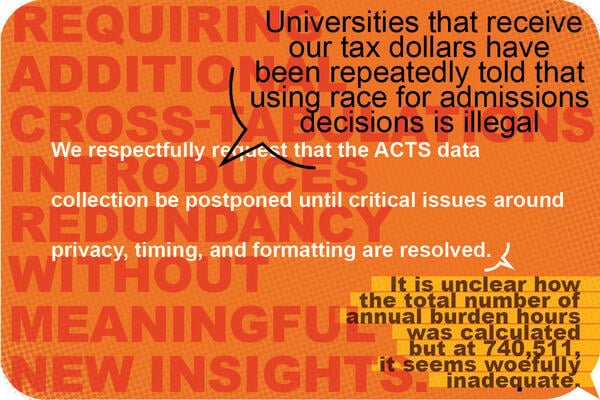
Nearly 90 percent of the more than 3,400 comments posted supported the proposed rule, all using near-identical language that reads, “As a concerned citizen, I am worried about the appearance of continued racial discrimination in college admissions. Universities that receive our tax dollars have been repeatedly told that using race for admissions decisions is illegal, yet it is unclear whether colleges have gotten the message.” It’s unclear what the source of this comment is, but it cites data from the right-wing nonprofit Defending Education.
Vague Language and Metrics
The ACTS data would only be required of certain institutions—selective universities that “have a higher risk of noncompliance in awarding scholarships because of their selectivity.” But some questioned whom those terms referred to, since they aren’t defined in the proposed regulation.
“What is the definition of a ‘selective admission’ institution? We are not open-access, but our admit rate exceeds 70%,” asked one commenter from Rider University, located in New Jersey. “Is there a benchmark for selectivity that would exempt certain institutions from participation?”
The proposal included a question about whether open-access institutions pose any risk “of noncompliance with respect to scholarship awarding practices that provide preferential treatment based upon race.” Several community colleges and other open-enrollment institutions weighed in to dispute that idea and stress that the ACTS survey would be a massive burden on their institutions.
Institutions also questioned the inclusion of several metrics that would likely be difficult to standardize. In a comment, University of Rochester provost Nicole Sampson wrote that high school GPA, for example, is calculated differently at different high schools—some using a weighted 5.0 scale, others only using an unweighted 4.0 scale—and has never previously been collected by IPEDS. Similarly, some institutions have test-optional or even test-free admissions policies, meaning they do not collect their applicants’ scores.
“We are deeply concerned that the Department’s data collection proposal is fundamentally flawed in its approach and has the potential to produce unreliable information that could mislead, rather than inform, future higher education policy decisions,” she wrote.
Similarly, some comments noted that graduate admissions are decentralized, often spread across professional schools and health centers, and those different schools or departments may collect different information.
A comment from the Association of American Universities also drew attention to a slew of issues the department may face in interpreting the data it has requested from universities, including the fact that the majority of institutions consider many factors outside of GPA and test scores when making an admissions decision.
“Accordingly, data disaggregated solely by GPA, test scores, race, or gender would not provide a complete or accurate picture of institutional decision-making or student merit,” AAU wrote.
The association also noted that local priorities may shape admissions decisions; in North Carolina, for example, no more than 18 percent of an incoming class may be out-of-state students, which may result in lower test scores and GPAs from in-state students.
Commenters also raised privacy concerns, noting that, with student information stratified by so many factors, it might be possible for a person looking at the data to identify individual students—which the AAU noted would be especially worrying depending on what data is made publicly available, something the government did not explain in its proposal.
Many commenters included similar lists of requested changes, encouraging the government to adjust the rollout of the ACTS survey by, for example, pushing back its implementation at least a year, piloting the rollout with volunteer institutions or reducing the amount of requested data.
Several commenters also suggested the department outline how it will safeguard students’ privacy and proposed that the government allocate funds to support institutions in their data collection—especially as cuts to IPEDS staff have already made it more difficult for colleges to complete their mandated data collection.
You may be interested

4/12: Sunday Morning – The Money Issue
new admin - Apr 12, 2026Jane Pauley hosts our annual "Money Issue." Featured: Obstacles to home ownership; fighting health insurance denials; Chinese EVs; opposition to…

Oil prices surge after Trump says U.S. will blockade the Strait of Hormuz
new admin - Apr 12, 2026The price of oil surged Sunday night after President Donald Trump said the U.S. would blockade the Strait of Hormuz…

Transcript: Sen. Mark Warner on “Face the Nation with Margaret Brennan,” April 12, 2026
new admin - Apr 12, 2026The following is the transcript of an interview with Democratic Sen. Mark Warner of Virginia that aired on "Face the…