


Inside the Canadian Indie Band’s Reunion

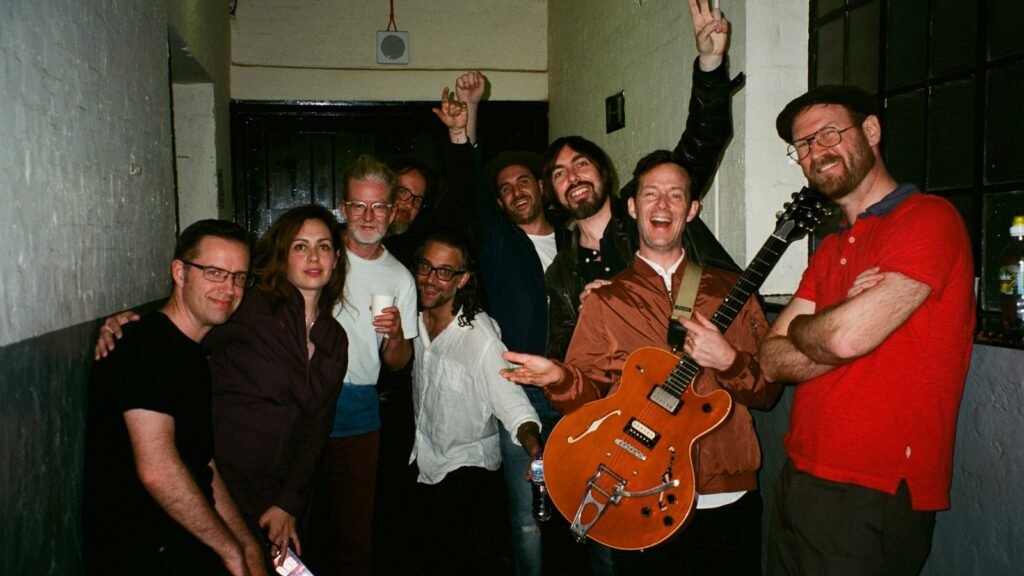
Broken Social Scene albums have always felt like massive impromptu gatherings of friends living in the moment and following one another’s lead — because that’s exactly what they are. Since 1999, the Canadian band has come together in different configurations, ranging from to six to almost 20 musicians at a time, more loose collective than formal music group. Along the way, it’s given us projects like the 2001 debut, Feel Good Lost, 2002’s You Forgot It in People, and 2005’s self-titled Broken Social Scene, each record packed with ambient, amoebic expressions that sound like rare time capsules decades later. Listen now, and they still brim with the kind of heart-bruising magic that seems impossible to replicate again.
But people are hard to let go of, and the band members have come back to one another multiple times since then, releasing 2010’s Forgiveness Rock Record and 2017’s Hug of Thunder, not to mention countless collaborations on other side projects and EPs. Still, nothing has felt like a Broken Social Scene reunion quite like Remember the Humans, their first LP in nine years, and one that connects them with David Newfeld, the producer behind You Forgot It in People and Broken Social Scene, for the first time in more than 20 years.
A lot of the project comes directly from looking back and seeing what an impact those records made. You Forgot It in People turned 20 during the quarantine, inviting fans to revisit what those songs meant to them, and inspiring the band members to get back into one another’s orbit. “It wasn’t supposed to be nine years,” founding member Kevin Drew tells Rolling Stone on a recent call. “I think what we went through with the pandemic and just sort of slowly climbing back and getting out there and honoring You Forgot It In People, it brought Newfeld back into our realm.”
Remember the Humans also reeled in members who haven’t been in the fold in a while. Feist and Hannah Georgas both appear on the LP, as does Lisa Lobsinger, who had been part of songs like 2010’s “Texico Bitches” and “All to All.” “Lisa was gone for a while, and she returned with a song that she wrote thinking it was a Broken Social Scene song during a meditation one night. She wrote us a letter,” Drew recalls. “It was undeniable to all of us that that was a song we wanted to put on this record, because we wanted Lisa back. We wanted her back in our lives. And we wanted to let her know that she’s always welcome, always.”
That’s what makes the album feel like a huge, longstanding house party starting up again — everyone familiar with the layout and eager to reconnect. Songs like “The Call” and “Not Around Anymore” are swelling, orchestral arrangements full of sounds and people. And yet there’s also a deep sadness to the record: Despite the ability to return to one another after so much time, nothing is completely the same. Grief comes up repeatedly — Drew and Newfeld were both grappling with the deaths of their mothers around the same time, but the album also deals with broader ideas of loss and nostalgia and moving on. “You’re alive. You’re in your fifties. You’re dealing with a lot of grief because people are going,” Drew says. “There’s also people who are alive in your life who have chosen the bottle, chosen the drugs, chosen a victimized culture, chosen the idea to be born again without really truly understanding who they were in the first place.”

Kevin Drew (Visual) + Jordan Allen (Layout)/Broken Social Scene*
And then there were the bigger, macro anxieties about our current era. Remember the Humans touches on ideas around AI and technology, and what it means in terms of human relationships and creativity. (The lyrics to the album’s first single, “Not Around Anymore,” go: “Thеre’s no need to cry here anymore/To reach outside here anymore/To redefine here anymore/’Cause it’s all gone away/Guess it’s called the times.”) The discussion came up a lot in sessions between the musicians as they were putting the album together. “If we look at what we were saying back in 2002 with You Forgot It in People, then today’s AI version of that record would be called Remember the Humans,” Drew says. “It’s very, very, very easy to go into a conversation about communication and information and how we’re all defensive and how we’re all reactive and how the idea of understanding is not really part of our social culture anymore. So [the title] became a slogan for ‘We are still here, and the bear hug actually still does exist.’”
Still, bringing all these ideas together wasn’t always easy. With a band as big as Broken Social Scene, there’s always some level of compromise and give and take, no matter how utopian and connected they might sound. “I suppose there was a reluctance in our return because we all know we’re about to go into the world of compromise and the world where you can’t control,” Drew says. “And this band teaches you so much in the idea that if you’re controlling things in life, you’re not living. But it’s difficult because we have so much time in our own lives where we get to control them. We don’t have to compromise. When you come back with Social Scene, you can’t do that. You have to allow for other people’s instincts.” Over and over, that’s what’s worked about the band. The musicians were reminded of this constantly while working together and thinking of the alchemy that has brought them here.
“When you were a kid, you longed to feel the pain,” Drew says. “You wanted to know what you were seeing on the screen, what you’re reading, what you are listening to. You wanted to know what that was. One of the things that keeps you real, in the aspect of that teenage heartbeat, is when you look back at things that you created, that people to this day still relate to. It means you captured a real, human moment.”
The songs are here to prove it, standing strong two decades later: “Anthems for a Seventeen-Year‐Old Girl” is a ubiquitous classic by now, sprinkled across TikTok and memes, and it’s also been embraced as a song for reflection in the trans community, while “Lover’s Spit” has been immortalized in movie scenes and Lorde lyrics. Others, like “Almost Crimes” or “Guilty Cubicles,” still echo deep-harbored emotions, even if some of them are wordless sketches. (Drew laughs recalling one memory: “I remember standing side-stage with a gentleman from Wilco, in Spain at Primavera. We had 10,000 people in front of us, and he leaned into me and he said, ‘Get ready, it’s the greatest feeling in the world. You must love it when everyone sings your songs.’ And I turned around and said, ‘We kind of mutter a lot on our records.’”)
Remember the Humans is more direct and voluble, with fleshed-out lyrics, but it still speaks to a particular feeling, celebrating experience and the passing of time. Some of it hurts — so much of the album seems to question, “What did we gain? What did we lose?” “Think of You,” for example, grapples with the idea of moving on and letting go. “Everyone sort of attributed it to my mother, which was not wrong,” Drew remembers. “But it was also about the loss of just thinking about someone, someone in your life that you couldn’t have been with, someone in life that hurt you. And I found myself just sort of referencing simplicities within the aspect of thinking of someone and ruminating over lost love. And that’s what all the songs are, the things that you think you’re over, but you’re never over them.”
By the end of the album, everyone might admit they’re a little broken and the worse for wear, but in that beautiful way that only comes from living. That’s a quiet feeling Broken Social Scene embraced from the beginning, and an ethos that hasn’t changed at all, no matter how much time goes by. That’s something they’ll keep giving their fans. “You have an absolute responsibility to the listener to try to make the most beautiful, adventurous music possible,” Drew says. “When you do that, even in the tiniest of ripples, it can help them keep going.”
You may be interested
Brandon Flowers’ Country Move ‘Thrasher’
new admin - Aug 21, 2026[ad_1] The Killers frontman does a solid job channeling his Nashville heroes on Thrasher, but the mystery train doesn't always…

Walmart is finally adding Apple Pay and Google Pay
new admin - Aug 21, 2026Walmart will soon allow you to pay for your items with Google Pay or Apple Pay. In an announcement on…
Turnstile Enlist Elton John, Hayley Williams for ‘Never Enough: Versions’
new admin - Aug 21, 2026[ad_1] Turnstile have enlisted artists like Elton John, Hayley Williams, Slayyyter, A.G. Cook and more for a “reimagined” take on…