



If ICE Won’t Show a Warrant, What Can Campuses Do?

Since President Trump took office with the promise of mass deportations, college leaders have consistently gotten the same advice from lawyers, consultants and Democratic state officials: If federal immigration agents try to enter nonpublic spaces on campus, ask for a judicial warrant or subpoena. Campuses have disseminated this guidance to staff and students in communitywide messages and resources for months.
But on Thursday, Columbia University tried that, and it didn’t work.
Five Department of Homeland Security agents gained access to a campus residential building by pretending to be searching for a missing child, Claire Shipman, acting president of Columbia, said in a statement Thursday night. A university security camera captured footage of the agents showing photos of the alleged missing child in the hallway.
They then detained Ellie Aghayeva, a student from Azerbaijan, in her apartment. A public safety officer “asked multiple times for a warrant, which was not produced, and asked for time to call his boss, which was not given,” Shipman said. Aghayeva was released Thursday afternoon, after a conversation between Mayor Zohran Mamdani and Trump.
A DHS spokesperson denied that agents misrepresented themselves in a statement to Inside Higher Ed. According to DHS, agents “verbally identified themselves and visibly wore badges around their necks,” and a building manager and Aghayeva’s roommate allowed agents into the apartment. U.S. Immigration and Customs Enforcement “placed her in removal proceedings” and released her while she waits for a hearing. Her student visa was allegedly terminated in 2016 for failing to attend classes.
The spokesperson did not address claims that ICE refused to produce a warrant.
The incident raises new questions for college leaders about how to prepare their campuses for visits from ICE agents and protect their immigrant and international students: If ICE throws out the rules, what does that mean for higher ed’s playbook?
Miriam Feldblum, president and CEO of the Presidents’ Alliance on Higher Education and Immigration, said, “What happened, as it’s been described, is deeply concerning.”
“When federal agents enter residential buildings under reported misrepresentation, it creates fear and instability in what should be one of the safest places on campus,” she said. Aghayeva’s detainment shows that “even when campuses follow protocols and the law, that doesn’t mean immigration officers will do so.”
Revamping Protocols
Nonetheless, Feldblum believes the guidance given to higher ed leaders should hold.
As far as she’s concerned, Columbia did all the right things to prepare for ICE: It differentiated between public and private spaces on campus and had protocols in place for demanding to see a judicial warrant if ICE tried to enter a private area. In the aftermath of the incident, the university ramped up campus safety measures, including increased public safety patrols around residential buildings and clarifying that residential staff should not allow law enforcement in during nonemergency situations without guidance from university public safety and the Office of General Counsel.
“Just because federal immigration officers are not following the law does not mean that campuses do not need to have protocols in place,” Feldblum said, “because what we learned from Columbia … is that when campuses have the protocols in place, then they are far better positioned to respond quickly when something’s happening and to support their students when a detention takes place.”
The university offered legal services to Aghayeva and “started work immediately to gain her release” with “help and support” from the mayor and governor, according to statements from Shipman.
Feldblum emphasized that institutions need to focus on what they can control.
“Institutions can control their internal procedures, even when they can’t control what federal immigration enforcement tactics are,” she said.
Gaby Pacheco, president and CEO of TheDream.US, a scholarship provider for undocumented students, said campuses need to teach all staff members and students—not just administrators and public safety officers—when and how to ask for a judicial warrant, if they haven’t already. She also encouraged immigrant and international students to have the name and phone number of an immigration attorney memorized should anything like this happen to them.
This incident is the result of “an agency that has no oversight … that has now way too much power to lie” and is “going after individuals in an illegal and unlawful way” with insufficient training, Pacheco said. “College campuses, unfortunately, from students to professors and staff, are now going to have to be vigilant and ensure that they protect each other, because we cannot trust our government to do the right thing.”
Pacheco also praised Columbia for providing legal support services to Aghayeva, noting it’s “the least” institutions can do when “one student [is up] against the United States government and the Department of Homeland Security.”
Calling for Accountability
In an environment where federal agents don’t always follow the law, advocates for immigrant students argued it’s important to pair these campus protocols and services with demands that ICE officers be held accountable by federal lawmakers.
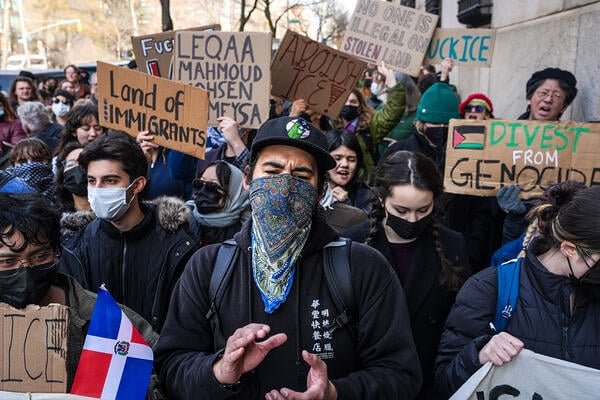
Aghayeva’s detainment comes at a time when Senate Democrats are blocking a bill that would provide additional funding for DHS, demanding reforms to immigration enforcement. And public school districts and university faculty members recently sued ICE over its policy of allowing immigration actions on or near public schools and college campuses. On Trump’s second day in office, DHS rescinded protections for “sensitive areas,” making campuses fair game for immigration enforcement actions. Since then, a number of detentions have occurred on or near campuses, including the arrests of Mahmoud Khalil, a Columbia University graduate and pro-Palestinian activist, and Rümeysa Öztürk, a Turkish graduate student at Tufts University.
Justin Mazzola, deputy director of research at Amnesty International USA, said in a statement on Friday that “ICE has no place in or around schools—period.”
Mazzola told Inside Higher Ed that colleges should put ICE preparation protocols in place and retrain staff on how to uphold them, but at the end of the day, “it’s really on ICE. They need to stop undermining the rule of law” and lawmakers need to ensure “oversight and accountability.”
“It really does put students in a state of terror,” he said. “People aren’t going to feel safe going to law enforcement if they’re concerned that ICE is pretending to be law enforcement in certain situations, if those rumors are correct from Columbia. So, it’s imperative that we rein in ICE.”
Higher ed leaders should add their voices to the chorus that federal agents be made to follow the law and keep away from sensitive zones, such as churches, schools, universities and hospitals, Feldblum said.
Shipman, in her statement, called out ICE in no uncertain terms.
“Let me be clear—misrepresenting identity and other facts to gain access to a residential building is a breach of protocol,” Shipman said. “All law enforcement agencies—including DHS and ICE—are obligated to follow established legal and ethical standards. And we expect those standards to be respected.”
Pacheco said it’s time for higher ed administrators and trustees nationally to send a message to lawmakers and federal officials: “This is unacceptable. This cannot happen again.”
You may be interested

College football news: Devonta Lee, former LSU football receiver, dead at 26
new admin - Feb 27, 2026[ad_1] NEWYou can now listen to Fox News articles! Former LSU receiver Devonta Lee, who was a member of the…
Lil Durk Set for August Trial After Judge Denies Severance Motion
new admin - Feb 27, 2026[ad_1] Lil Durk will have to wait until August for his federal murder-for-hire trial after a judge denied a request…
Trump in Texas amid heated Senate GOP primary race, no endorsement yet
new admin - Feb 27, 2026Trump in Texas amid heated Senate GOP primary race, no endorsement yet - CBS News Watch CBS News President Trump…