

How Should Leaders Respond to McMahon’s Letter?

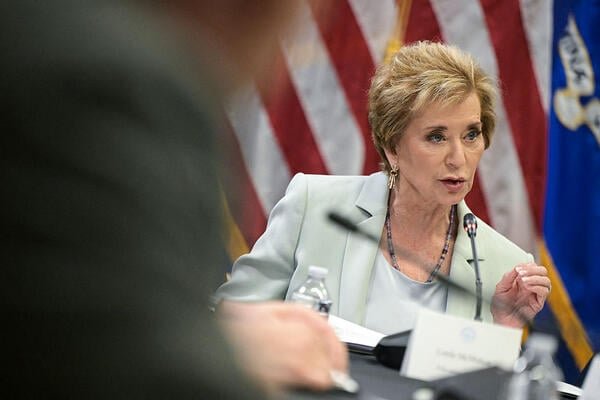
Education Secretary Linda McMahon last week summoned college and university leaders to publicly declare their commitment to rebuild trust in higher education. But the path forward is murky, as leaders wrestle over whether to respond and how to walk the fine line between compliance and standing their ground.
The three-page “Call to Action” asks presidents and boards to address questions about admissions, free speech, intellectual pluralism, college affordability and more.
Unlike last year’s “Compact for Academic Excellence in Higher Education,” McMahon’s letter appears to hold no direct bearing on institutions’ research funding. And this time around, the department consulted several university leaders when designing its invitation. But higher education experts say the letter still carries significant risk despite its softer tone.
For one, a pending rule would allow Trump officials to slash federal grant funding for colleges not aligned with the president’s political priorities. Though responding to McMahon’s letter appears voluntary, if a college declines or answers in a way the Trump administration views as insufficient, the institution could be at risk of losing millions in federal aid, experts say.
The clock is ticking for colleges to respond by McMahon’s December deadline. So far one appears to be ahead of the game. Vanderbilt University announced just days before the letter was published that its board had accepted a “Declaration of First Principles” in June. Vanderbilt is not one of the colleges reported to have helped department officials craft the “Call to Action,” but it co-authored a June report on biases in the humanities sector in partnership with Washington University in St. Louis. McMahon applauded the report in her letter, and WashU President Andrew Martin has confirmed he was involved in the letter’s development.
However, Martin has since made an effort to downplay his involvement, saying that though he “participated in broader discussions with the White House,” he “was not involved … in the drafting of the letter,” St. Louis Magazine reported.
Other university presidents and governing boards, however, haven’t decided if and how they will answer the Trump administration’s questions. Inside Higher Ed reached out to more than half a dozen college and university system leaders to ask what risks and rewards they have considered when it comes to answering McMahon’s call. All declined to comment.
Experts, on the other hand, were confident that the decision will be consequential and require a nuanced approach. When considered in the broader context of Trump’s ongoing attack on higher ed, McMahon’s letter could quickly become a formidable weapon, they warned.
But “being in a place where there’s no clear right answer and lots of unknowns is very much where we’ve been since the beginning of the Trump administration,” said Audrey Anderson, a higher education attorney at Bass, Berry & Sims PLC.
As college presidents and their boards work to make sense of the administration’s latest outreach, we asked lawyers, scholars and public relations specialists what they should consider.
Timing and Tone
The four experts Inside Higher Ed spoke with agreed that McMahon’s latest letter is intentionally vague and that the timing of its release was deliberate.
“There is a strategy behind having the Department of Education come in strong just as the school year is starting, to say, ‘Here’s another way for us to try to get some sound bites, some clips and some action when it comes to higher education,’” said Teresa Valerio Parrot, a principal at TVP Communications, a higher education consulting firm.
This is one of the busiest seasons of the year for academic administrators, added Jodie Crosby Ferise, a former university administrator and now partner at Church Church Hittle and Antrim Law. Many leaders have so much on their plate that they haven’t had time to deeply consider how they will address McMahon’s letter, she said.
“I have talked to university presidents all week, and not one of them has actually asked me a question about [the new ‘Call to Action’]. I’ll just be honest with you,” Crosby Ferise said, “I think that they are looking at it as a thing that they may need to address. They have until the end of the year, and they hope they can address it in a sort of a benign way.”
That said, when college and university leaders do come around to respond, the letter’s noncommittal tone and lack of clear consequence will certainly influence their decision-making process, experts explained.
In fact, “leaving that question open—of what happens if you don’t participate—will move some institutions closer to participating for the fear of the unknown,” Valerio Parrot said.
And that appears to be what the Trump administration is hoping for. In an interview with The Chronicle of Higher Education, Jonathan Pidluzny, the department’s deputy chief of staff for strategy and implementation, said he hopes the letter will create a snowball effect of “bold reforms.” He said there are no “direct penalties” associated with the letter but that it would “only be natural” that the government would want institutions committed to those changes at the table in funding conversations.
Brendan Cantwell, a higher education professor at Michigan State University, said the letter’s ambiguity is what gives it power, allowing for the existing rifts in higher ed to grow.
“It has the power to sow further division inside of higher education and to split universities into categories—like red, Republican-aligned campuses and campuses that are not Republican-aligned,” Cantwell said. “And that’s pretty important, because it can weaken the ability of higher education to speak with something closer to a single voice, in saying that the government doesn’t get to dictate our mission.”
Funding Risks
Legal experts stressed that colleges should assume the greatest possible risk if they opt not to respond: loss of federal research funding.
“I think most college leaders will find it difficult to read that letter any other way than ‘if you do this, you’re with us, and if you don’t, we’ll have no choice but to assume you’re not,’” Crosby Ferise said.
She and other legal experts say the best option for many institutions will likely be to answer, but to do so in a way that is broad and stays off the Trump administration’s radar.
“I don’t want my clients to become a test case” for the Trump administration’s agenda to crack down on higher ed, Crosby Ferise said. If a president or college board asks whether they should answer McMahon’s questions, “I will say, ‘It’s not a bad exercise.’”
“There is no way that I would advise someone to post tremendously specific answers that paint themselves into a corner and end up being used against them later,” she added. “But the seven areas that are outlined in the letter are nothing that these campuses aren’t already thinking about. So find a way to use that exercise and leverage that.”
Anderson from Bass, Berry & Sims made similar comments adding that while responding is probably the best option for the largest research universities and wealthy liberal arts institutions that depend heavily on the federal government for grant funding, it may not be the case for all-access community colleges or public regional institutions.
Since January 2025, the Trump administration has mostly leveraged research grants to initiate higher ed reform, leaving Title IV student aid funding untouched. Dozens of civil rights investigations into predominantly R-1 institutions, and the OMB’s pending grant regulations, further suggest that the administration is looking for reform among wealthy research institutions more than anywhere else.
“If an institution is not getting a lot of federal grant money, I think they really need to think about whether they want to spend time on this at all,” Anderson said.
Still, for colleges that do respond, nothing is guaranteed, she added. If the answer you provide doesn’t adequately align with the Trump administration’s desires, that could also lead to funding cuts or further investigations.
“The context of the ‘Compact for Academic Excellence in Higher Education’ is important because it tells us the answers that this administration wants. So, if you answer these questions, but you answer them in a way that’s not consistent with the compact, well, it’s not going to do you very much good,” she said. “Institutions need to be careful about how they answer those questions, so as to not make themselves a target for administration enforcement actions.”
The Audience
However, even the legal experts recognize that there is more to this decision than just the legal or financial risks; leaders must also consider the feedback and criticism that could come from students, faculty members and state leaders—especially in blue regions.
“It really comes down to relationships and to governance,” said Valerio Parrot from TVP. “You have to be thinking about the ecosystem that your institution exists in. Is this something that your community will want you to participate in? When, in theory, the attempt from the department is to create trust externally, the question is trust with whom?”
Valerio Parrot also said she would advise college leaders not to stay silent, as that can leave community members questioning where they stand and how committed they are to their morals. The key, she said, is making sure the way they answer doesn’t just provide “fodder” for the Trump administration to use in its “victory lap.”
“There is an opportunity to still be talking about the value of higher education, the impact and the outcomes that we produce on our own terms,” she said.
Similarly, Crosby Ferise said if institutions can find a way to “ride that middle ground … and just feature all of the good things that you’re already doing,” constituents won’t think they’re aligning with the administration. “I think it is just a smart move that you have time to consider making.”
Cantwell from the Michigan State University, on the other hand, hopes to see college leaders push back and explain why.
“I don’t think colleges should ignore the questions. But I do think that they should be forthright about them,” he said. “They should say, ‘We believe … that this is an attempt to coerce us, to say that science funding, and other federal resources are contingent upon signing onto the ideological agenda of the administration and breaking the traditions of American higher education, not reinforcing them. And for those reasons, we are taking an informed risk to push back on this and say that this is unacceptable.’”
You may be interested

Taylor Farms recalls jalapeño products at retailers like Target and Walmart over salmonella risk
new admin - Aug 11, 2026Taylor Farms is recalling several food items made with jalapeños suspected of being contaminated with salmonella. Tom Hanson reports and…

7.4 magnitude earthquake rocks Colombia, over 100 dead, president says
new admin - Aug 11, 2026A 7.4 magnitude earthquake toppled dozens of buildings in western Colombia on Monday. President Abelardo de la Espriella said over…

Trump secretly switched to different plane in Turkey amid Iran missile threat
new admin - Aug 11, 2026Shortly before Air Force One took off from Turkey at the end of last month's NATO summit, President Trump secretly…