



How One College Is Rethinking Basic Needs Support

Affordability concerns have left many college students struggling to cover not only tuition but also rising food prices, housing costs and other everyday expenses. As those financial pressures grow, colleges are rethinking what student support looks like—and what role they should play in addressing students’ basic needs.
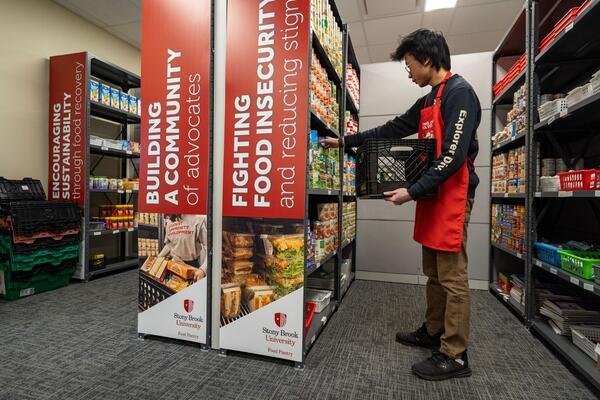
At Stony Brook University, that shift has meant transforming its traditional campus food pantry, Seawolves Pantry, into a broader hub for basic needs support. Originally opened in 2013, the pantry extended its hours and services in 2020 as student demand increased during the COVID-19 pandemic.
Today, the pantry stocks culturally significant foods, multilingual educational materials and an expanded selection of hygiene products, including skincare and dental care items. The new inventory reflects a reality many students know well: Groceries are only one part of the rising cost of living. The pantry is designed to address a range of basic needs that university leaders said can influence students’ ability to stay focused on their education.
Katie McCombs, coordinator for the Department of Student Community Development at Stony Brook, said pantry usage has increased by more than 30 percent over the past year, rising from about 7,000 student visits during the 2024–25 academic year to roughly 9,000 this year.
The data also challenges common assumptions about which students are most likely to experience food insecurity. McCombs said pantry usage is split evenly between undergraduate and graduate students, as well as between residential and commuter students.
“People often assume that because commuters may not have a meal plan or graduate students don’t have the same financial support that undergraduate students do, there would be more of a lean in one way or another,” McCombs said. “But the truth of the matter is that undergraduate, graduate, residential and commuter students are all facing food insecurity in very similar ways.”
Supporting student needs: Emily Snyder, director of the Department of Student Community Development, said the university has regularly adapted the pantry’s services based on student feedback and research.
“It is always our goal to evolve the operation and to innovate,” Snyder said. “It’s really important to keep considering how we bring the work to the next level, both because we take pride in the work that we’re doing, and because we feel it’s really important to do right by our campus community.”
Many of the pantry’s newest offerings have been shaped by student-led research projects, McCombs said. One initiative led to the addition of more culturally significant foods. A social work intern surveyed students about what they needed and found many students preferred staple ingredients such as dried beans and rice over canned goods.
“We do have a decent number of international students who utilize the pantry, and a lot of the feedback that they gave us was that they weren’t used to the processed chemicals that were in the foods, or weren’t sure how to cook them properly,” McCombs said. “So, introducing foods that were more familiar to them made them feel more confident in their ability to cook the food and make a meal for themselves.”
Another project examined the relationship between diet and skin health, while another highlighted a decline in students receiving routine dental care. As a result, the pantry stocks face wash, pimple patches, face masks and other skincare products, in addition to dental care essentials.

Student usage of Stony Brook’s pantry has increased by more than 30 percent over the past year.
The pantry’s impact is often reflected in students’ growing confidence to ask for help, McCombs said. For example, one student with multiple dietary restrictions, including being gluten- and dairy-free, struggled to stretch their Supplemental Nutrition Assistance Program benefits far enough each month.
“Originally, when they were coming in, they were very shy and timid using the pantry,” McCombs said. “Over the months they’ve definitely grown into their own confidence of being able to come in, ask for what they need and be very clear, communicative with what their needs are.”
Snyder said those kinds of experiences reflect the university’s broader effort to reduce stigma around using the pantry and make it a more normalized part of student support.
“We’re doing our best to remove this kind of shadow of shame that can sometimes be associated with asking for help,” Snyder said.
A national trend: Stony Brook is one of a growing number of colleges rethinking how they support students experiencing food insecurity.
At Roxbury Community College in Massachusetts, more than 1,500 students have relied on the campus pantry, known as the Rox Box, since it opened in October 2023. Like Stony Brook’s pantry, the Rox Box provides not only food but also diapers and personal care essentials to help students meet everyday needs.
The University of Dayton in Ohio has leveraged its academic programming to expand basic needs access. Its student-run Flyer Farm has grown from a handful of garden beds in 2017 into a full-scale urban farm with more than 30 beds, an orchard, beehives and chickens. In 2024 and 2025 combined, the farm donated more than 12,000 pounds of produce to the university’s Food4Flyers pantry and to Miami Valley Meals, a local nonprofit.

Many of the pantry’s newest offerings have been shaped by student-led research projects examining basic needs insecurity.
These campus efforts come amid mounting research that food insecurity remains a significant barrier to student success nationwide.
A recent analysis from the Institute for Higher Education Policy found that Pell Grant recipients are nearly twice as likely to experience food insecurity as nonrecipients—42 percent compared to 22 percent. The report notes that changes to SNAP eligibility, combined with a projected $16.9 billion Pell Grant funding shortfall, could further strain students’ ability to meet their own basic needs and remain enrolled.
Serving the whole student: McCombs said students experiencing food insecurity are often navigating multiple overlapping challenges that extend well beyond hunger.
“Our students who are struggling with food insecurity aren’t typically just struggling with that,” McCombs said. “They might have academic issues, they might be facing financial issues, they might even be facing homelessness or something along those lines. So you can’t ever just look at an issue a student is facing in a silo.”
Snyder agreed, noting that basic needs support is closely tied to student persistence and success.
“Basic needs insecurity and persistence, there’s a relationship or an alignment between those two things,” Snyder said. “For us, what we think is important is to consider not only the whole student, but also recognizing that running a pantry or addressing basic needs shouldn’t be looked at through the lens of ‘If somebody is in need, they should take what they can get.’”
“We want all of our campus community to know that they are fully seen as whole people, whether that’s through food, hygiene products and other forms of support,” she said.
Get more content like this directly to your inbox. Subscribe here.
You may be interested

After 51 Years at Bard, Months of Scandal, Botstein Retires
new admin - Jul 01, 2026[ad_1] During his 51 years as president, Botstein racked up a long list of accomplishments, but the final six months…

American icons reflect on the ideals the U.S. was founded on, look toward the country’s future
new admin - Jul 01, 2026To mark the 250th anniversary of the Declaration of Independence, 60 Minutes invited leaders in the arts, sciences, sports, technology…

Morrisons and Marks and Spencer confirm more closures this summer — full list
new admin - Jul 01, 2026Morrisons has confirmed seven locations affected by the closures, which include some branches in York and the North East. Shutting…