




Historians Blast Trump’s Freedom 250 Exhibits

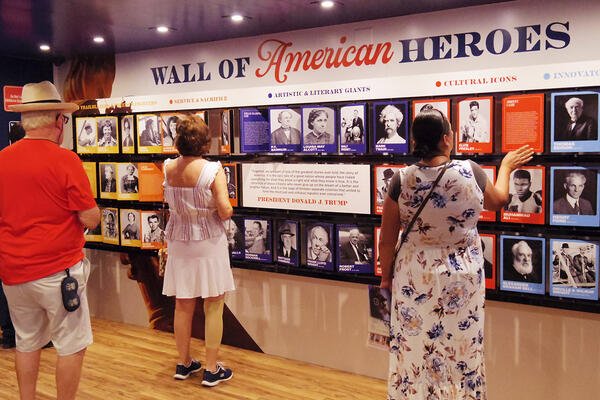
Step inside the PragerU Freedom Truck stationed on the National Mall and George Washington comes alive as an artificial intelligence avatar extolling on the sacrifices of revolutionaries and the noble American cause.
“Our rights are a gift from God, not a favor from kings or courts,” he tells visitors (a line historians call uncharacteristic of Washington).
The walls of the mobile museum are overflowing with text, QR codes, more AI avatars of founding fathers and other historical figures, and a video message from President Donald Trump. PragerU’s Freedom Truck is one of several crisscrossing the country, stopping at libraries, K–12 schools and festivals. Though the trucks emphasize early American history, they also showcase figures ranging from the founding fathers to cultural icons.

An AI avatar of George Washington is one of the first sights in PragerU’s Freedom Truck.
Outside, as part of the 16-day Great American State Fair that kicked off last week, simulated gunfire cracks from a group of soldiers in period garb demonstrating battle techniques of the Revolutionary War era.
Many historians see Freedom 250, the Trump-led commemoration of the semiquincentennial, as a flawed effort. Critics argue that the Trump administration and ideological allies involved in the project, such as Michigan’s Hillsdale College and PragerU, are focused on promoting a triumphal retelling of the past that aligns more with the Trump administration’s worldview and political agenda than it does to the reality of American history.
Historians argue that the Freedom 250 effort essentially narrows history to a small group of mostly white men—many of whom were slaveholders—and fails to grapple with the American past in a nuanced way. Many of the associated videos, they note, omit the history of founders as slavers and overemphasize the role of Christianity in the nation’s founding.
Additionally, some of the content on the Freedom 250 website appears to be made up, such as a section that features narratives from Americans who don’t appear to exist, which historians say delegitimizes the project.
The project shows a clear divide in how higher education has approached teaching the past versus the Trump administration’s preferences. Last year, Trump issued an executive order demanding the restoration of “truth and sanity” in American history, with the president arguing that a “revisionist movement” has too often focused on issues of race and class “rather than fostering unity.” Accordingly, issues of race and class largely linger only in the background in the materials produced by Hillsdale and PragerU.
Narrative vs. Nuance
The Freedom 250 website lists only one partner from the academic world: Hillsdale College.
Hillsdale produced a series of videos, in partnership with the White House and the Department of Education, telling the story of America’s founding. The videos, typically 10 to 15 minutes long, are heavy on military history and feature voices including Vice President JD Vance and Defense Secretary Pete Hegseth, culture warriors such as Eric Metaxas (a 2020 election denier), and a few conservative academics.
Save for a video on the “forgotten heroes” of the American Revolution, the series mostly ignores slavery during the era and omits the contributions of Native American tribes who fought on the side of colonists. Founding fathers are presented largely without flaws.
John Fea, a senior fellow at the Lumen Center, which studies Christianity and culture, said while there is “very little, if anything, in those videos that is factually wrong,” he argues that the series is shot through with “bad theology” and presented in a cherry-picked manner without nuance.
“It’s marshaling the facts into a particular narrative that suits the political moment,” Fea said. “If you want nuance and complexity, then you have to talk about Washington as a slaveholder, [Thomas] Jefferson as a slaveholder. These are important parts of the story. Talk about them in a way that gives dignity to all human voices that existed in the United States from 1776 to the present.”
Hillsdale officials have brushed off such criticism.
Matthew Spalding, who serves in multiple roles at Hillsdale, including as dean of the Van Andel Graduate School of Government, told Inside Higher Ed the college wanted to focus on the narrative that emerged from the nation’s founding, which he believes is straightforward. (Spalding also served as an academic adviser to the PragerU Freedom Trucks effort.)
He said the series sought to focus on the clear historical arc that began with the American colonies and moved into the American Revolution, centered around the Declaration of Independence and its emphasis that all men are created equal, which leads eventually to the U.S. Constitution. And while the nation did not initially live up to its founding principles, the declaration of equality in founding documents ultimately upended slavery.
“A lot of modern history doesn’t tell the narrative anymore; all they do is focus on these other things, so it wasn’t to exclude those things, but to tell the main parts of the story,” Spalding said.
Although he emphasized “history should be taught warts and all,” he noted that limitations to the videos and the wall space in the Freedom Trucks prompted choices about what content to include and exclude. Ultimately, he said, he wanted to highlight the most important aspects.
“For a K–12 student—not an academic, a college professor who wants to get into the nuances of everything—we thought the most important thing for them to know was the arc of that story and the narrative. The big events, the big figures, which are still the big events and the big figures,” Spalding said.
He also defended the partisan lineup of presenters.
“It was a partnership with the current administration. If you’re going to invite the secretary of defense to talk about a defense matter, it is going to be the one of the current administration,” Spalding said.
Faking History
While historians argue Hillsdale didn’t delve deeply enough into the nation’s past, other parts of the Freedom 250 website don’t appear to grapple with history at all. The Voices of Liberty section, which features scrolling narratives from seemingly everyday Americans, looks to be fabricated.
Historian Karen E. Park was the first to point out the discrepancy in her Ex Voto newsletter, where she noted the folksy narratives, which include names and locations, don’t point to real people. Park cast the lack of business websites, LinkedIn profiles and online activity as suspicious.
“It doesn’t say on this website, ‘These aren’t real people, these are representative examples of our great nation and [its] types of people.’ It just passes them off as real people,” Park said.
Like Park, Inside Higher Ed could not verify the authenticity of the 20 names in the Voices for Liberty section despite searching business, court and property records based on corresponding details. The most common result, based on name and location, was obituaries from years past.
(The White House did not respond to questions about the Voices of Liberty section, nor did representatives from Platform Communications, a public relations firm supporting the Freedom 250 effort.)
Multiple historians told Inside Higher Ed that if those narratives are manufactured, it would undermine any legitimacy that Freedom 250 organizers have in presenting the nation’s story.
“It tells us that their approach to history is a politicized invention designed to make political arguments as opposed to an accurate, evidence-based interpretation of the American past and apparently the present,” said Sarah Weicksel, executive director of the American Historical Association. “If this is fabricated, it makes it clear how little the administration values transparency and the preservation of this moment for future Americans and the historical record.”
American University history professor M.J. Rymsza-Pawlowska was equally blunt.
“If those are not real people and not real quotes, then it’s not history,” she said. “History is the documentation of things that actually happened, and none of these things actually happened.”
Historians were also critical of an AI-generated video of John Adams.
In the video, created by PragerU and uploaded to a White House YouTube playlist, the AI Adams closely paraphrases conservative media personality Ben Shapiro, remarking, “Facts do not care about our feelings.” The first-person AI narratives were manufactured to explain who the figures are in the words of their avatars, meaning they never spoke most of their lines and should not be considered historically accurate. Still, many historians cringed at a historic figure quoting a modern conservative provocateur.
“That is not history by any stretch of the imagination,” Weicksel said.
Beth English, executive director of the Organization of American Historians, told Inside Higher Ed that AI founders spewing fake quotes “twists the truth” of the American past.
“It’s fundamentally problematic when you start essentially pushing out a form of misinformation, which is putting words in the founders’ mouths—John Adams, in this case—that they didn’t say,” English said.
Underpinning the fake quote is a broader conversation about how historians use AI. Some see it as the next frontier in an increasingly visual approach to teaching history. Others worry that it will distort and rewrite history, given its proclivity to fabricate results, and will undercut research integrity.

Many of the videos created by PragerU can be viewed online and in their mobile museums.
While PragerU’s video content relies heavily on AI, Hillsdale’s videos eschewed the technology, opting for a more traditional documentary-style approach. Still, Spalding defended PragerU’s use of AI.
“You’re not going to get rid of it, you’re not going to erase it. People don’t read as much anymore,” Spalding said. “You’ve got to capture the imagination, so AI is a really good tool.”
(PragerU did not respond to a request for comment from Inside Higher Ed.)
Commemoration or Spectacle?
Historians note that the semiquincentennial celebration is a stark contrast to the bicentennial.
Rymsza-Powlowska, who wrote a book about the 1976 bicentennial and how it sparked greater interest in public history, noted that the Nixon administration also wanted to organize a celebration that emphasized conservative values, similar to what the Trump administration has created. But those plans were thwarted by critics who accused him of hijacking the moment.
“With national commemorations in particular, if you are a party in power or presidential administration, it is an unparalleled opportunity to align yourself and your policies and ideologies as closely as possible with the American past and the American future,” she said. “To see this compounding of political propaganda into American history is not altogether surprising.”
She added that while Congress created its own organization—America 250—to celebrate the nation’s founding, that effort seems to have been overshadowed by the Trump administration. (The less splashy celebration from America 250, which Congress created in 2016, includes signature events such as a benefit show, a time capsule burial and block parties.)
“The America 250 effort has not seemed to me to be significant,” Rymsza-Pawlowska said.
English and the OAH have been broadly critical of the Trump administration’s approach beyond the 250th, recently releasing a report detailing what the organization has cast as “The Federal Assault on History.” She argues that parts of the commemoration, such as the recent UFC fight on the White House lawn, are “untethered from history” and the celebration has instead become about spectacle.
“It’s decentering history from what should be celebrated as a historic milestone,” English said. “What we’re seeing is a nationalist spectacle instead of a sort of substantive public engagement, in not just celebrating, but in trying to understand and grapple with the meaning of the 250th.”

Booths at the Great American State Fair also include art with patriotic themes.
Although the White House did not respond to specific questions sent by Inside Higher Ed, a spokesperson wrote that Freedom 250 was focused on national pride and patriotism and argued that the associated events will ultimately serve to help Americans better appreciate their nation.
“President Trump is ensuring that America gets the spectacular 250th birthday it deserves—and Freedom 250 will execute on the president’s historic vision,” Davis Ingle, a White House spokesperson, wrote in an emailed statement. “Between the Great American State Fair, the Salute to America Celebration, the Patriot Games, Rededicate 250, and other exciting events, 2026 will feature a renewal of patriotism and national pride under this President’s leadership.”
You may be interested

This could be our best look yet at Samsung’s new wide foldable
new admin - Jun 30, 2026Samsung is expected to unveil its next generation of foldables at a Galaxy Unpacked event next month, but now we…

Democratic primaries in Colorado mark latest fight over party’s direction amid push by insurgents
new admin - Jun 30, 2026Washington — One week after Democratic insurgent victories in New York, the focus is now moving to Colorado, where challenges…

Inside a University’s “AI Kitchen”
new admin - Jun 30, 2026[ad_1] As a woman pursuing a career in computer science, Tiffany Le sometimes struggled to picture where she fit in…