



Geddy Lee, Alex Lifeson in Full on Their Return

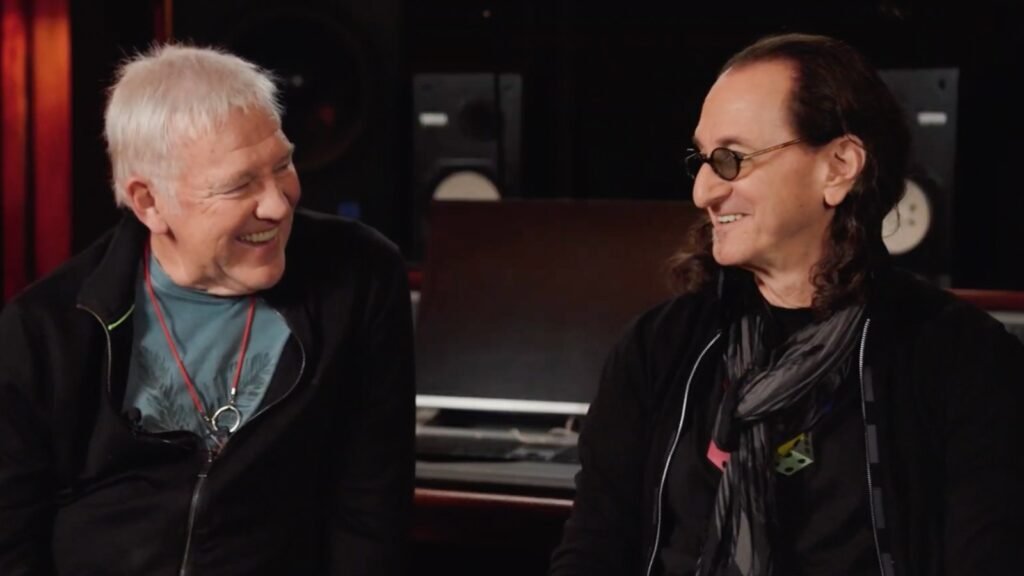
For Geddy Lee and Alex Lifeson, playing Rush concerts has never been exactly easy — the insanely tricky, ever-shifting music they wrote for themselves made sure of that. Even so, no shows were ever as daunting as their four-night run at Los Angeles’ Kia Forum in June. The kick-off of Rush’s Fifty Something Tour marked their first shows since the devastating loss of drummer and lyricist Neil Peart in January 2020, and the first Rush concerts, period, in 11 years. Not to mention that the shows debuted touring drummer Anika Nilles, taking on the scariest gig imaginable, as well as keyboardist Loren Gold, who expanded the band to a four-piece for the first time.
Even in the face of all that pressure, the shows — which debuted the tour’s four revolving setlists — were wildly successful, with tributes to Peart helping one of rock’s most cerebral bands hit new heights of emotional impact. Two days after completing that triumphant initial run, Lee and Lifeson sat down in the basement studio of West Hollywood’s Sunset Marquis hotel to look back at what it took to get there. In the interview, conducted for a cover story in collaboration with Rolling Stone Canada, they talked for the first time about Lee’s reactions to Lifeson’s public reluctance to tour, about Lifeson’s newfound abstinence from THC, and much, much more. Below is a full, lightly edited text version of the interview, or watch the whole thing on YouTube.
It’s all felt pretty miraculous from the outside, but how did it feel the first night when you were taking your places, with double necks weighing on your spine and smoke everywhere, and you knew what you were about to unleash on that audience?
Geddy Lee: Last Sunday was a particularly nerve-wracking day for all of us. I think we all were trying to handle it, because we’re very well-rehearsed, but there’s no replacing opening night. It’s a very different atmosphere, and I know Anika was tight and I was focused. Before a show I’m always a little tunnel vision, as you have to be.
But there was a cumulative tense vibe. And then when we came up onstage and heard the crowd, you start to relax into it. I was really proud of us that night because we did one of the best versions of that set that we’ve done yet. And so we just were cruising, and I kept saying to myself after each song, “There’s another one down.”
And then we’d go in the next one and go, “That was pretty good. OK, another one down.” I kept looking over at Anika to make sure she was cool and relaxed, and she was smiling, so I think we kinda found ourselves on that first night. I really think it was just one of those rare —
Alex Lifeson: Great gigs. It’s funny. When we walked up onstage, the film is still running, and we’re behind the screen and just getting ready. And I was surprisingly not really that nervous like I expected to be. Normally I’d have butterflies, and my heart would be racing. But I was relaxed.
Just, “Yeah, I got this. I got this.” And I put my foot on the volume pedal to get started on “Xanadu,” and then the screen went up, the lights came on, and it was like, “Ahhhh! Oh, there’s people out there.” I couldn’t see the neck, and it was like, “Oh, OK.”
Lee: Yeah, ’cause we were drowning in fog. So I have a little mirror on the bottom of my stage so that I can see Anika when I’m doing the pedals. I like to be able to look over and see her. And the fog completely got… And I was in there.
Lifeson: The next day Ged said to me, “You can just blow it away ’cause it’s very light, that vapor, and you can just blow it away.” And it was like, “Oh, genius.” Of course. Just one little puff…
Lee: There’s my pedals. There it is.
You mentioned looking back at Anika, but I was struck by the faith that you guys had in her from the first minute.
Lee: In my history as a musician, I don’t think I’ve ever rehearsed that much as an individual and also as a band. Of course, we needed to because it was a monumental task. Not just to learn one set and one show. Four shows, over 40 songs she had to know.
It was a really tough year for her, and she worked really hard. And then in the last month and a half before the tour started, I think at one point we did the show 24 times in 27 days.
Lifeson: That’s a lot.
Lee: So we were well-rehearsed. And towards the end of rehearsals, you start making all these goofy mistakes, and she would make goofy mistakes.
And I would look at her, and I go, “You OK?” And she goes, “Yeah, it’s just my brain.” I had a little pep talk with her and Loren, and we said, “Look—” When you over-rehearse you get rehearsal brain. Rehearsal brain is that you’ve played the song so many times that you’re not excited by it anymore.
You’re more worried about it, and so you’re overthinking it, and you make dumb mistakes because part of your brain is bored with the song. All it takes is one human being to walk in the room and it’s like, “Whoa, we have someone to play for,” and it changes everything. So I said, “Just remember, forget about them out there. You’re playing for us. We’re playing for each other. Let’s have a great time and we’re gonna have some fun.” And that helps. It’s reinforcement, reminding her that we have faith in her. And she knows. She’s a pro, and she rose to the occasion on opening night. She was magnificent, I thought.
She dropped the drumstick right at the beginning of “Xanadu” and recovered without missing a millisecond. I can only imagine the terror of that.
Lifeson: “Oh, this is how it’s gonna be.” Right at the start.
And the heroic thing is to just be like, “I’m not gonna let that faze me” in the worst possible moment. The whole thing is remarkable.
Lee: It is. And it’d been a long time since we were on a stage, and we worked so hard, and we put so much of our heart and soul into shaping a show and perfecting our parts, working on being ready. And when the curtain goes up, you just never know which version of you is gonna arrive.
When it all goes well, as it did, and the crowd was so loving, it’s just… It was great. It just felt great at the end of the night when, in between set one and two, that little bit of a group hug backstage. Here we go. Let’s do it again. It was just a great night.
Lifeson: And it just became more and more comfortable.
The third and fourth night, we were goofing around and laughing and joking with her, and she’s got a beautiful smile. And she uses it quite easily. She’s a wonderful person who has a beautiful heart, so it’s not hard to just be happy out there.
Lee: Yeah, it’s interesting. We did loosen up by show three. Four, we were much looser. Onstage. Goofier. I can tell ’cause my back was more sore after the show.
Lifeson: Same here.
Lee: No, it was really nice, and you start to believe that, yes, we have this.
You’re even jumping. Are there people begging you not to go off the ground?
Lee: Yes. My trainer’s begging me. My wife, my daughter, which—
Lifeson: Insurance company.
Lee: My daughter said to me the other night, “Dad, don’t jump.” I said, “I got this, hon.” [Grabs his back.] Oh, yes, I got it. I got it here, I got it there.
And Alex, as you said, night three and four were much looser. You were moving around more. Something clicked for you?
Lifeson: Yeah, I just felt more relaxed with my playing, and I felt like I didn’t have to concentrate so intently all the time, that I could just be a little looser and be in the moment, and just play. And there’s a difference. When you’re too tight, you’re thinking ahead of the next chord or the next phrase or what’s coming up in the next song.
I struggled with that a couple weeks ago, those sort of things. And I’m trying to be much more present and in the moment, and just trust my hands to do the right thing. I find that it’s flowing more easily now when I get out of the way and just let it do what it wants to do.
Lee: Yeah, getting out of the way, that’s the right word. You can be your own worst enemy up there. It’s a Zen state you have to find. And if you find that Zen state, then all your rehearsal starts to pay off.
It just comes out, and you can enjoy the moment, enjoy the audience, and feed off the beauty of the song you’re playing. And that’s what started to happen as the week went on.
Ged, you have that song on your solo album about looking for perfect, and perfectionism is a thing for the band as a whole and for you personally — you said in your book that you can be a head case to work with. So how does that play against doing this for the first time in so long, with a new drummer, and human limits?
Lee: That’s a good question, because you have to balance. You can’t just be a tyrant and come in there and demand perfection. That’s not how it works, ’cause it’s a long game. I try to be strict in the sense that, OK, we’re gonna play this whole show. We’re gonna do day one, day two, day three, day four, day one, day… We’re going to work a lot. But you also have to recognize — I remember after the first two shows we did, I could see the stress was weighing down on Anika.
And we were all tired. So I went up to her and I started talking. Said, “How about instead of doing a show tomorrow night, why don’t we just pick certain songs that need more work than others?” ‘Cause you have songs you repeat and then songs you only play once every four days. So she just went, “Oh, that would be so great.”
It’s not being so up your own ass that you can’t tell when people need a break of some kind, and because of the way we structured our rehearsals, we really didn’t leave enough time for rehearsals, so we had to do these really intense day after day. But we started to build in those days where both Loren and Anika know she can come in and she doesn’t have to perform that set.
We can work on that song. How did that feel? And I always check in with her. “How did that feel? Do you need it again?” And she’ll go, “Yeah, I need it again.” So we would do it again, and sometimes three or four times. For me, sometimes I need to do it multiple times. And so you have to create the atmosphere where they’re part of the decision-making and you’re reading the room, you know? Don’t just be Mr. Bossy Pants, as I naturally become.
You chose to do perhaps the most ambitious version of this that one could imagine — almost to the point of masochism or sadism. All of “2112.” “The Camera Eye,” and all of Moving Pictures. Four different set lists. You brought “A Farewell to Kings” back for the first time since 1979. You’re singing “Anthem.” What was the thinking behind taking it to level 95?
Lee: The fans.
Lifeson: I think we wanted to be better than we’ve ever been, not just be as good as we were, and challenge ourselves with songs that we haven’t played in a long time. Like, all of them were challenging after 11 years anyways. But to bring back “A Farewell to Kings,” that took a lot of work.
Lee: That was the hardest one.
Lifeson: Probably the hardest song of all.
Lee: It’s a really mental song. It’s just a weird—
Lifeson: Structurally, yeah.
Lee: It’s a weird song.
Break down the difficulty. I know the time signatures are tough, but what’s the actual essence of it?
Lee: Each part is difficult to play in and of itself. And then when you add them… even the beginning, it sounds like a walk in the park with a minstrel, but it’s not.
Each song is structured in a very difficult way to play smoothly and convincingly. And then you go into the intro. The intro, it keeps changing. The intro and the outro, beats are added, beats are dropped, and you have to remember the order that those happen in.
Then you get into the opening riff. That’s a tricky riff for a guitar player to play.
Lifeson: Yeah. I’ve played classical for a long time, but I really struggled with it. My hands are not operating like they once did, and I work really hard to get them to that level, and it’s been pretty successful so far, I think.
But to play that, Ged said, to play that in a very smooth, delicate way, and that’s the way it is on record, while you still have another guitar draped on your sore neck, it takes a lot of gymnastics to get it all done.
Lee: And even the electric part. When the electric part comes in, it kicks off the verse. That’s not an easy… It’s not just a straightforward arpeggio. And then you kick off the verse, and I have to sing in this fucking stratosphere. And I have to build my confidence to sing in the stratosphere and know that I can hit those on a nightly basis.
So there’s a lot of insecurity that comes with bringing back a song from that long ago.
Lifeson: Then the solo section switches to 7/8 for that whole thing, so you gotta know where you’re going.
Lee: One bar of eight, one bar of six. One bar of eight.
Lifeson: So now you have to be so cognizant of where you are in it.
And the solo is a very spaced-out solo. It’s not just a constant playing. It goes in on a particular spot, comes out on a particular spot in every section of the solo. So that has to be smooth and it’s just a really challenging—
Lee: It’s a challenging song. And now you know in detail why.
And you didn’t just get onstage and play “A Farewell To Kings” and say goodnight — this is towards the end of a show that had also featured all of “2112.” When you compound all that, it’s just—
Lee: It’s a tough show. Each night has its own difficulties. But we’re all professionals and that’s why you do all the work. My day and my off days are not fun. I sleep late because now I’m on a late schedule. I have to see my physio person.
I have to do a good workout physically. I have a half an hour to catch my baseball scores, and then I have to work out with my vocal coach. And that’s gonna happen for the whole tour. And that’s how you remain a professional and you don’t let people down. When they paid good money to come see you play, you have to give them the best you got.
And like Alex said earlier, coming back at this age, your fear is that you can’t do it anymore, and you’re going to be a compromised version of yourself. And I don’t want that. That’s why Neil retired. He retired because he refused to show anything but his very best in public. And so that’s on your mind, and that’s driving you.
And that’s why, according to my daughter, I didn’t smile for a year and a half before appearing onstage. My daughter came up to me and she was so happy. She said, “You look so happy up there. I haven’t seen you smile like that in a year and a half.” I’m like, “Really? Am I really a grump?” But it’s not grump.
It’s that I had to go into tunnel vision to prepare myself for this job. And so not to let myself down, not to let the public down. And I know Al went through the same thing, and I know Anika was — that was a huge yes. When she said yes to joining our band, that was a big yes. I don’t think she fully understood the magnitude of that yes and the amount of work.
And so all of us, Loren included, worked as hard as we could, took it very seriously, and touch wood, we had a good first week.
It probably over-condenses it to say, “Oh, he saw a vocal coach.” You’ve done something I haven’t seen a lot of rock singers do. Some are steady, some lose the top notes and learn to compensate. But you reversed what was lost. I’m wondering what that took. It’s part of the miracle of this tour.
Lee: It was important to me to do as many original versions for our audience as we could, and I didn’t want to have to start changing keys to every song and go into that whole bullshit. But how do I do that? A friend of ours recommended this vocal coach for me. His name is Mitch Seekins, and a terrific guy.
He’s great singer, lives in the country now, and that’s his job. He coaches all kinds of people. It’s really interesting. He coaches opera people. He coaches a lot of rock bands. He coaches one guy who does the play-by-play announcement at a horse racetrack. All kinds of people need vocal training, for various reasons — he coaches people that for one reason or another have started to lose their voice, and so he’s very well-versed in analyzing what you got. So I started with him, what, about a year and a half ago now?
And the first few sessions he was listening to what I had, and he said, “OK. You’ve got a voice that the muscles are out of shape. You haven’t sung in 11 years. That’s normal.” So after the first number of sessions, he said the good news is you still have that range in there, but we’ve gotta strengthen your voice so you can access it. So that became the beginning of this whole exercise regime. It’s no different than going to the gym and getting strong.
I go to the gym four days a week, get my body strong. You have to get this muscle strong, and that’s what I’ve worked on. And as we went along, he’s very good at getting me to stretch my range and also give me confidence in my range. Part of it is learning new techniques to access your range so that you’re not working so hard to do it.
He would look at videos. Sometimes he’d come to a rehearsal, and he would video me, and I’d go, “That’s embarrassing.” And he would show me the video and say, “Look how hard you’re working to hit that note. But yet when we’re warming up, you hit that note and you’re not working hard at all.”
So you have to learn while you’re standing there to breathe at the right time, that’s more than half of it. And to position your vocals and to take a more forensic look at how a voice makes a sound and apply it. So it’s been a year and a half, but it’s paying off, and I’m pretty pleased at my progress.
I think if I keep working at it it’ll keep getting better. I hope. And I have to stay healthy, and I live in scarf, sweater. I live in constant fear of a cold, because once you get a cold… The irony is when I first started working with him, I had a cold, and of course, we couldn’t do the same workouts that we do now.
But he taught me how to handle a cold as a singer, and he’s got so much experience that I’m just learning a lot, you know? And that’s a nice thing.
I imagine you’re hitting notes you couldn’t have imagined would still be accessible to you.
Lee: I thought, “There’s no way I can do this song. There’s no way I can do that song. I can’t hit those notes.” And he would listen to them, and he’d go, “That’s an E. That’s high, but you can hit it. You’re doing E in warmups. And I’ve stretched you out to F sharp. I’ve stretched you out to G.”
This is above high C basically, right?
Lee: Yeah. I remember I did one workout with you in a car.
Lifeson: Yeah, on the way to the house.
Lee: ‘Cause he works out with Mitch as well, and you said, “I have to stop now ’cause this is, I don’t have this octave. He doesn’t work me out in this octave.”
And so it all fit together — if I can hit these notes again, maybe we can do “A Farewell to Kings.”
Lee: Exactly. I was nervous to try some of those songs, and then he would encourage me, and I would do them.
And I would struggle at first, and then I’d listen to them with him, and he’d go, “No, you can do this. Try this. Breathe here. Remember when you’re singing the choruses of ‘A Farewell to Kings,’ make it bounce.” And that helps. All those little tricks — they’re not tricks, they’re exercises — help you realize, “Look, I got this.”
The funny thing is, back in the day you were doing this without any thought and without any—
Lee: Without any schooling and with more youthful verve, right? Like, he said, “When I listen to your early records I can’t believe the way you’re hitting those notes without even thinking about it,” because it’s a combination of what they call blending, where you’re blending chest voice and head voice, right?
And I did that instinctively my whole life. At a certain point I didn’t really work on the techniques to keep those high songs, so we just started dropping some of those super high songs. And so that was a challenge for me to bring them back.
I think “Anthem” you keep in D instead of E or something. Is that right?
Lee: “Anthem” is down a step. And “2112” is down a step. Everything else is in original key.
Gotta draw the line somewhere.
Lee: Frankly, “Anthem” sounds much heavier down a step, yeah. Sometimes you drop a step to make the song feel more powerful. And although I could do “2112” in its original key, I think it just sounds heavier like this now.
Now, it’s partly an excuse and partly the truth. Yeah, both of those songs I don’t think have suffered. We were gonna drop “Kings” originally. Was it “Kings”? Yeah. And then we went, “Nah, it just sounds better in its original key, so we have to keep it in the original key.” We went through the whole catalog like that, judging if the keys were fine.
And especially with “Freewill.” There was no way I would do that song unless I could hit that third verse, which is really the highest verse that I sing all night.
It’s pretty high. You can feel the audience being thrilled that you’re there.
Lee: They’re rooting for me.
They want you in that octave.
Lee: I love them for that, quite honestly.
In one of Neil’s books he talks about a tour in the Nineties — maybe the one that became Different Stages — where you were pushing for more songs and he said, “That’s it. No more songs.” And even now, you hit Anika’s hard drive limit. You’re always gonna push it to the absolute limit of possibility.
Lee: It’s how I’m built. I’m crazy. I love being ambitious. I love trying to exceed what my own expectations of myself are. And this was a big show to put together, but I didn’t wanna half-ass it. I didn’t wanna come back as a compromised version of what we had already established. What’s the point of that? “Let’s go out on tour and disappoint 80,000 people in Los Angeles.” No, it’s not acceptable. I just have to be myself. He has to be himself. And we pushed Anika a lot. And I remember when we told her we were adding “By-Tor” to the set.
Lifeson: And she went, “No.” “Enough.”
Alex, are there points where you almost curse your younger self for inflicting some of these parts on you?
Lifeson: No. No, not really. Like Ged, I like the challenge. I like to try to meet that standard that I set in those parts. It’s unique to my playing. It’s unique to my composing. I feel proud of the work that I’ve done to make my part of the band. The solos particularly.
A lot of them are very difficult. Some are difficult because they’re not difficult. And they need the right approach, the right temperament.
“The Pass” is such a simple solo, but so beautiful.
Lifeson: It’s simple. But it has to be delicate in a way and emotive, and it has to have this crescendo. It has to go to a positive place.
Lee: It was really hard for him to get ready for this tour, because he’s battling genetics, and he’s wrestling with… ‘Cause he’s crazy, so of course he’s got this fucking incredibly complicated setup of pedals and sounds just because he wants each moment of the song to be true to the original moment of that song.
So he really tackled a lot, and we were watching from the sidelines going, “Why, poor guy.” He’s like, “I’ll be ready in five minutes.” And then 30 minutes—
Lifeson: Every day.
Lee: You’re waiting to do the song.
Lifeson: It was constant tweaking.
Lee: But he got there. He got there, and with persistence and diligence.
Lifeson: We have the technology now to do those sort of things, so I really embraced it. But it requires a lot of attention and a lot of work, and I was tweaking. I still am. Like, I go in early, and there’s always something that I wanna just get a little bit better. And I like it. That keeps me going, and that’s kind of the way my brain works.
Lee: He’s such a fucking guitar player. There’s an old studio joke about guitar players where the guitar player is in getting his sound, and the producer goes, “That’s it. It’s perfect.” And the guitar player says, “OK, I’ll change it.”
Lifeson: Yeah, that is true.
Alex, in May 2024 we spoke, and you said there were both physical and emotional reasons you didn’t want to tour — the physical was the easier part, the emotional was harder. For the physical, you went to a wellness clinic in Austria?
Lifeson: I had problems with my digestive system. I had a couple of surgeries. They didn’t go particularly well. The first one failed after a few years, and the second one had to cut through all of that failure. And I had terrible nausea for about a year and a half, and really struggled with so many things, eating and—
The food was digesting very slowly.
Lifeson: Yeah, gastroparesis. Very slow motility. So food hangs around for 10 or 12 hours in my stomach before it starts to move. It just requires a completely different approach to eating and awareness. And a really good friend of ours told us about Vivamayr, which is a clinic in Austria, and Ged decided to come along.
They provide such great treatment, particularly for digestive issues. And they really set me straight. They taught me how to eat, what to eat, when to eat, all of those things, and a lot of other wellness treatments just to get the body in shape and feeling good. I lost about 30 pounds.
And I just feel so much better. I have issues from time to time, usually my own fault. But I know how to deal with it now, and I can recover from those little moments. That was a big part of getting back in shape. I have arthritis. I’ve had arthritis for a long time. I’ve been very proactive with my treatment, so I just work around it.
I make sure that I work on the treatments daily. We have a therapist that travels with us. We get my hands in shape and all of those things. So you just work through the problems. Everybody has problems. You just work it out and you move forward. Emotionally, it was a little different for me to get excited about touring again.
I really felt like we were done. There were aspects of it that I missed, but there were some that I really didn’t miss. You could feel like a hotel room is prison when you’re in there and you have no place to go or you don’t have the motivation to go and do things, to go for a walk or go to see a museum or do something outside of that space.
And after a while, you’re tired and you don’t really want to. So you sit there on the edge of your bed with the remote in your hand going back and forth watching CNN or whatever, and that can be a lonely place. And I didn’t know if I really wanted to do that, and I felt that we had a really great legacy and we could live on that.
But when Ged and I started talking about doing the tribute for Neil and our history and how much fun it is to be together and to play together, I thought, “Maybe there’s a chance. Let’s see.” And then we started getting serious about it. In fact, when we were at Vivamayr, I set up a little studio in my room, and we practiced there. We rehearsed all the songs. Yeah. Both times.
Lee: When I heard he was going there with this friend of mine, I said, “I’m gonna go with you as moral support.” But boy, it changed my life, too. That was such a great experience for me. It really really helped me.
It’s a very simple place, it’s a medical clinic. Not—
Lifeson: Fancy.
Lee: It has a few frills, but it’s not a fancy joint or anything. So he said, “I’ll just bring my studio gear from home, and we can get some instruments from the local music store. And we can just jam.” And so we ended up jamming every day at four o’clock after we’d done our treatments and starved all day.
And there’s no booze. There is no caffeine—
Lifeson: No music in the building.
Lee: Yeah, it’s very calm place, and we would play for an hour and a half every day. And we started really getting into it. And then when you combine that feeling we were having with the fact that he was feeling good, I think that’s what convinced him that maybe we should think about this.
Alex gave a bunch of interviews where he was pretty adamant about not doing this. Ged, every time you saw that, how did you take it? How did you grapple with the disappointment — and with him maybe sending you messages that way?
Lee: Alex is great at saying one thing to your face and then saying something else in public. And we’re like, “Oh, that’s interesting.”
Lifeson: Yeah, I kinda do do that.
Lee: It’s like, OK, didn’t know he felt that way. Pretty, pretty strong feelings there, Al.
Alex, was it that you were playing out your internal conflict between the things you were saying to Ged and the things you were saying in interviews?
Lifeson: Yeah, maybe. When you do an interview, you’re just in a different sorta space, and I tend to speak pretty openly. Sometimes I don’t put my thoughts in the correct order. I don’t say what I really mean. Talking about keyboards in the past, I always come across as being very negative about it, but in fact I think it was a really important part of our history, and I love the sound.
I love those records. I just didn’t—
Lee: I have to pay him now for saying that.
Lifeson: I just didn’t express myself in the right way. And often I’ll read an interview, and I go, “Ah, that’s not really what I meant.”
Lee: But those feelings were real. Those feelings were real. And that was fine. I understood. I know this guy.
Lifeson: I know you did. I know you did.
Lee: And I know what he meant.
Lifeson: But maybe with this, maybe I was trying to send a bit of a signal. Maybe I wanted to create this wall that I didn’t have to climb over, by saying, “Oh, no, I don’t wanna be in a Rush tribute band, and blah, blah, blah, blah, blah.”
But when we sat down, this was not about being in a Rush tribute band. This is about being Rush. And it’s in one of its best forms, and that was a whole different kind of thing.
Was there a moment when the switch really turned for you?
Lifeson: Probably last Sunday. [Laughter.] No, seriously, 14 months of rehearsal, it was difficult, and in the last month of rehearsals, there were times I was sitting on the edge of my bed thinking, at two o’clock in the morning, “Did I make the right decision? Can I do this?” And that’s part of that whole rehearsal syndrome.
Sitting on the bed, “Can I play? Am I good enough?” Self-doubt and all this stuff. And I changed, as I was telling you earlier, changed things in my life, some habits that I loved dearly, and I wanted more focus and I wanted to feel better and more complete, and how am I gonna handle that when I really need to be able to handle it?
And it wasn’t really until Sunday when we played that gig that it all came down this funnel and spilled out. It was at that moment that I thought, “Yeah, this has all been worth it. This is where I really am happy to be.” I’m tired this week. I’m tired. Not too bad. I’m tired, but I’m really seriously happy.
Lee: I know how he feels and how he’s felt for a long time. We’re friends. We’re friends first. And when I heard this thing about the tribute, I’m like, “They’re your songs, motherfucker.” It’s not a tribute band. We own those songs as much as we did with Neil.
And they’re part of us. They’re part of your soul. They’re part of your heart. And when we started playing them together again, that kinda woke up in me. Why do you do it? It’s a test, in a way. It’s howling at the moon. It’s saying, “I’m this age now. Can I still do it?”
And those moments of self-doubt that you’re describing, of course, we all have those. Anika had those, and she’s much younger than us, apparently. That’s just being a human, you always doubt that you can stretch and play at your apogee. Can I play at my apogee — I didn’t play bass on a regular industrial level for 10 years. I was playing. I thought I was in shape, ’cause I would go down the studio and I would play one of my zillion basses, and I would go, “Ah, this is a great bass,” and you think you’re in shape. You’re not. That’s not playing shape. That’s not touring shape.
Not until you get calluses on calluses do you realize — and your fingers are sitting there at night sizzling. That’s getting in shape. So I had already made the decision before Al agreed to do any tour to get my fingers back in shape. Because I had just finished my third book, and I love doing books.
I found a different part of myself in those books. But I just put the baseball book to bed and I said, “What’s next? I don’t like not having a project. I’m not happy if I don’t have something to engage me.” And I thought, “Time to write some lyrics. Time to get your fingers in shape.” OK.
And that’s what I was starting to do when we started to jam again. And then we sparked.
Were you loosely thinking about a solo album and maybe your first solo tour?
Lee: Yeah. I was thinking, I’ll get Al over, we can jam, and that was the reason you first came over. I thought maybe we can write together, but I wasn’t convinced that all of those lyrics were appropriate for us, and some of them are really personal. So I thought maybe it’s time to think about another solo album, and I don’t know if people think in terms of albums anymore or an EP. I didn’t really understand where the music business had gone and what that was all about. But before I got to that point, we sparked on what we’re doing, and we ended up on this road.
If you’re comfortable, Alex — it might be worth talking about that change in habits you mentioned, because it’s a big life change.
Lifeson: Oh, sure. Yeah. So I was a pot smoker. I really enjoyed smoking pot. I started smoking pot when I was a young teenager for the first time and gone through periods where I didn’t. But certainly for the last, I don’t know how many, 20 years or so, I’ve been a pretty regular pot smoker.
And I won’t say chronic smoker continuously all day. But most days I would, usually to go to bed or I’d have a puff, and I’d play almost always for an hour before I went to bed, and it was really fun. In the studio I enjoyed it because I found it did spark some creativity that was different from the straight world.
But I never felt like the execution was as good as when I didn’t smoke pot. And it didn’t really matter ’cause some of the projects I was working on, like the Envy of None stuff, was a very different feel to it, and I could get away. It wasn’t a rock thing. And so it was all fine and good until one night I would typically go to the bathroom before going to bed, and I would smoke, have a joint or something, and I’d get my iPad out and look at it.
Then I would go into the bedroom, and I would play for a bit before going to bed. And I found that when I was playing, I wasn’t playing that well. I would play every night, but I didn’t feel like I was playing that well, and I thought maybe being high was interfering with that.
I started having these negative feelings. Like, I never felt paranoid, and I actually was lucky I never really had the munchies and all of those classic kind of pot things. But I did start to have negative feelings about my confidence, and about what was ahead of us, and that we were just halfway through the process, and it’s too late to jump off this ship that’s screaming across the sea.
And I thought, “This is interfering with the way my brain should be working,” and the kind of focus and discipline that I all of a sudden really wanted to have in my life. I was carefree and easygoing, and I’ll get high, no big deal. But I thought, “OK, I’m gonna go for a week.”
And I got up the next morning, and I went to the bathroom, and I took all my little jars of pot and the pipes, and I threw them in the garbage bag. And then I went in the kitchen, and in that drawer I took all my pipes and threw it all out again. Then I went in the studio, and I took all the beautiful, great pot.
I looked at one container of these pre-rolls, and I thought, “Oh, I really like these. Maybe I’ll just hang on to these.” And it was like, “Al, this is not the idea.” So I tossed that in and so I went to every little place I had stashes, and it was a garbage bag like this full of pipes and bongs and pot, pot, pot, pot.
All my friends said, “Why did you throw it out? You could’ve called me. I would’ve been happy to take it.” But I threw it out, and I don’t have anything against it. But I haven’t had the desire to get high once. I thought the first week, I’ll just try it for a week, see how that goes.
And then it was two weeks, and I thought, OK, a month. THC stays in your system typically for a month, 30 days. So I got to the month. I thought, “Oh, my God, maybe I’ll just try it for two years now, for the whole tour. I won’t smoke.” And the other day I was standing onstage thinking, “Thank God I’m not smoking pot anymore,” ’cause I’m so much clearer.
I don’t procrastinate like I used to. My memory is so much better. It’s all the stuff that they tell you about cannabis. But I never believed it. That’s thing. I started really drinking a lot last… Not that I was really a heavy drinker or anything, but at—
Lee: But you were already not drinking.
Lifeson: Yeah, at Vivamayr, we—
Lee: ‘Cause it’s really not good for him.
Lifeson: It’s not.
Lee: But all these wines we used to drink together, he can’t really drink them anymore. It’s too acidic for him.
Lifeson: Every once in a while, like last night, I had a little bit, but I do feel much better when I don’t. And Vivamayr was no drinking, so I came home and it was easy to not drink anymore. So I’m gonna try to keep all those sort of good habits because I just wanna be healthy and I wanna be strong, and I wanna be mind-healthy and strong as well. So it’s all part of this commitment to what we’re doing.
Lee: It’s a big priority. To play well, play as well as we can every night. When you’re at this age people expect you to be a lesser version of yourself, and that’s just not acceptable.
There’s the tempo thing as well. I noticed “Tom Sawyer” is at exactly 87 BPM, the precise studio tempo. [Lee and Lifeson fist-bump in celebration.] I tapped it out to make sure. Is Anika not using a click at the beginning of songs to do that?
Lee: She has her own way. I think she hits a little thing and she hears it. And then it sets a tempo in her mind and goes for it. But music is emotional and it’s given to the evening.
Some evenings a song will be a little slower, some evenings a little faster depending on how you feel. And it’s also about perceptibility. Sometimes I think we’re playing something too slow, and those guys feel like we’re right in the pocket. That’s subjective.
So I’m glad to hear that it’s that tempo. Her tempo on opening night was fucking dead on. Dead on. And we’ve had so many conversations about tempo during rehearsals. And we would do a little debrief after rehearsal and we talk about this song, we talk about that song, what parts are giving her problems, what parts need more rehearsal.
And the tempo, how do we feel? And we talk about it as a group if we can because of the subjective nature of the field.
Some bands as they get older do slow down without realizing it.
Lee: And sometimes the song is better if you slow down a bit. One thing that bothers me about some of the early Rush songs is they’re so fucking fast. And so you pull those back a little bit and the song gets heavier. It still feels like the song, but now you’re playing a little more powerful version of it. And I think that’s completely acceptable.
At our age, having played with — I hate using that phrase by the way — but having played those songs for 50 years, sometimes there’s a slightly better arrangement for that song that’s more appropriate for the period of life that we’re in. ‘Cause it’s our songs, and if we wanna interpret them a little bit differently because it’s a different time, that’s cool as long as it still feels essentially like the song that those fans love.
What kind of conversations did the two of you have before you reached out to Anika — about what to do about this massive issue of a drummer, and what would be appropriate — before you decided to make that one call?
Lee: To be honest, we didn’t really talk about drummers much, right?
Lifeson: Yeah, I don’t think so.
Lee: We didn’t really talk about it much until he had gone through the clinic, until we looked at each other and said, “If we’re gonna do this, we need a drummer.”
Lifeson: Honestly, that’s kinda the way it was. Yeah, I guess so.
Lee: And everything we’ve said in our little stupid videos about it is really how it happened. How do you replace someone who you can’t replace? And as I mentioned earlier, my tech, Scully, had worked for Jeff Beck when I was not touring. He was working for Jeff, and he came back after one tour, and he was raving about this drummer.
And so I looked her up back then, and I started watching her videos, and I was like, “Oh, my God, she’s so good. She’s so interesting, and she’s got such charisma, personal charisma and flair.” And I just kept it to myself, and then when we got to that point, I brought her name up, and he had some other guys that he was thinking about might work for the gig, but we really didn’t have an in-depth discussion about it.
I asked Alex to go and listen to some of Anika’s stuff, and he came back and said, “Wow, I see what you like about her. She’s really good.” So I said, “Should we reach out to her?” We didn’t really have management at that point. We didn’t really have plans, per se. We were just starting to learn about the state of the music business in 2025.
How do we… It was overwhelming. So we just tried not to take too much on. I guess I had talked to some people in the business that were potential management people, but so I said, “Should I get Scully to reach out to her?” And he did. I wanted to do that, and then we got on a Zoom call with her, and she was great, and I said, “Would you like to come to Toronto for five days and just jam and bang it out. Do you wanna jam?”
Lifeson: And she came up—
Lee: And we really didn’t consider anybody else.
And the thing that shifted on the last day, where something locked in and you thought, “Oh, this is gonna work” — what was it? What did she figure out?
Lee: Feel.
Lifeson: Early on.
Lee: It was a feel of, for example in “Tom Sawyer.” “Tom Sawyer” feels like “Tom Sawyer” because of the attitude that Neil has with the snare, with the hi-hat in particular, and the bass drum beats, and how they interact, and the tension that he creates laying on that backbeat. And she comes from a kind of a fusion, world beat, really interesting world of music that doesn’t play like that, doesn’t have any reason to play like that.
So it took a few days of us talking about those songs and sitting down. And we have a good friend who’s our lawyer who’s also a drummer, and he would come down and his insight was really valuable, because when we were trying to listen to “Tom Sawyer,” for example, and explain that interplay, nobody explains it better than another drummer.
A drummer talking to a drummer, it’s like another language. And she was, like, listening. And so “Subdivisions,” same thing. There was a different feel. She was bringing a lot of grace, extra grace notes, which is completely appropriate to the style of music she came from. And I don’t think she fully understood what her mandate was.
We asked her to learn these songs and come play them, so she didn’t know how much of it was she was free to play whatever the fuck she wanted, and what parts were supposed to be sort of—
Sacrosanct.
Lee: Sacrosanct. Good word. Once that message reached her, she approached listening to the songs in a very different way, and of course, she’s more than capable of doing that, but she had to change the way she plays, and sometimes that hurts when you’re a drummer, getting up on the hi-hat in that way, and she realized, “I can’t use these cymbals to play songs that Neil played ’cause they’re so different sonically.” And she got so knowledgeable in the nuances and the little things about Neil’s cymbal work that a lot of people don’t realize set him apart as a drummer.
So those things started to reach her. And on that last day she incorporated just enough of them to make us go, “Whoa. She’s just entered that realm.”
Lifeson: I remember one day in rehearsals she said, “I like being a rock drummer. It’s so different.”
Lee: And then, we had assembled a little kit for her, and we were sitting around and we said, “Yeah, you need more drums.” She said, “Yeah, I need more drums.” And so slowly every time she came there was more drums. It was a growing process for her now. And I saw she was doing an interview the other day, and I think she said, “I can’t see myself going back to a smaller kit.” So congratulations. You are now a rock prog drummer.
The spirit of Neil — there’s no reason to think the grieving process is over five years later, six years later. And you could see stuff happening emotionally onstage, especially the first night with those tributes. You’re still in it emotionally.
Lifeson: That’s a celebration, though.
Lee: It is. But I’m still processing. I have to sing his lyrics, and I feel very close to him when I sing a song he wrote. It’s impossible not to, unless you’re dead inside. And even just talking about it sometimes I can’t help myself. It’s hard. So there’s a part of him that will never… That grief will just never completely disappear.
But I would say there’s only a couple of songs where I’ve had trouble getting the words out.
Is it ever genuinely freaky — especially when Anika is really nailing it — to look back and see a 42-year-old German woman there instead of who you were expecting to see?
Lee: Definitely. There are some times when she plays the hi-hat, oh, my God, I keep expecting to see Neil’s intense mug back there, but it’s this smiling… blessing in a way. So there are moments where I’m just so proud of her.
Because in order to do this gig, let’s be frank, you have to compromise a bit of yourself. Because you’re trying to be true to another drummer’s parts. And I talked to her about it, and she said, “I love learning his parts because they’re so interesting, the way he constructed fills and rhythms,” and she knows that she will always have that inspiration going forward into whatever other gigs she does after this gig.
She’s gotten trained in the Neil Peart school of drum fill writing and rhythm writing. So that’s a really positive way to interpret this experience. I’m just very happy that she has that attitude and she feels her job is to make us happy and to make our fans happy, and that that’s a sacrifice.
Lifeson: It means a lot to her. It’s so great to see the audience really accept her.
Lifeson: And root for her. They really want her to be a success.
Has Neil popped up in your dreams during this process?
Lee: He’s in my waking dreams. He’s not in my sleeping dreams. But I had an incident with a bird the other day.
I did hear about this. Tell that story.
Lee: Monday morning after the first gig, I walked into the living room part of where I’m staying, and there was a little bird on the ground looking at me. And he was the same shape and size of the bird on that poster that we have.
And he flew towards me, and then he flew by me, and he flew around my bed, and he landed on the bed, and he turned and looked at me. It was weird. And then he flew out the window, and I thought that was… I’m not a big believer in mumbo jumbo weirdness, but it was, I don’t know, it was special.
And so I got on the text and I was writing Al and said, “Al, the weirdest thing just happened.” And as I hit send, I looked to the door and the bird had stuck its head in the door and was looking at me. I swear to God this happened. And then I looked at him and he flew away again. So that was a waking dream.
The image you’re talking about is the one that was done for the tour where the two of you are birds, and there’s a third bird flying away. There was a lot of care in the tone of everything around this tour — to have the tribute, but to have the humor and not let it get too dark.
Lee: Yeah, it’s difficult because when we really needed to do a tribute was just when Covid had struck. And you know that story, and then we got bogged down. And then, we didn’t have a band, we didn’t have management, and we didn’t have a machinery to put on a concert just like that. It’s not so simple. If you’re the Foo Fighters, you have enormous resources, and you are a functional, current band, and what they accomplished for the Taylor tributes was unbelievable. It was masterful. It was beautiful. But we weren’t able to do that and we kept talking about it every couple of months. It was a weight that we needed to somehow pay homage to our missing pal. The tone is important, and you wanna be considerate of Neil’s widow, Carrie, and [his daughter] Olivia, and make sure that they’re involved in the process of vetting the images that we’re gonna use, and all that stuff had to go on.
It had to be sensitive and had to be appropriate. We didn’t want it to be funereal, because we wanted everyone to remember him happily and celebrate the fucking amazing person that he was. So yeah, it was a lot of care and a lot of back and forth. We used a lot of different resources, and I’m very pleased with the way it’s gone down for fans and I think they need it.
I think I heard Carrie and Olivia were at a couple of the shows, which is yet another emotional wrinkle.
Lee: Yeah. They came to the first two shows and we saw her after the second show, her and Olivia. And yeah, I think it’s hard for them. Very hard for them, they’re still grieving, a lot. And we try to be as respectful as we can to their feelings, and I think for them to sit through a show where we’re doing it again, that’s hard. I appreciate the difficulty.
Have you thought about using Neil’s words? There are so many of them, and there must be unused stuff — songs that could be written with what he wrote.
Lee: Have not thought about it, to be honest. Not at all. I think right now it’s tunnel vision. It’s a good question, but it’s not one that I can answer now. I just don’t have any thoughts about it.
When you were writing Clockwork Angels, there was a new kind of peak reached in that partnership. It’s unfortunate we haven’t had more music since then. But knowing you’d reached that point must push you to think there’s more music to be written.
Lee: When we jam, there’s always a spark. But I can’t afford to get ahead of myself. And when we put this band together, it was for the purpose of this tour. And after this tour, we can talk and reassess and see what we have and what we want to do. And I can’t really give you a better answer than that.
What Rush means as a band, as an entity, has been redefined, at least for me, in this century. In “2112” there’s that line, “There’s something here as strong as life.” Ever since you guys first came back after Neil had his tragedies, and now you’ve come back again. There’s maybe something profound happening onstage, a celebration of — not to get too corny — life itself, between you and the fans. I wonder if you’ve thought about the meaning of what you’re doing on a broader level.
Lee: I haven’t. But I feel it. I feel what you’re describing. I feel it onstage and I feel it from the crowd.
Lifeson: It’s beautiful to see everybody so joyful. ‘Cause these are not joyful times that we live in right now, and it’s a bit of an escape. And I look at our audience, and it’s like a family reunion. The whole family’s together for this big picnic, and there’s lots of high-fiving and laughing and crying, and it’s a beautiful moment in time.
Lee: What I was thinking about the other night was that people are responding to this tour because they need something that’s going on here. And maybe that’s what you’re talking about, and maybe there’s not enough of it right now in the world, and in the shape of a rock band, and we are a rock band. And there are not a lot of us that are still going. There’s some great ones. We are a quirky rock band, but we are still out there trying to rock.
And so maybe that’s what I was sensing the other night when I was thinking about how the audience is appreciating it.
Ged, you said onstage, “I never thought I’d see this again. What a bonus.” A bonus implies almost an afterlife of the band — you got what you could hope for, but now you’re in sort of extra innings.
Lee: I do feel that way. I very much feel that way — we are the luckiest people in the world that we can put a show together like this, and it’s so well-appreciated, and those people are just rooting for us out there.
Lifeson: Yeah! [Laughter.]
You may be interested
Newsom signs "Jay Leno's Law," allowing classic cars to hit the streets for short trips
new admin - Sep 21, 2026California Gov. Gavin Newsom signed a bill known as "Jay Leno's Law," allowing high-emission classic cars to hit the streets…
60 Minutes Transcript: Patrick Clancy
new admin - Sep 21, 2026Over the last few months, a murder trial in Massachusetts has become a national obsession and a cultural Rorschach test.…

Alberta to vote on whether to stay a part of Canada
new admin - Sep 21, 2026The Canadian province of Alberta, a major supplier of oil and natural gas to the U.S., will vote next month…