




Ford is fighting against physics to build affordable EVs

To say that Ford has struggled to make profitable electric vehicles would be an understatement. The company recently pulled the plug on its F-150 Lightning, a truck once heralded as the most important EV ever made, after taking a staggering $19.5 billion hit on its EV investments in 2025. A new focus on hybrids and extended-range EVs, as well as internal-combustion engine vehicles that still bring in the most revenue, are now the new way forward for the iconic 122-year old company. Everything old is new again.
But Ford still sees EVs as the future — just not oversize ones with “no path to profitability,” like the Lightning, as Andrew Frick, president of Ford Model e and Ford Blue, said last year. Instead, the automaker is betting the farm on more affordable EVs, purpose-built with unique designs and smaller batteries, that can reignite customer demand while also turning a profit. Oh, and they need to be super fun to drive, too.
Tasked with this monumental challenge is Ford’s Silicon Valley-based skunkworks lab, led by Alan Clarke, the automaker’s executive director for EV programs and a 12-year veteran of Tesla. So far, Ford has hidden much of that work from the public — but now it’s ready to start showing off. In a briefing with a small group of reporters last week, Clarke pulled back the curtain on Ford’s so-called Universal EV Platform (UEV), which will eventually underpin a whole family of low-cost EVs, starting with a $30,000 midsize truck in 2027.
The team of around 500 engineers, spread across Silicon Valley and Los Angeles, is organized around two basic principles: efficiency and affordability. Success in the former — shedding weight, reducing friction, enhancing aerodynamics — is seen as absolutely critical in boosting the latter. And now the skunkworks team is getting ready to graduate to the main event, Clarke said. The product is being fully integrated into Ford’s manufacturing engine, with the goal to combine innovation with the company’s massive scale. In other words, Ford’s UEV team is moving past the design phase and into the “heavy lifting” of securing a supply chain and preparing for mass production.
“Once you do that, it’s much less of a ‘skunkworks’ model and much more the way that Ford operates. And so, it is smaller than a typical program, yes; but it’s also the largest product and platform change that Ford has done in at least a decade.”

The biggest impediment in bringing down the cost of an EV, Clarke says, is the battery, which typically comprises about 40 percent of the total cost of the vehicle. But rather than hold out hope for a mythical, long-promised innovation, like solid-state batteries, Ford’s skunkworks team opted instead to focus on squeezing the most range out of the smallest possible battery pack.
To do this, Ford introduced a new system it calls “bounties” to guide its engineers’ decisions. These are numerical metrics assigned to key efficiency drivers such as vehicle mass and aerodynamic drag — factors that directly affect range and cost.
For example, a one-millimeter change in roof height can translate into a $1.30 savings in battery costs. Or perhaps a small increase in material costs could reduce brake drag, which then translates into improved efficiency and range. As they model different materials and designs, Ford’s engineers are constantly thinking about these tradeoffs thanks to the new bounty system, Clarke said.
“Bounties is a very tangible way for every engineer, every product person, every designer to understand how their micro decisions on a day-to-day basis impact the customer and the end product,” he said.
In low-cost vehicles, it can seem counterintuitive to use a more expensive part just because it’s lighter. But by assigning a monetary value to weight savings in terms of reduced battery cost, Ford’s engineers can determine those types of parts actually lower the overall cost of the whole vehicle.

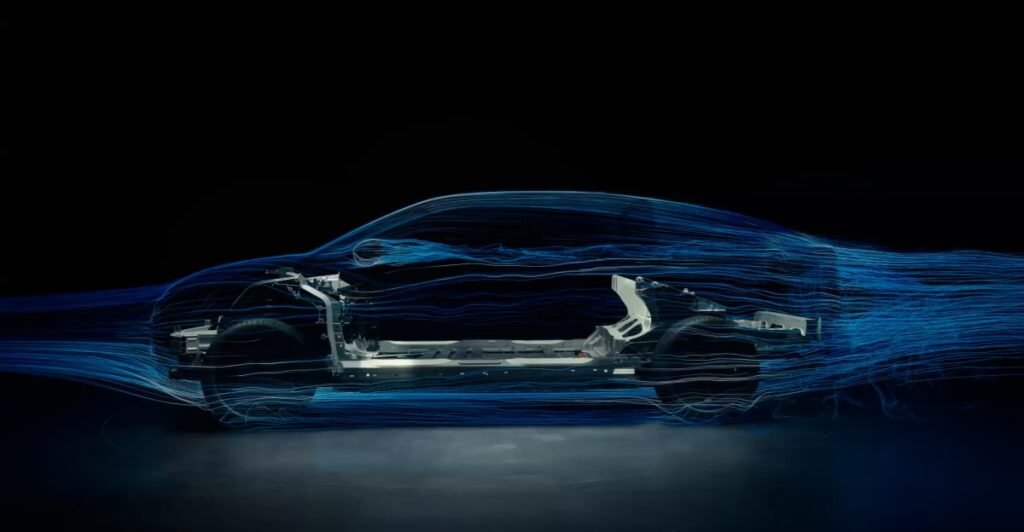
Ford’s push to develop affordable EVs is also a fight against physics itself. Every bit of inefficiency caused by drag robs you of range. At higher speeds, drag becomes even more of a hindrance. If you go twice as fast, the air holds you back four times as much, and you need eight times more power to keep going that speed, Clarke says.
With that in mind, Ford’s engineers got together with some of the brightest minds from Formula One and took direct aim at this problem. They streamlined the UEV’s underbody by making bolt holes shallower, carefully routed airflow around tires and suspension, and shaped certain components to hide the front tire wake behind the rear tires. Bounty estimate? 4.5 miles of range added.
The side mirrors also needed a rethink. Rather than using separate motors for mirror adjustment and folding, Ford merged both functions into a single actuator that moves the entire mirror body. This allowed the mirror to be more than 20 percent smaller than normal, reducing mass, cost, and drag. Bounty estimate? 1.5 miles of additional range.
Weight is another enemy of aerodynamics. To slim down, Ford is for the first time using large aluminum unicastings, which the automaker estimates will deliver more than a 27 percent weight improvement compared to competitors. For context, the Ford Maverick uses 146 structural parts in its front and rear structure. The new midsize electric pickup will use just two.
Ford also aims to slash its battery costs by adopting cheaper LFP batteries that eschew cobalt and nickel, two minerals that are among the most expensive to acquire. Using prismatic cells, Ford developed a highly efficient cell-to-structure architecture that effectively turns the battery pack into part of the truck’s skeleton. Tesla is generally recognized as a pioneer in structural batteries; BMW, Volvo, and now Ford are now seeing the gains in efficiency and weight in their use.

The UEV Platform will be Ford’s first crack at a zonal wiring system, rather than one that is a domain style. A zonal architecture means fewer electronic control units (ECUs), less wiring, and most importantly, decreased production cost. Tesla pioneered the use, and it has since been adapted by several EV-only shops, including Rivian and Scout.
But Clarke challenged the idea that Ford was simply chasing those other automakers in the adoption of a zonal architecture. The term itself is often used in marketing, he argues, despite actually referring to a form of zonal aggregation in most vehicles, where ECUs mainly serve to shorten wiring harnesses while logic remains centralized.
“In reality, very few vehicles that exist in the world are actually zonal architectures,” he added.
In contrast, Ford’s approach moves that logic closer to where functions physically occur in the vehicle, Clarke says. This reduces harness complexity further and allows compute resources to be used more dynamically across the car, depending on what functions are needed at a given time.
Ford extends this consolidation to power electronics as well. The DC-to-DC converter and the AC charger now share a single board and components in one compact module, which also manages power distribution and battery management, and can provide AC power to a home during an outage. By grouping these systems together and consolidating shared components, Ford created a small, serviceable module known as the E-Box.
There are tradeoffs, of course. With 400-volt architectures, Ford’s new EVs won’t charge as fast as 800-volt Hyundai and Kia EVs, for example. Clarke explained that after extensive internal studies, the team concluded 800-volt systems don’t provide any meaningful charging or powertrain advantage for this vehicle segment. And Ford wanted flexibility to support not only lithium iron phosphate batteries but also future chemistries, which will be more straightforward at 400 volts.
In addition to battling physics, Ford is also fighting political headwinds that are directly contributing to a slowdown in EV sales growth. But Clarke says that the company’s future success never depended on incentives like tax credits, which Ford always viewed as “icing on the cake.”
As a 122-year-old legacy company with a sprawling network of suppliers, Ford was always going to lag behind more vertically integrated companies like Tesla in developing software driven EVs. But the UEV project begins the necessary work of bringing as much of those systems and components under Ford’s direct control, Clarke says, so the company doesn’t have to negotiate with third-party companies about future feature improvements.

In a video presentation, Ford teased some of the designs under consideration for its future truck. In contrast to most of the trucks today, Ford’s new electric pickup will be more aerodynamically designed, with an angled hood and teardrop-shaped roofline. Not your average high-riding truck with a blunt front-end, but rather another egg-shaped EV — a design trend that has been criticized for being overused.
Clarke explains that if the aerodynamicists worked alone, the result would likely be a pure teardrop shape, which would be impractical and undesirable as a truck. Instead, by embedding aerodynamic experts alongside Ford’s other designers, each decision becomes an opportunity for shared learning.
“You can be the judge when you finally get to see the truck,” he added. “We know we want people to desire it immediately. They have to want to buy it. They have to like the way that it looks.”
You may be interested

Lana Del Rey Releases New Single ‘White Feather Hawk Tail Deer Hunter’
new admin - Feb 17, 2026[ad_1] “Whoopsie daisy! Yoo-hoo!” Lana Del Rey is back, all right. The singer-songwriter has officially returned with “White Feather Hawk…

Yankees’ Aaron Judge admits early frustration in team’s slow offseason
new admin - Feb 17, 2026[ad_1] NEWYou can now listen to Fox News articles! Turning 34 in April, it's becoming more and more likely that…

This backup camera cleaner hides behind your license plate
new admin - Feb 17, 2026A Vermont-based startup has announced a new upgrade kit that adds a remotely triggered backup camera cleaner to your car.…