



First supermoon of the year will appear tonight. Here’s what to know.

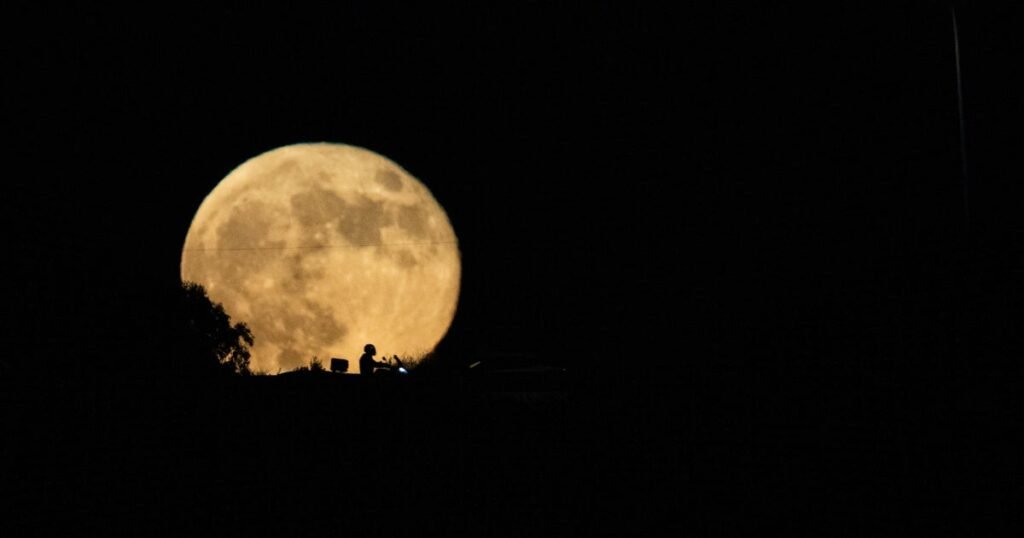
The moon will appear slightly larger and brighter Monday night during what’s known as a supermoon.
October’s supermoon is the first of three this year. It happens when a full moon is closer to Earth in its orbit. That makes the moon look up to 14% bigger and 30% brighter than the faintest moon of the year, according to NASA. The subtle difference happens a few times a year, sometimes coinciding with other astronomical events such as lunar eclipses.
“It’s not really very unusual,” said Derrick Pitts, chief astronomer with the Franklin Institute in Philadelphia.
Everyone in the world can see a supermoon without special equipment, if the skies are clear. But the difference can be tough to discern, especially if people haven’t observed the regular moon on the nights leading up.
“If you go out and just look at the moon when it’s very high in the sky, there is nothing relative to it to give you an idea of how big it looks,” Pitts said.
In the latest viewing, the moon will pass within about 224,600 miles of Earth. The closest supermoon of the year is slated for November, followed by another in December.
The spectacles continue in 2026 with two lunar eclipses: a total eclipse across much of North America, Asia and Australia in March, and a partial one in August across the Americas, Africa and Europe.
Why does the moon appear bigger and brighter during a supermoon?
Like Earth’s orbit around the Sun, the moon’s orbit around Earth is elliptical, or oval-shaped. This means it’s positioned at different distances from the planet depending on the time of the month. The distances range from about 226,000 miles and 251,000 miles, according to NASA.
When the moon is hovering around one of those closer distances along its path in orbit, and there’s also a full moon, it becomes a supermoon. The proximity to Earth can make the moon appear bigger to skywatchers on the ground. Sunlight reflecting off the moon can also appear brighter, NASA says.
Supermoons only happen three or four times a year, since the moon’s closeness to Earth rarely coincides with monthly full moons. They aren’t identical, either. Astronomers generally consider a full moon to be “super” if the moon’s position in orbit is at least 90% of the distance from its farthest point to Earth in the ellipse to its closest. The absolute closest point is called the perigee.
You may be interested

I don’t miss the camera on the Ray-Ban Meta Audio glasses
new admin - Oct 13, 2026The other day I whizzed past several people while running in the park, my playlist blasting at full volume. The…

Diesel futures signal higher prices to come, despite Trump moves
new admin - Oct 13, 2026[ad_1] Diesel futures traded sharply higher Tuesday, as doubts mounted about the likely impacts of the Trump administration’s latest efforts…

Iran is increasingly targeting British military sites, MI5 boss says
new admin - Oct 13, 2026LONDON — Iran is escalating its campaign of threats on British soil, expanding attacks beyond dissidents abroad and Jewish sites…