


Fewer Immigrant Families Submitting FAFSAs in California

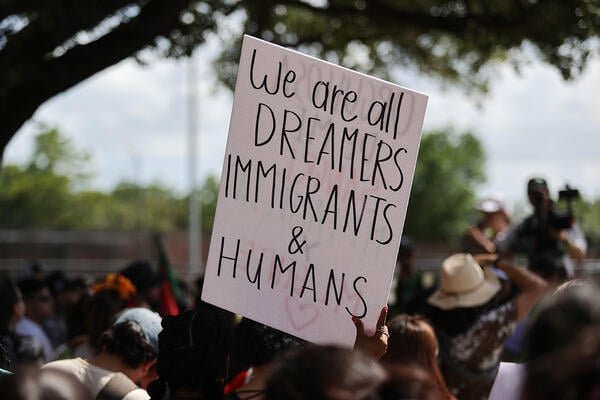
Applications for the California Dream Act, which allows eligible undocumented students to receive state aid, are down by 41 percent.
Reginald Mathalone/NurPhoto/Getty Images
California is seeing a steep decline in federal student aid applications from students whose parents aren’t U.S. citizens.
The California Student Aid Commission presented data last week showing that Free Application for Federal Student Aid submissions from this group, commonly referred to as mixed status, are down by 3,000, or 8 percent compared to the previous year. Applications for the California DREAM Act, which allows eligible undocumented students to receive state aid, are down by 41 percent. Over all, FAFSA applications in the Golden State are up 8 percent, according to federal data.
“The consequences of this trend for undocumented students and mixed-status families, as well as for California’s workforce, are dire,” said Nicole Kangas, public information office for the commission, at a media roundtable last week.
Kangas and others say students’ fears about exposing their loved ones to immigration enforcement or over how the federal government will use their application information are deterring them from applying for aid. Federal law does prevent the Education Department from sharing students’ information, but fears have persisted amid the administration’s mass deportation campaign.
“When students have to weigh their financial and educational futures against the safety of their families, we are facing a college access crisis that further deepens inequities for immigrant-origin families,” Kangas said, adding that the state has about 3.3 million students from mixed-status families, which represents “a core part of California’s student population and workforce future.”
CSAC has called for a coordinated campaign among K–12 school systems, colleges and other groups to encourage students to apply for the state and financial aid they are eligible for. CSAC officials repeatedly pointed out that the California DREAM Act Application has a safe option, noting that there are legal protections in place to protect students’ information.
“California has spent years telling students that college is the pathway to opportunity, but for many immigrant students and mixed-status families, that message now collides with another reality—fear,” Kangas said. “That fear is reshaping college-going behavior in California in real time, and if we do not respond with urgency, we risk losing an entire generation of students, not because they lack talent, but because they lacked awareness of CADAA as an option and because they lacked a sense of safety.”
Persistent Concerns
Since President Trump took office, federal officials have sought to tap various federal data sources as a way to identify immigrants who are living in the country without authorization and aid in the administration’s mass deportation campaign. For instance, they’ve requested public housing data and records of who applied for the Supplemental Nutrition Assistance Program.
But under federal law, the Education Department can’t use the information that students submit for anything other than awarding financial aid.
“Even when strong privacy protections do exist, confusion will often spread faster than any reassurance that can be provided, especially through social media, peer networks, rumors,” said Justin Hurst, government relations and advocacy manager at CSAC. “So not applying often feels like the safest choice for an individual.”
The National College Attainment Network, an association for college access organizations, encouraged its members to advise mixed-status families on a case-by-case basis about the risks and benefits of applying for federal aid.
“NCAN believes mixed-status families should make a thoughtful, well-informed personal decision about whether to submit identifying information to the federal government through the FAFSA,” the organization said in guidance shared last fall.
That guidance also noted that the organization could not “assure mixed-status students and families that data submitted to [ED], as part of the FAFSA process, will continue to be protected.”
“While the Office of Federal Student Aid has confirmed that ED has not and will not share information that breaks the law, we understand many families’ confidence in this statement may not be as certain under the current administration,” NCAN wrote in the guidance.
Zenia Henderson, the chief program officer at NCAN, said that she wasn’t surprised by the latest data from California.
“Given the fear that we’ve heard about and that we’ve seen from families … it’s understandable that it’s impacting other parts of life like getting a college education,” she said. “I wouldn’t be surprised if other states [see] declines.”
The Education Department did not respond to a request for comment.
You may be interested

How LGBTQ+ Leaders Are Navigating the Political Moment
new admin - Aug 17, 2026[ad_1] When the group LGBTQ Leaders in Higher Education started taking shape in the 2000s, it consisted of a handful…

'Best war film ever made' streaming now on Netflix
new admin - Aug 17, 2026One 2014 film, that's been called the 'best' war film ever, is now on Netflix Source link

U.S.-Iran memorandum of understanding deadline about to expire without a deal, amid stalemate
new admin - Aug 17, 2026Adm. Brad Cooper, the head of U.S. Central Command, praised the crew of the USS Abraham Lincoln after he visited…