
Faculty, Grad Workers Left Out of Va.’s Unionization Bill

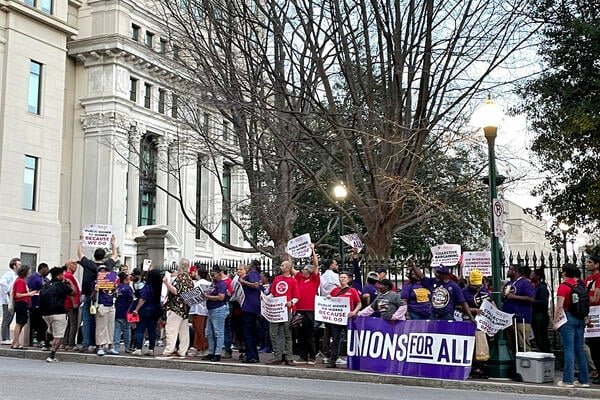
Democratic Virginia lawmakers are on the cusp of a major victory to expand worker power.
Last year, they sent Republican governor Glenn Youngkin legislation to end the state’s longtime ban on public employees bargaining collectively. The ban stretched back to the General Assembly’s squelching of a 1940s unionization effort by Black workers at the University of Virginia Hospital.
But Youngkin shot the bill down, writing in a veto message that it “would threaten the funding and delivery of critical state and local services and will collectively costs [sic] taxpayers hundreds of millions of dollars a year.”
However, this month, Democrats passed a similar bill and are sending it to their fellow Democrat, Gov. Abigail Spanberger. If she signs Senate Bill 378, Virginia will no longer be among the multiple Southern states that fully ban collective bargaining at public universities.
There’s a big caveat to SB 378, though. The bill exempts several categories of public workers from collective bargaining rights, including judicial branch employees, General Assembly staff and public college and university workers, “except for service employees.” That means faculty and graduate student workers at state institutions will continue to lack the right to form officially recognized unions that colleges and universities must negotiate with.
“It’s devastating,” said Harry Szabo, president of the unrecognized United Campus Workers of Virginia union, which seeks to represent all workers on public campuses.
Federal law gives higher ed workers at private institutions nationwide the right to bargain collectively with National Labor Relations Board recognition. Before President Trump retook power and disrupted that board’s makeup, higher ed unionizing was surging. An August 2024 report from the National Center for the Study of Collective Bargaining in Higher Education and the Professions found that unions had grown to represent roughly 38 percent of grad workers and more than a quarter of faculty.
But states are in charge of granting—or denying—workers at public colleges and universities the right to unionize, and setting up state-level boards to oversee the process.
Szabo said they got into organizing because they lacked health-care coverage as an adjunct faculty member. They are currently a non-tenure-track term faculty member at Virginia Commonwealth University.
“Being excluded feels like it’s completely unreflective of the actual wages and working conditions that we have,” Szabo said. “It feels like we’re being caricatured as some kind of ivory tower elites when a lot of us struggle to put food on the table. It’s both hurtful and insulting.”
Tim Gibson, president of the Virginia American Association of University Professors Conference and a tenured associate professor at George Mason University, said the bill, even with the exceptions, “is a really huge historical achievement for the governor and the Legislature, to extend this very basic human right of collective bargaining.”
But, Gibson also said, “you can’t build a world-class university on the backs of exploited faculty and graduate students.”
There’s still a chance that faculty and grad workers could be included in SB 378. Virginia’s Constitution gives the governor the right not just to sign or veto legislation, but to amend it and send it back to lawmakers for approval of her changes.
Spanberger hasn’t revealed what she’ll do; her press secretary simply told Inside Higher Ed in an email that “the Governor is carefully reviewing and considering all legislation on her desk.” Gibson said his organization is calling on the governor to include those excluded.
Szabo noted that SB 378 also excludes some higher ed staff. Specifically, it only extends collective bargaining rights to higher ed employees who work at least 16 hours per week “in connection with the care or maintenance of property, including a janitor, security officer, groundskeeper, concierge, clerical and administrative assistant, door staff, maintenance technician, handyman, superintendent, elevator operator, window cleaner, building engineer, or food preparation services worker.”
Lost in Committee Meetings
The original version of the bill, introduced by Senate Majority Leader Scott Surovell, extended collective bargaining rights to all public higher ed workers. Surovell said it’s unclear why there was opposition to faculty and grad students being included in the final draft. “I was never given a reason,” he said.
The version the Senate originally passed excluded home health workers, Surovell said, while the House’s version excluded all public higher ed workers. With the chambers not on the same page, the bill went into conference committee meetings, which legislatures use to hash out disagreements between House and Senate versions of bills.
What emerged on March 14, the last day of the General Assembly session, was the current iteration of the bill. Surovell said Kathy Tran, the Democratic delegate who pushed the bill on the House side, told him there weren’t enough House votes to pass it if it included all higher ed workers.
“I couldn’t risk the entire bill going down,” Surovell said, so he accepted the compromise. He said the bill gives roughly 690,000 new employees the ability to unionize, adding that “it’s a big, historic bill, and I’m proud to be part of it, and it’s way overdue.”
Tran didn’t return Inside Higher Ed’s requests for comment.
Major universities that Inside Higher Ed reached out to didn’t say whether they lobbied against including faculty and grad workers in the bill, nor did they state positions on the legislation. Spokespeople for the University of Virginia, Virginia Commonwealth University and Virginia Tech said in emails that their institutions don’t comment on “pending legislation.” George Mason University sent a statement saying it “has taken no formal position on collective bargaining legislation. We will work with whatever the General Assembly and the governor ultimately agree to.”
Even if faculty and grad workers are left out of the legislation, Szabo said they are proud of United Campus Workers’ lobbying work and its support for other groups of workers to be included.
“I really think that it’s worth fighting for the future of higher education, and I think that organizing ourselves as workers is the way to do it,” they said.
Gibson, with the AAUP, said that if Spanberger “decides not to amend us [in] and continue the conversation in this session, then we will be back next year.”
“If you care about the integrity and the independence of higher ed in Virginia and in the nation at large, then you need to empower faculty and students, because when our academic freedom, when the integrity of the university is under attack, it’s always faculty and students who rise to its defense,” Gibson said. “Administrators, not so much.”
You may be interested

How Therapy Saved My Life
new admin - Mar 24, 2026[ad_1] Lily Cornell Silver, daughter of the late Soundgarden frontman Chris Cornell, grew up feeling shy about making her own…

Meta’s reckoning over kids safety is in the hands of two juries
new admin - Mar 24, 2026Two juries are currently deliberating a series of cases that could either usher in a legal reckoning for Meta, or…

Meghan Markle’s chic jumper is perfect for spring | Royal | News
new admin - Mar 24, 2026[ad_1] The first hint of spring sunshine has finally landed, but let’s be honest – in the UK, that still…