




Faculty Concerned About ASU’s New AI Course Builder

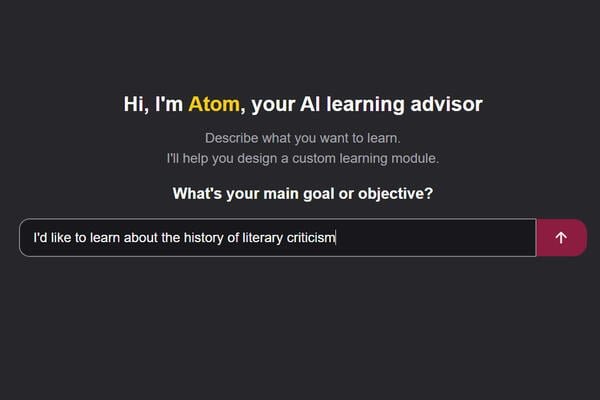
Arizona State University soft launched a web app earlier this month that allows anyone, for $5 per month, to create an apparently unlimited number of customized “learning modules” using artificial intelligence. The AI chatbot, called Atom, uses online instructional materials from ASU professors to create a course that’s tailored to the goals, interests and skill level of the user. After asking a handful of questions and processing for about five minutes, Atom debuts a personalized course that includes readings, quizzes and videos from a half dozen experts at ASU.
But several professors whose content Atom pulls from were surprised to learn that their materials—including video lectures, slide decks and online assignments—were being perused, clipped and repackaged for these short online course modules. The faculty wasn’t told anything about the app, ASU Atomic, they said.
“I was really taken aback to see my face looking back at me a few moments later,” said Chris Hanlon, a literature professor at ASU. After learning about Atomic, he prompted the AI to create a module on the history of literary critique—something he knew a lot about. He called the result “Frankensteinian.”
“One video of me was very modified from its original form—it was something I had uploaded to Canvas a long time ago. And then I saw many other videos of other faculty members … and I contacted them all. Not one of them told me that they had been consulted about this. They never heard of Atomic.”
Faculty concern over the web app highlights ever-present questions about how universities are deploying AI: Where does its seemingly infinite knowledge come from, who owns it and who will benefit from it? And what control, if any, do professors have over how their course materials are co-opted by AI tools and the university officials who sanction them?
At a recent faculty Q&A with ASU president Michael Crow, a faculty member asked about Atomic. Crow seemed surprised by the question, said Michael Ostling, a religious studies professor who attended the meeting.
“He did say that this is an experiment and it’s early stages,” Ostling said. “He was understanding that this was not really ready for prime time. It hadn’t been evaluated yet. It was not being promoted intensively—at least not yet. And he said … that the question [about] curriculum is legitimate.”
According to ASU’s intellectual property policy, the Board of Regents owns the rights to most instructional materials. The board claims ownership of “any intellectual property created by a university or Board employee in the course and scope of employment,” the policy states. Scholarly works—like published research—are excluded unless they are produced with “significant use” of board resources, which includes material produced during work hours while employed by the university. Works of fine art and student works are also excluded.
By uploading instructional content onto Canvas, the learning management system that ASU uses, professors open their intellectual property to much wider distribution, according to Hanlon.
“Part of the agreement that universities enter into when they subscribe to the Canvas platform is that Canvas retains the right to redistribute, to modify, to just simply use in any way it sees fit, content that is uploaded to the platform,” Hanlon said.
As is the case for many AI chatbots still in their infancy, Atom gets things wrong. In the module it designed for Hanlon, it included clips from an old lecture he gave focused on the work and career of 20th-century literary theorist Cleanth Brooks. Throughout the course it called the critic “Client” Brooks.
The video clip was “embedded in other material, some of which appeared to me to be, probably, AI generated, like descriptive material to attempt to contextualize the video and prepare students to understand it,” Hanlon said. “It did not accomplish that … I couldn’t understand why [that part of the video] was selected.”
Ostling is worried that Atomic “will start being used widely, and I have content on my Canvas shelves that would be very inappropriate to show up without context in a course,” he said. “Not only do I think the students will be poorly served because they might learn things that aren’t true, but it could potentially get me in trouble.”
Ostling fears that Atomic could help political actors identify and harass faculty members who teach about race, gender and sexuality, he said. It’s not an unfounded concern—right-wing politicians and social media accounts have used the online syllabus-hosting platform Simple Syllabus to find and dox professors over their teachings.
“It would just be amazingly easy, I think, for a bad actor to get an Atomic account, ask for a course and get a whole bunch of material from classes on conflict in the Middle East, or classes on race and gender, and get what looks like ‘evidence’ of various professors teaching terrible things,” Ostling said. “But that evidence would be false, because we teach carefully, we teach in context, we frame, we do all of the things that teachers are supposed to do to help our students understand what we’re teaching and why. Removed from those frameworks, it can look pretty weird and could be potentially really damaging.”
Still in beta, Atomic is limited as to what it can offer. Inside Higher Ed first asked the AI for a course module on dog psychology, to which it replied that it didn’t have access to materials on animal psychology, behavioral science or veterinary studies, pointing instead to broader STEM course options like statistics. When asked for a module on statistics for journalists, it noted that journalism instruction—a discipline for which ASU is well-known—wasn’t available, either.
On the home page, the app advertises its use for learning “sought-after business skills,” including learning about AI, how to build a business, project management, investing and real estate. The website notes that “new content is being added regularly.”
An ASU spokesperson did not say what AI model Atom is built on. When asked directly, Atom at first declined to say, but later said it was Anthropic’s Claude. It did not answer any other questions about its training or make. The ASU spokesperson also declined to answer any of Inside Higher Ed’s questions about Atomic and instead shared a short statement.
“A pilot launch of the program began in April,” the spokesperson said. “The pilot explores how ASU can use existing digital content in new ways to reach learners beyond those enrolled in degree programs.”
You may be interested

The Game Takes Aim at Kendrick Lamar — and He Brought Drake With Him
new admin - Aug 21, 2026[ad_1] Last night, Los Angeles rapper the Game released his latest album, The Documentary III, a sprawling 24-track epic in…

Pixel 11 gets in on the digicam trend
new admin - Aug 21, 2026I recently looked back at a photo I’d taken on a smartphone in 2014, and I was struck by just…

Alfalfa sprouts linked to food poisoning illnesses like E. coli and salmonella
new admin - Aug 21, 2026Alfalfa sprouts linked to food poisoning illnesses like E. coli and salmonella - CBS News Watch CBS News Alfalfa sprouts…