



“Epic Disruptions,” AI and Higher Ed Work


Epic Disruptions: 11 Innovations That Shaped Our Modern World by Scott D. Anthony
Published in September 2025
Over the last couple of weeks, I’ve been experimenting with Claude Cowork. The more I integrate this platform into my day-to-day tasks, the more convinced I become that AI will change how work in higher education is done.
It is in this context of thinking about AI as an epic disruption within higher ed that I want to talk about—and recommend—Scott Anthony’s new book, Epic Disruptions: 11 Innovations That Shaped Our Modern World.
Full disclosure—Scott is a clinical professor of business administration at my institution.
Epic Disruptions is not about AI. Scott could have written a book on how AI is disrupting business. His expertise in that area is widely recognized. Perhaps I’ll be able to convince Scott to write a book about how AI might disrupt universities.
What Epic Disruptions can do for our conversations about AI and higher ed is place this technology in a historical context. Not the history of AI; instead, a history of ideas, practices and technologies that are transformational. This transformation can be on a scale as large as countries and geopolitics (gunpowder—Chapter 1) or as narrow as a single industry or product (Pampers—Chapter 9).
For Scott, disruptive innovation is a subset of innovation. Where innovation creates value, disruptive innovation creates value at scale.
Examples from the book range from the introduction of the assembly-line process for automobiles (the Model T—Chapter 5) to the printing press (Chapter 2) to the transistor (Chapter 6).
A disruptive innovation might make a previously expensive product affordable (McDonald’s fast food breakthrough—Chapter 8) or might fundamentally subvert the conventional wisdom of the day (Florence Nightingale—Chapter 4).
What we learn from reading Epic Disruptions is that innovation is, to use Scott’s words, “predictably unpredictable.” In the moment, it is always difficult to predict if a new service, product, method, invention or idea will rise to the level of permanently disrupting the status quo.
Where does this leave us with AI and how universities work?
In the short time I’ve been experimenting with Claude Cowork, the platform has changed how I do my job.
Cowork’s ability to maintain a persistent context across documents, databases, websites, tools and discussions enables me to collaborate with the AI on a wide variety of tasks.
I’m old enough to have lived through the transition from pre-internet to internet academic life. In grad school in the early 1990s, we used computers for everything, but most work was done on local applications and batch processing at the university. My dissertation-writing graduate school days were spent reading journal articles, engaging in conversations, running analyses in SPSS (as a batch job on the university mainframe running VM/CMS) and writing in Word.
Nowadays, I look back longingly on the hours I had for academic work that were not broken up by email, Slack, Zoom and multiple browser tabs. Today, if the campus network goes down, my academic work stops.
We seem to be entering a second phase of higher ed work disruption. Can you do your faculty or staff job if your AI goes down? Today, probably so. Tomorrow, maybe not so much.
The majority of the conversation about AI and higher ed has focused on the technology’s impact on teaching, learning and assessment. My hypothesis is that the real change AI will bring to higher education will be found less in the classroom (digital or physical) and more in the work of the humans employed by colleges and universities.
Think about what a professor or staff member did day to day, hour by hour, in their jobs before there was email and browsers. Now consider what it would mean if AI tools like Claude Cowork made the new way of working at university dramatically different from how we work today.
I suspect that stepping back and taking a wider (historically informed) lens to our current campus AI debates would be wise. Campus committees thinking about AI might want to consider assigning themselves some (pleasurable) homework.
Reading Epic Disruptions will not provide any answers about how AI will change higher education, but the book might help us determine whether we are entering campus conversations by asking the right questions.
What are you reading?
You may be interested

Gold medalists call on IOC to ban Iran over reported wrestler execution
new admin - Mar 24, 2026[ad_1] NEWYou can now listen to Fox News articles! Seven Olympians from multiple countries, including three gold medalists, have condemned…

Google’s Android Automotive is moving from the dashboard to the ‘brain’ of the car
new admin - Mar 24, 2026Google announced a new version of its Android Automotive open-source operating system for software-defined vehicles. Whereas previously Android Automotive operated…

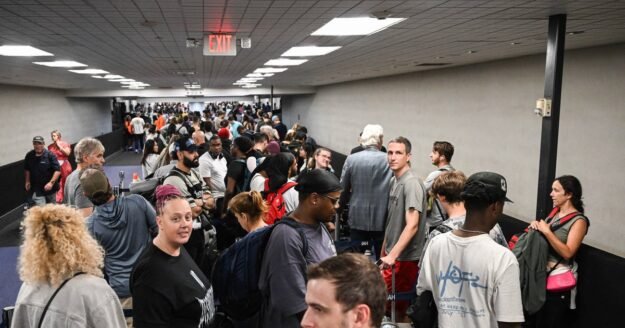
As airport delays continue, can enrolling in TSA PreCheck save you time?
new admin - Mar 24, 2026As many travelers continue to face long security lines at major airports across the country, enrolling in TSA PreCheck remains one option…