




Eldercare workers leading America’s job growth are under pressure


The U.S. added 130,000 jobs in January, according to federal data released this week. But a closer look shows that the lion’s share of this growth came from one specific task: caring for older Americans.
Grouped under the formal categories of “social assistance” and “healthcare,” at-home care services, hospitals and long-term care facilities added 124,000 positions.
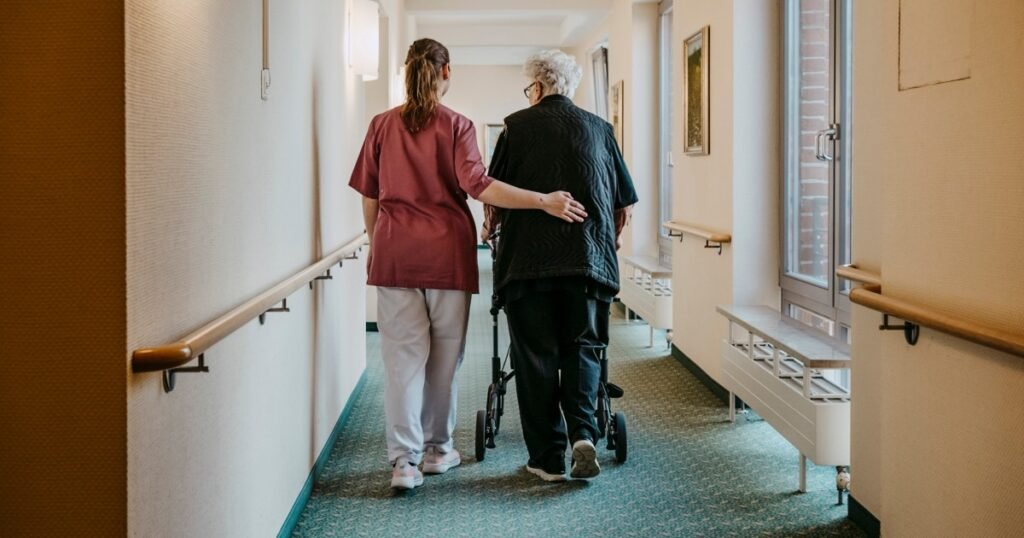
Much of this expansion was among the tens of thousands of aides and assistants who help elderly and disabled people bathe, dress, eat and manage their daily lives. Their work is essential — and booming — but it is also physically demanding and often modestly paid.
The trend underscores a broader shift underway in the American labor market. While recent headlines suggest that employment in the U.S. is resilient, much of today’s job growth is not in the corporate offices or on the factory floors that have traditionally powered economic expansion. It is concentrated instead in labor-intensive care and service-based roles.
As the country ages, demand for long-term care is projected to keep rising. At the same time, immigration restrictions, falling birth rates and sweeping Medicaid funding cuts are narrowing the pipeline of workers willing, or able, to fill these roles.
Low pay, high demand
Health care spans some of the highest-paid professions in the country. Surgeons can earn more than $450,000 annually, data from the federal Bureau of Labor Statistics shows. But physicians are not the people driving the surge in health care work that amounted to more than 700,000 new jobs last year.
Nationwide, nearly 4 million people, most of them women, work as home health or personal care aides, per the BLS. Another roughly 1.5 million work as nursing assistants.
Pay for many of these roles remains modest. Home health and personal care aides earn a median of about $16.82 an hour, or roughly $35,000 a year. By comparison, the federal poverty level for a family of four is $32,150.
Nursing assistants earn a median of about $19.84 an hour, or roughly $41,000 annually. Both figures sit well below the national annual median wage of $49,500.
“When we talk about the direct care workforce, we’re talking about people who are providing typically long-term care services to older adults and younger people with disabilities,” Priya Chidambaram, senior policy manager at KFF, a nonpartisan health policy research organization, told NBC News in an interview.
The direct care workforce is overwhelmingly female, about 87%, and more than a quarter are immigrants. Roughly 11% are noncitizen immigrants and 17% are naturalized citizens, according to KFF’s analysis of federal data. About 40% of workers are at least 50 years old. Care at home is even more dependent upon immigrants, with around 1 in 3 home health workers foreign-born.
Many enter the field after caring for a family member at home.
“We see some people entering the workforce just from their own personal experience,” Chidambaram said. Others want to work in health care, but encounter financial or educational hurdles that make a shorter certification program for a direct care role more attainable than a nursing degree.
Training requirements vary by state. Nursing assistants typically complete certified nurse aide training, while home health and personal care aides often take short certification courses. Roughly half of direct care workers have a high school education or less.
Despite relatively low educational barriers, the work itself is anything but easy.
“It’s emotionally and mentally and physically demanding work,” Chidambaram said. “The financial benefits associated with the work don’t meet up with the demands of the work itself.”
Alyssa Crockett, a licensed practical nurse (LPN) currently working in long-term care, described the reality on the ground in a social media post: “We cannot do everything. It’s so messed up. My 12-hour shift? I get 25 minutes per person. … How is this possible?”
“I’m truly at the point of realizing that I’m going to lose my nursing license working in long-term care,” she continued, “which sucks, because it’s my entire heart. We need to do better.”
Not surprisingly, turnover within the profession is high. Studies show annual turnover among nursing assistants can approach 100%, and home care roles see turnover rates of around 75%, reflecting both burnout and unstable hours.
An aging population
The strain on this workforce is building at the very moment the country needs it most.
The share of Americans ages 65 and older is projected to reach over 20% by 2035, meaning roughly 1 in 5 Americans may require some form of care. Baby boomers are moving deeper into their 70s and 80s, and more older adults say they want to age at home rather than in institutional settings.
“All these things are combining to create this inevitability that there will not be enough of a workforce to meet the demands of an aging population,” Chidambaram said.
Immigration policy adds another layer of uncertainty. Visa categories typically used by highly specialized workers, such as H-1B, are less common for these roles. Instead, employment-based immigrant visas and temporary protected status (TPS) holders are more likely to be represented, though detailed visa breakdowns are not publicly available.
The Trump administration has tightened pathways for legal immigration, including pausing or restricting some employment-based immigrant visas and ending TPS designations for several countries that have historically been the source of large numbers of care workers in American facilities.
This raises questions about how future staffing needs will be met: “This workforce will be heavily impacted by federal policy as a result of immigration changes,” Chidambaram said.
Medicaid, which pays for the majority of long-term care services in the United States, also plays a central role. Cuts to the program — including approximately $1 trillion in reductions passed in recent legislation — could ripple through agencies that employ aides and nursing assistants.
Reduced funding would likely squeeze the workers themselves. The most probable outcome is that “direct care workers are going to be paid less somehow,” said Chidambaram.
While some economists have questioned whether an economy so dependent on elder care could eventually face a demographic drop-off once the baby boom generation passes, researchers say the more immediate risk is the opposite: not having enough workers to meet the coming waves of demand.
“We have this growing demand, and it sounds like the supply is going to reduce pretty significantly over the next few years,” Chidambaram said, noting that the workforce serves not only aging Americans but also younger people with disabilities who rely on long-term care.
It’s a strain that’s already building — and one that will not fade quickly. As Chidambaram put it: “It’s going to impact us for the next 30 years.”
You may be interested

To Reach Students, College Marketers Prioritize AI Visibility
new admin - Feb 13, 2026[ad_1] When Abby Isle’s daughter, now a senior in high school, began looking into colleges in late 2024, she had…

Households told to stop eating dessert ‘immediately’
new admin - Feb 13, 2026This is due to the product being labelled with the incorrect use-by-dates. This mislabelling makes the products “unsafe to eat”.…

State Higher Ed Officials Do Away With the Term “Noncredit”
new admin - Feb 13, 2026[ad_1] A couple of years ago, the Louisiana Board of Regents decided to ditch the term “noncredit” as a way…