



ED Warns Colleges With High Student Loan Nonrepayment Rates

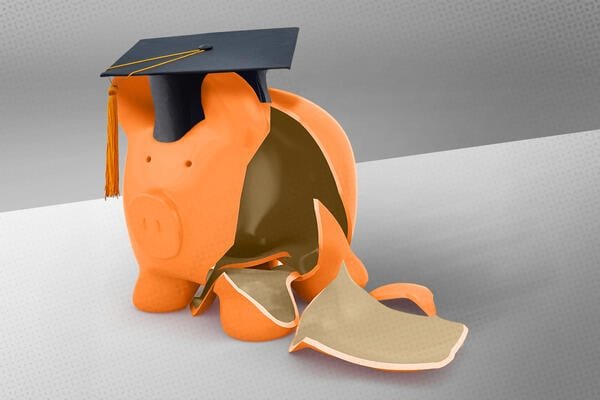
A recent analysis estimates that 12 million borrowers are behind on student loan payments.
Photo illustration by Justin Morrison/Inside Higher Ed | DenisKot and EyeEm Mobile GmbH/iStock/Getty Images
At least 25 percent of borrowers at more than 1,800 colleges and universities are behind on repaying their student loans, according to federal data released last week that offers more insights into the growing delinquency and default crisis.
The Education Department says the latest batch of nonrepayment data serves as an “early indicator” of what institutions could be at risk of failing a related accountability measure based on the percentage of borrowers who default on their loans. The list includes a range of institutions. Nearly two-thirds are for-profits, while public institutions comprise a quarter. At 122 institutions, more than half of students are at least 90 days behind on their loans.
In light of this data, the Education Department says institutions of higher education must do more to ensure their students and graduates repay federal student loans.
“Student borrowers have an obligation to repay their loans, but institutions also share a responsibility to ensure their students are prepared to enter repayment and understand the consequences of nonpayment,” Education Under Secretary Nicholas Kent said in a news release. “Institutions cannot benefit from taxpayer dollars while ignoring the fact that a significant share of their students are not well-prepared to repay their loans. It’s time for institutions to step up or risk losing access to federal student aid.”
The release also highlighted best practices for institutions’ default-management strategies, such as creating a web portal aimed at borrowers that includes financial literacy resources.
Loan delinquency and default rates are up significantly since the Trump administration resumed collecting on student loan debt last year; collection had been paused since the COVID-19 pandemic. An analysis of student loan data from the American Enterprise Institute, a conservative think tank, published last fall shows that nearly 12 million borrowers are behind on repayment.
Preston Cooper, a senior fellow at AEI who studies student loans and the analysis’s author, said ED’s campaign aims to “encourage colleges to take a little bit more responsibility for this delinquency and default crisis because, after all, it was colleges that were the ones that benefited from making these loans available.”
Since the 1990s, colleges have faced penalties based on the cohort default rate—a measure of how many borrowers at given institution have defaulted on their loans. But Cooper said that rule hasn’t been a significant issue over the past two decades because few institutions have actually exceeded that limit. Now, as student loan delinquency rises across the board, “a lot of schools are in that danger zone,” he said.
An institution risks losing access to federal financial aid if its cohort default rate hits 30 percent for three consecutive years or 40 percent in one year.
An institution’s nonpayment rate is not the same as their CDR; the nonpayment rate includes any student who hasn’t paid their loans within 90 days, while the CDR includes only those who have defaulted, which happens after 270 days of missed payments. The cohort default rate has been low for years because of payment pauses during the pandemic, but that could be changing now.
“I think the department’s doing the right thing and disclosing this information for institutional awareness,” said Jordan Wicker, senior vice president of legislative and regulatory affairs for Career Education Colleges and Universities, an organization that represents for-profit institutions. “I do think it’s important to make the distinction between nonpayment rates and cohort default rates, because it’s cohort default rates on which sanctions are applied. Publishing nonpayment rates, while helpful … can also be a very intimidating thing.”
He added that, while institutions play an important role in enforcing loan repayment, “there are a lot of exogenous variables going into repayment rates that need to be considered.”
Surveys of student loan borrowers show many are experiencing great financial hardship; more than four in 10 borrowers say they must choose between paying off their loans and putting money toward basic needs like food and housing. Many borrowers are also unaware of debt-relief programs like income-based repayment.
The majority of the institutions listed in ED’s data release are for-profit colleges: that includes everything from small vocational schools to the country’s biggest online universities, like the University of Phoenix, which has a 25 percent nonpayment rate among 181,800 borrowers reviewed by ED. Among the 434 public institutions on the list are some of the largest community colleges in the country, such as Ivy Tech Community College, the two-year system in Indiana. Almost all are open-access institutions.
Wicker said that for-profit institutions have a strong track record of reducing defaults; between 2010 and 2020, he said, default rates went down “significantly” among for-profit institutions.
“We feel strongly that the sector is very responsive to this, understands its responsibility, and we’ve done it before, so we can do it again,” he said. “But I do think that is, again, not unique to the sector; all institutions are facing these headwinds that are outside of institutional control when it comes to borrower behavior.”
You may be interested
Experts say people who eat 1 type of food are more likely to live to 100
new admin - Feb 24, 2026One popular food choice may help you live longer, especially in older age (Image: Maskot via Getty Images)Nutritional choices vary…

These ‘incredibly beautiful’ earrings are just like Princess Kate’s | Royal | News
new admin - Feb 24, 2026[ad_1] Princess Catherine delivered a standout jewellery moment at last night’s BAFTAs, wearing the breathtaking Greville Chandelier Earrings – valued…

This limited edition Death Stranding-inspired tablet is the coolest computer I’ve ever touched
new admin - Feb 24, 2026The Asus ROG Flow Z13 was already a unique beast. It’s a chunky gaming tablet with impressive AMD Strix Halo…