


ED Rejects Call to Expand Access to Higher Grad Loan Caps

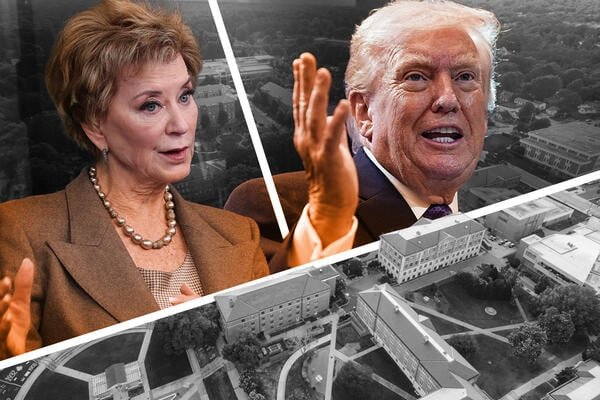
President Trump signed the loan caps into law last summer, but the Education Department had to craft regulations that detail how the limits will work.
Photo illustration by Justin Morrison/Inside Higher Ed | Win McNamee/Getty Images | Aaron Schwartz/Getty Images | Ryan Herron/E+/Getty Images
The Trump administration finalized regulations Thursday that will put in place new loan limits for postbaccalaureate degrees as well as make changes to how students repay their loans.
The finalized rule maintains the department’s limited definition of “professional.” This means that access to the highest amount of federal loans—$50,000 per year and $200,000 in total—will be limited to 11 degree programs: pharmacy, dentistry, veterinary medicine, chiropractic, law, medicine, optometry, osteopathic medicine, podiatry, theology and clinical psychology.
All other degree programs will be deemed “graduate,” and students will only have access to $20,500 per year or $100,000 in total. Congress passed the loan caps last summer, and the final rule is the last step of the department’s monthslong rule-making process.
This definition is exactly the same as what a panel of policy experts and advisers agreed to when negotiating the regulations last fall. But it faced significant pushback from the committee members. That carried over into the public comment period, when tens of thousands of respondents—ranging from students to institutions, trade associations and bipartisan lawmakers—shared their thoughts on the proposal. The vast majority of comments were negative.
Critics argue that the department’s definition violates congressional intent by taking a nonexhaustive list of example programs pulled from the Higher Education Act and making it exhaustive. The consequence, they say, is that students will no longer be able to finance key, high-cost, high-demand degrees—many of which involve health care. As a result, enrollment in those programs will decline and the nation could soon face a shortage of nurse practitioners, physical and occupational therapists, audiologists, and more. Other non–health care–related degrees affected include education and social work.
In response to the comments criticizing the professional definition, ED officials argued their approach “provides a clearer and more uniform boundary than commenter-suggested approaches that hinge on program title, generalized licensure concepts, or case-by-case characterizations of professional status.”
The rule currently posted to the Federal Register is the unpublished version. The formal published version will go up May 1, but no changes are expected between now and then. The rule will take effect July 1.
This is developing story. Inside Higher Ed will have more coverage throughout the day.
You may be interested

AI ‘content creators’ are getting harder to spot
new admin - Jun 07, 2026This is The Stepback, a weekly newsletter breaking down one essential story from the tech world. For more on AI…

Steven Spielberg watches scene from “Close Encounters of the Third Kind”
new admin - Jun 07, 2026In this web exclusive, Steven Spielberg, director of the new film "Disclosure Day," walks Turner Classic Movies host Ben Mankiewicz…
5 taken to the hospital after strong winds at NCAA tournament in West Virginia
new admin - Jun 07, 2026Five people were taken to the hospital for treatment of injuries sustained when a strong wind tore through an area…