

Colleges Use 250th to Reflect on U.S. History

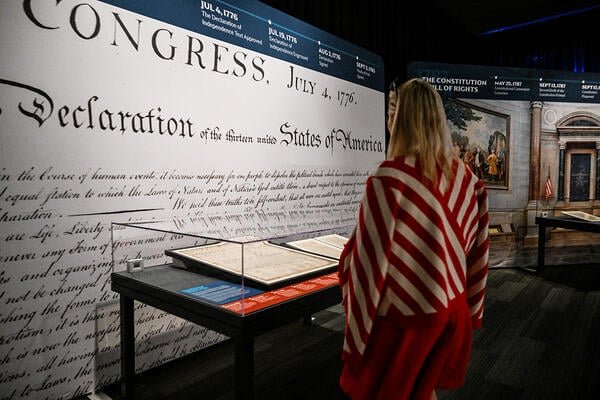
Colleges and universities are seizing the 250th anniversary of the signing of the Declaration of Independence as an opportunity to facilitate community reflection about the complexities of the nation’s history—and what it means for the future of democracy.
That reflection has taken on many forms, including essay contests, art installations, lectures, quilting bees, civic dialogue events and film screenings. And much of the semiquincentennial programming happening on college campuses this year shares a similar goal: foster respectful conversation about the people, policies and events that have shaped American history—warts and all.
For example, Ohio State University’s America 250 web page says it’s tapping university experts and community voices to “encourage honest exploration of American history.” In Maryland, Towson University is putting on its monthlong America 250: Voices of a Nation celebration focused on honoring “the struggles and triumphs of those who have fought—and continue to fight—for freedom, equality, and self-expression.” And earlier this week, Arizona State University President Michael Crow implored colleges and universities to embrace their role as “instrument[s] of democracy and equality” and “celebrate the sacred messiness of democracy.”
Universities are the ideal forums for those nuanced discussions, said Karin Wulf, a history professor and director of the John Carter Brown Library at Brown University.
“Free inquiry and working in the public interest is inherent to higher education’s work,” said Wulf, who helped launch Brown 2026, a campuswide initiative aimed at highlighting the role of research universities in a democratic society through a series of on-campus lectures, exhibits and oral history projects, among many other events. “As teaching and research institutions, we are committed to exploring the truth as best we can and contribut[ing] to a really full record of the past.”
However, the higher education sector’s approach to commemorating 250 years since the founding contrasts with the more simple, triumphant narrative presented by the Trump administration’s Freedom 250 initiative. Developed in consultation with Hillsdale College and PragerU—two right-wing organizations—Freedom 250’s historical exhibits have prompted historians to call them flawed, inaccurate and the latest effort by the White House to distort and sanitize the ugliest parts of the nation’s past, such as race-based slavery and segregation. (Hillsdale officials have countered that they were aiming to tell a more straightforward narrative that highlights what they consider the most important elements.)
But that contradicts what historians know about engaging people with the past—and how it informs the present and future.
“People are interested in complex history. They don’t want a simple story because they understand that life isn’t so simple,” Wulf said. “The fullest story is both good history and good civics. It helps us to be healthier as a country, but it also [helps professional historians] uphold a commitment to [writing] good history.”
Many of the semiquincentennial commemorations happening on college campuses this year were in the works long before Trump set out to reshape higher education—an effort that’s included funneling millions toward civil discourse programs and prioritizing grant funding for programs that promote a patriotic education. At the same time, the administration has cracked down on a wide range of diversity, equity and inclusion practices and cut grant funding for research focused on race and gender, which has raised concerns about the ability of college faculty and staff to teach what they want. And some Republican state officials are taking a closer look at what faculty are teaching and seeking to remove courses focused on diversity and social justice from graduation requirements.
All the scrutiny colleges and universities are facing right now has added another layer of importance to the programming.
“All of higher education is in a very challenging situation right now. But in many ways. universities have embodied democratic values, and it’s important to reiterate that,” Wulf said. “What better thing could you do for the 250th than talk about democratic values and how we substantiate those?”
‘What’s Next, America?’
At James Madison University, those values have been on display through 250th anniversary–related programming focused on the question “What’s next, America?”
In March, the Madison Center for Civic Engagement held the first of several planned deliberative community conversations, placing students, faculty and staff into small, facilitated groups—representing a mix of political and religious beliefs—to explore big questions about America’s future. And often, that includes discussion of the country’s thorny past.

JMU students are participating in a civic discourse series as part of the university’s 250th events.
“If we’re having conversations about what values we should advance and leave behind, questions about our nation’s history are part and parcel of those questions. We can’t talk about those values without talking about the historical context behind them,” said Kara Dillard, executive director of JMU’s civic engagement center. “Slavery does come up. It raises the question of which values we need to advance as a country that allow us to move ahead [without] jettisoning the past and forgetting it happened.”
Those conversations also tie into broader efforts by JMU—and many other universities—to promote constructive dialogue across differences in this era of heightened political polarization. That’s in part because the early days of the United States were marked by fierce debate.
“The Constitution itself came out of deep deliberation and working across differences. There was contestation about what our democracy should look like. There was give-and-take,” Dillard said. “It’s a living value of the benefit of engaging in dialogue, debate and deliberation to be able to chart a path forward together.”
Telling that story has lessons for the college students of today, who Dillard said are often hesitant to talk about charged topics with peers who may hold different viewpoints.
“Attending one of these forums may be the first time anyone has ever asked them to air an opinion, and they’re having to air it to people who are very different from them, which is scary for students who have grown up in media and community silos,” she said. “They have to grapple with those differences and navigate them to find shared solutions. Many of them have never experienced anything like this, and that’s the beauty of higher education.”
‘Freedom in Progress’
Helping the public understand that discord and division defined American politics even before the country’s founding in 1776 is also a focus for Louise Breen, an associate professor of history at Kansas State University who delivered two lectures focused on the lead-up to the American Revolution at a local farm in Manhattan, Kan., last month.
“The sanitized version is that there was one American ideology that everyone agreed with and the colonists became independent,” she said. “But the fact is that people argued about what liberty meant leading up to, during and after the Revolution because different people had different ideas about how to define liberty … We continue to debate that today.”
In Tallahassee, Florida A&M University raised a similar question as part of its commemoration of the semiquincentennial. Earlier this year, the university held an essay contest open to students and the broader community with the prompt, “What does freedom mean to you?”

The winners of FAMU’s America 250 essay contest.
“We wanted to get to know students and how their perspective enhances the conversation,” said Kendra Mitchell, an associate professor of English at FAMU and director of the university writing center. While some reflected on personal experiences, others grappled with bigger political issues. But all the stories, Mitchell added, helped advance community conversation about freedom in America.
The winning essay, titled “Freedom in Progress,” explored the evolving definition of freedom by tracing the history of African Americans and charting a vision for the future.
“Freedom in America has never been clearly defined, but has continually evolved through struggle, resistance, and progress. From slavery and Jim Crow to the rise of HBCUs, African American history shows that freedom has often meant overcoming systems of inequality,” wrote Bryce Webb, the FAMU student who won the contest. “The next 250 years of freedom must be spearheaded by equity, opportunity, and justice for all.”
You may be interested

AI won’t save advertising, says Digitas’ Amy Lanzi
new admin - Jul 02, 2026We’ve got a special Decoder today — I had the chance to talk with Amy Lanzi, the CEO of Digitas…

Employers added 57,000 jobs in June, far below forecasts as hiring slowed
new admin - Jul 02, 2026U.S. employers added 57,000 jobs in June, far below analysts' forecasts and signaling that hiring may be losing momentum. By the…

U.S. economy adds 57,000 jobs in June as the unemployment rate dips to 4.2%
new admin - Jul 02, 2026[ad_1] IE 11 is not supported. For an optimal experience visit our site on another browser.Now PlayingU.S. economy adds 57,000…