
Colleges Invest Heavily in Creating a Perfect Campus Tour

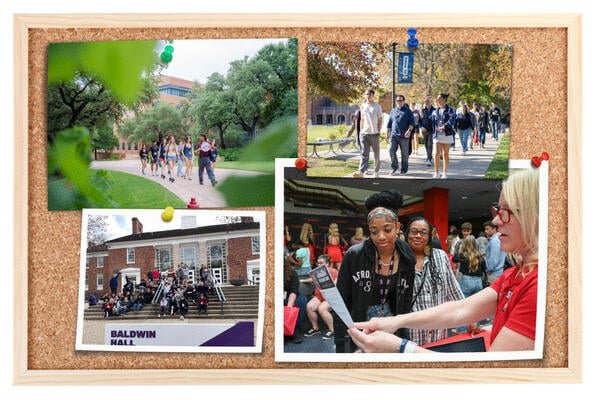
Rides in shiny, branded shuttles. Personalized parking spots and goodie bags. Free flights and hotel rooms across the country. Multithousand-dollar scholarships, and multimillion-dollar welcome centers.
These are some of the ways colleges and universities are investing in campus tours and visits, in the hopes that new and improved experiences will convince more prospective students who visit to eventually enroll.
Campus tours have long been an important way for institutions to capture the interest of students and parents. But during the COVID-19 pandemic, when Americans broadly weren’t traveling or attending in-person events, some campuses launched virtual versions of their tours, raising questions about whether in-person tours would become obsolete.
Six years on, families and institutions alike seem to agree: In-person campus visits are more important than ever. Today’s juniors and seniors, were in elementary school when COVID-19 shut down their schools, leaving much of their generation with social deficits and, in some cases, mental health struggles, whose impact still lingers. That means the amorphous campus vibe—the pure energy of a normal day on campus that every tour seeks to capture—carries special weight.
“As a high school student, their knowledge and their perspective is really oftentimes limited to that which they can find—guides, rankings, U.S. News reports,” said Matthew Lysne, an Oregon-based lawyer who took his daughter, now a freshman at a small liberal arts institution, on a cross-country college tour last year. “She had ideas about” where she wanted to go, he said, but “the thing that she thought would matter most ended up not being [as important]. And it was tours that ended up revealing that.”
Studies have found that whether a student visits campus is one of the strongest predictors of their matriculation. Tours are even more valuable for smaller campuses; in a summer 2026 survey conducted by Niche, a college rankings company, 92 percent of enrollment leaders at small colleges cited the campus visit as the single most important strategy for securing an incoming class.
That’s why some institutions are focused on jazzing up their tours.
Take Hofstra University. When admissions and enrollment leaders realized it was impossible to show the entire 244-acre New York campus in a single walking tour, they invested in an old-fashioned trolley, complete with wooden seats and decked out in Hofstra’s blue-and-gold color scheme, to take visitors on a scenic trip through campus at the start of every tour. The innovation is as much about helping save prospective students’ feet from getting sore as it is about conveying Hofstra’s brand.
“The trolley is as charming as all of the trees—we are an arboretum—and that trolley kind of reflects the charm of our campus,” said Jessica Eads, senior vice president for student enrollment, engagement and success at Hofstra.

A campus tour at Trinity University.
Lucero Salinas/Trinity University
Enrollment leaders at several campuses told Inside Higher Ed that efforts to improve their tours have fueled student interest and led to major year-over-year increases in the number of tours they conduct annually; at Albion College, a small liberal arts institution in Michigan, tours have increased by about 23 percent since 2022, the first year after COVID-19 that in-person tours reached normal levels. At John Carroll University, a Jesuit institution in Ohio, they’ve increased by 46 percent over that period.
“When you’re trying to make the decision about the institution that’s right for you, you can read as much as you want about it, or you can see that big school football game day atmosphere on TV,” said Mandy Konkle, vice president of enrollment management at Albion. “But actually being on campus, surrounded by the people that are going to be in classes with you, that are going to be teaching you—that gives you that feeling in your gut that tells you it’s the right place.”
Changing Priorities
Campus tours have been around since the Vietnam War, when four-year colleges began competing in earnest with community colleges; before then, according to a 2011 Slate article on the history of the practice, students occasionally visited college campuses, but not in an organized way.
Still, the campus tour of 60—or even 20—years ago bears little resemblance to today’s. For one, students need vastly different information now than they did even at the turn of the 21st century. Pre-internet, students learned details like student-to-faculty ratios, cost of attendance and majors offered during information sessions on campus visits; now, that information is readily available online, and students use the visit mainly to gain a sense of the campus. Academic priorities are also shifting; students and families are more concerned than ever about the return on investment of their degree.
But what exactly do today’s students want out of their campus visits?
One thing a swath of institutions have landed on is personalization. That doesn’t just mean swag emblazoned with their names—though that’s part of it. Trinity University in Texas told Inside Higher Ed that students attending tours have VIP parking spots set aside for them by name. Meanwhile, when a student begins a tour at Baylor University, a spire in the welcome center lobby lights up with their name, plus what they want to be when they grow up.
The ability to have a specialized experience on the tours … helped my daughter visualize what her life would really be like.”
—Matthew Lysne, parent
In some cases, personalization means individualized tours focused on what a given student is interested in seeing instead of a set route. Institutions including the University of Dayton and Albion offer one-on-one experiences, where each student is paired with a tour guide who shares their prospective major—or perhaps an extracurricular interest or where they went to high school.
That connection between tour guide and prospective student is key, enrollment leaders said, because it allows the student to ask specific questions about their experience that other guides might not be equipped to answer.
Tour guides at Marquette University in Wisconsin are given a short fact sheet about upcoming visitors so they can choose the best fit for themselves. Zachary End said he gives tours not only to visitors who are interested in one of his three majors—psychology, cognitive science and economics—but also to undecided students, because he, too, started Marquette unsure what he wanted to study.
“I tend to relate to those students better,” he said. “I think being able to talk about how, when you come here, you don’t have to have that figured out, and I didn’t have that figured out, and I’m in a really good space—it’s something that puts not just the students on tour at ease, but it also really puts the families at ease.”
One-on-one tours aren’t new to Marquette, but as demand for tours has increased, the campus has had to hire more tour guides to maintain that ratio, according to Kate Bracciano, director of admissions visits and special programs.
The Rise of Add-Ons
Colleges are also expanding what they include in tours. Some institutions, like Trinity, allow prospective students and their families to select “add-ons” to their tours—additional experiences such as sitting in on a class, eating lunch with a current student or meeting with a particular faculty or staff member.
Tours that offered such add-ons made the biggest impression during Lysne’s tours with his daughter.
“The ability to have a specialized experience on the tours … helped my daughter visualize what her life would really be like,” he said. “So, at one school, she [got] the chance to see the honors college and honors dorm, and a student going to that school in the honors college is going to have a drastically different college experience than someone who’s not … and that was really helpful for her, and it [was] a very big selling point for her on that college.”
Marquette, meanwhile, has begun giving prospective students an opportunity to dive deeper into their academic interests through specialized visits to academic departments, where they can meet with faculty—many of whom have received training about how to talk about the university with visitors, Bracciano said.
“We shared with them some high-level information from different reports of, here are the things that Gen Z is looking for in a campus visit. Here are the questions that families are going to come with that you should be prepared for. You should have someone ready to greet the family—really trying to help them build a structure around those visits and understand strategies or practices to really engage that family in the visit,” she said.

Visitors to Southern Illinois University Edwardsville reading documents about the university and taking a tour.
Some colleges are also sponsoring visits for students who may not have the means to travel. Mount Saint Mary’s University in Los Angeles pays for flights and lodging for out-of-town students attending certain events, such as scholarship interviews and Admitted Students’ Day. Marquette has flown in admitted students and their families from markets beyond the Midwest since 2022, with the program growing each year; last spring, 318 families participated. John Carroll sends buses to bring local high schoolers to attend events on campuses.
Hofstra University, on Long Island, meanwhile, takes a slightly different approach: The university flies in college counselors from across the country for an overnight visit so they can learn about the institution firsthand.
As another incentive to convert tour attendees into enrolled students, some colleges also offer application fee waivers or even scholarships to students who visit campus. Albion College provides $2,000 per year, or $8,000 total, for example, to any enrollee who took a tour.
“We decided to do this because we know that students aren’t going to choose us if they don’t see us, and so it’s important to get as many students to campus as possible,” said Konkle. “So while $2,000 may not seem like a lot to some families for one year, $8,000 over the course of four years is important.”
Back to Basics
To make a positive first impression, some colleges are redesigning or erecting new visitor centers on campus. John Carroll, for one, is creating a brand-new welcome center on the first floor of its library, changing “what used to feel like a large conference room” into “more of a community space,” said Mike Andelbradt, assistant vice president for enrollment and director of admission. “We were going [for] coffee shop–meets–museum, so a lot of soft seating, beautiful furniture. The space is actually an old Jesuit dining room from when our campus was originally founded.”
Trinity University, too, is launching a new welcome center as a sort of “grand entrance” to the university, according to Dean of Admissions Justin Doty, who said the project was first conceptualized a decade ago. Opening in November, the space is tailored to prospective students and will house the institution’s admissions department, but it will also serve as a hub for other members of the campus community. That dual purpose is by design, Doty said: “Any time you put food and drink in any space, it’s going to be activated with current students. So, I think the synergy is actually going to be really cool, to have prospective students and our current Trinity students kind of bumping into each other.”
You want the visit to feel effortless, for there to be no hiccups, no issues. People don’t realize on the back end all of the work that went into making it appear effortless.”
—Alicia Taylor, associate director of admissions at Southern Illinois University Edwardsville
Not every tour innovation has to be pricey or flashy, though. Enrollment leaders also talked about attention to detail; things like cleanliness, landscaping and tour guide expertise all play a huge role in a prospective student’s experience. Institutions have taken steps to improve the visual appeal of their campuses specifically to improve tours; at Southern Illinois University Edwardsville, for example, the chancellor of the university took a tour himself just to spot the imperfections, Alicia Taylor, SIUE’s associate director of admissions, told Inside Higher Ed.
Following his tour, “they completely changed the face of our quad area on campus; everything’s branded. We have beautiful flowers now, everywhere around campus,” she said. “It just feels like a more cohesive, thoughtful kind of space.”
Colleges have also worked to cultivate star teams of customer service representatives, from the front desk workers in the admissions office to the tour guides themselves. At Trinity, being a tour guide is one of the best-paid on-campus jobs, and administrators believe that investment helps them recruit the most knowledgeable and charismatic students, Doty said.
Faced with mounting pressure to bolster enrollment, many college leaders seem aligned on one point: Few expenses are too big—and no detail is too small—when it comes to crafting a flawless campus tour.
“You want the visit to feel effortless, for there to be no hiccups, no issues,” said Taylor. “People don’t realize on the back end all of the work that went into making it appear effortless.”
You may be interested

Three major news outlets sue Trump administration over White House ban
new admin - Sep 21, 2026Three major news outlets sue Trump administration over White House ban - CBS News Watch CBS News CNN, MS NOW…

CNN, Politico and MS NOW plan to sue the Trump administration over ban on White House coverage
new admin - Sep 21, 2026[ad_1] News outlets CNN, Politico and MS NOW plan to file a lawsuit Monday against the Trump administration after President…

Newsom Signs Community College Bachelor’s Degree Bills
new admin - Sep 21, 2026[ad_1] The California governor signed the legislation after the Assembly passed an amended version. California Governor Gavin Newsom signed legislation…