



“Cities in the Sky” and an Imagined High-Density University


Cities in the Sky: The Quest to Build the World’s Tallest Skyscrapers by Jason M. Barr
Published in May of 2024
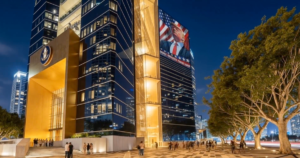
In 2022, I riffed on Stefan Al’s book Supertall to imagine a skyscraper university: floors one through 10, library/student center/CTL, 11 through 40 classrooms and labs, 41 through 66 faculty and staff offices, 67 through 100 student housing.
In 2023, I wrote about the dangers of concentrated wealth to connect Katherine Clarke’s Billionaires’ Row: Tycoons, High Rollers, and the Epic Race to Build the World’s Most Exclusive Skyscrapers to higher ed. (It was a stretch.)
Now I find myself imagining ways that Cities in the Sky, written by Rutgers economist Jason M. Barr, relates to the university.
Save the notable exception of the Cathedral of Learning at Pitt (42 floors and 535 feet), universities are not known as producers of supertalls. Wikipedia has a helpful list of the tallest educational buildings worldwide, with the Main Building at Moscow State University taking the top spot at 36 floors and 787 feet. (Although the Mode Gakuen Cocoon Tower in Tokyo, home to three postsecondary educational institutions, has more floors at 50 and a height of 688 feet).
Barr is a skyscraper enthusiast. This love of tall buildings might create some blind spots. His pro-developer and pro-skyscraper arguments in Cities in the Sky largely skirt complaints about empty buildings (as the super-rich spend little time in their penthouses) amid extreme housing shortages.
Where Cities in the Sky is particularly illuminating is in Barr’s detailed discussion of the economics of skyscrapers. And it is in the finances of building tall that we might bring universities back into the frame. Super-tall buildings, it turns out, can also be super-profitable.
It’s easy to make the mistake of thinking that skyscrapers are only about ego, vanity and bragging rights. The world’s tallest building, the Burj Khalifa in Dubai, cost $1.5 billion to construct in 2010, but generates $250 million to $400 million annually through observation ticket sales, commercial and residential rentals, and hotel operations. Some estimates of the Burj’s revenues are much higher, with one study reporting that the building generates over $620 million annually from its 17 million visitors. Whatever numbers you believe, the Burj quickly paid for itself.
Closer to home, the Empire State Building (also profiled in Cities in the Sky) earns over $100 million each year from its observation deck, which, when added to its over $350 million in annual office rent income, makes the building a money-spinning machine.
Can we imagine a university consolidating its operations into a single building to take advantage of the economic benefits of density? Heating and cooling a single structure is exponentially more efficient than the same operations across a spread-out campus. How many alumni would want to have apartments at their alma mater, paying both rental income and perhaps even tuition dollars to take classes during retirement?
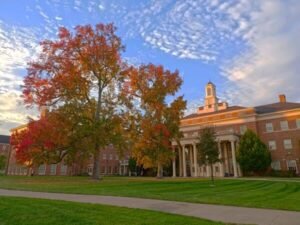
While I’m not suggesting that building skyscrapers is the financial solution for cash-strapped, tuition-dependent nonprofit institutions, I am wondering whether colleges of the future should be designed around the affordances of height and density. Our image of the campus is more horizontal than vertical. A university embedded in a multifunction building may enjoy diversified revenue streams and easier repurposing of physical space to match enrollment trends.
As Cities in the Sky discusses, new skyscrapers are as likely to be built today to house apartments as offices, and many are mixed-use. A new building containing a large number of residence hall–size microapartments and access to courses, credentials and university amenities (library, recreation, health care, etc.) might prove enormously appealing to people of every age.
Reading Cities in the Sky, it is difficult not to get caught up in Barr’s skyscraper enthusiasm. The supertalls of the world tend to be built around distinctive designs, as buildings by star architects—starchitects—command a premium in sales and rentals and are more likely to get investor dollars and municipal approvals. Even designs that were controversial when proposed, such as the Shard in London or the Transamerica Pyramid in San Francisco, are now iconic.
Will we see a mile-high skyscraper in our lifetimes? The limitation on a mile-high skyscraper is not stability or even costs, but elevator technology. Advances in lift technology, including carbon-fiber cables being used in the 3,300-foot Jeddah Tower, now back under construction in Saudi Arabia, promise to lift existing height bottlenecks.
It is possible, however, to retain a healthy skepticism of skyscrapers built for absent billionaires while still being excited for ever-taller buildings. Tell me you wouldn’t be curious about the economics and engineering of a mile-high building. And a skyscraper that tall certainly has room for a university taking up some of its many, many floors.
Cities in the Sky is a worthy addition to the reading list of every skyscraper enthusiast and skeptic.
What are you reading?
You may be interested
Trump’s $950 million presidential library on collision course with Democratic Congress
new admin - Nov 07, 2026As President Trump prepares for the final two years of his presidency, he is expected to devote more attention to…

No one knew why a dad couldn’t eat. Then a surgeon took a second look.
new admin - Nov 07, 2026Richard Satin was sure he was dying. Things had been fine until the fall of 2025. He had enjoyed the summer…

You're 'wasting Netflix membership' if you haven't seen 3 crime documentaries
new admin - Nov 07, 2026A film buff claims these three Netflix documentaries are among the best on the streaming service. Source link