
Chicago’s Trumpet Player Lee Loughnane on Outlasting His Bandmates

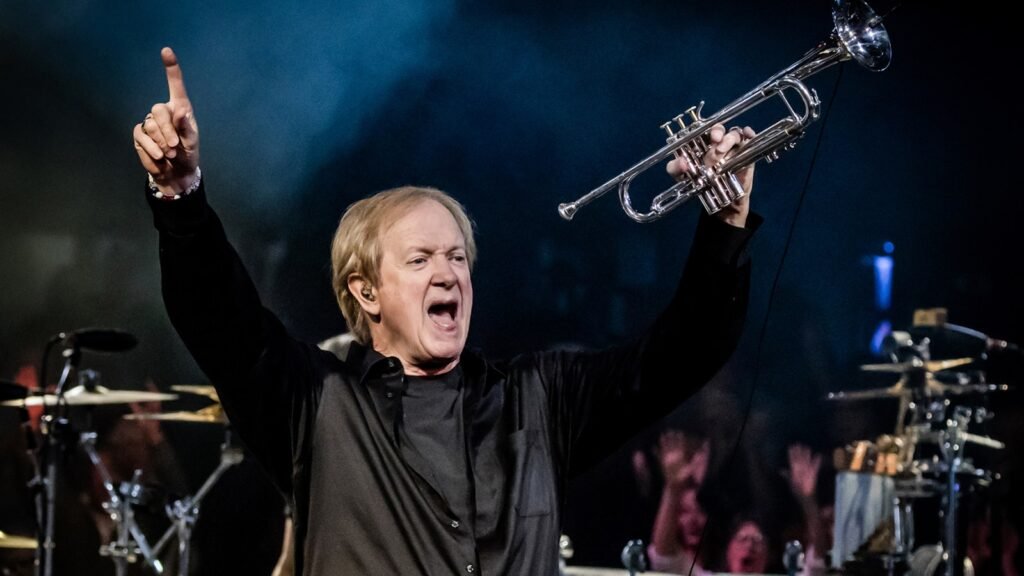
Rolling Stone‘s interview series Last Man Standing features long-form conversations between senior writer Andy Greene and musicians who are the last remaining members of iconic bands. In some cases, they are the only classic-era member in the current touring lineup. In others, they are the only ones still alive. In either case, the task of keeping the torch lit has fallen onto their shoulders, whether they wanted that responsibility or not.
In early 1967, 20-year-old trumpet player Lee Loughnane formed a band with his buddies at DePaul University. They initially called themselves the Big Thing, before changing it to the Chicago Transit Authority, and ultimately just Chicago. Over the past six decades, they’ve scored 20 Top 10 singles, 23 gold records, including an astounding five consecutive Number One albums, and they’ve played more concerts than just about any other band in rock history. They’ve also survived major musical shifts, internal battles, drug addictions, health setbacks, the senseless death of a key member near the peak of their success, and more lineup changes than your typical NBA team.
Today, Loughnane is the last member of the original band still in the touring lineup, following the quiet retirements of singer-keyboardist Robert Lamm and trombone player James Pankow just last year. “I always preferred being in the background, not having to put myself out in front and talk to the audience and do all that,” he tells Rolling Stone via Zoom during a short break from the road. “I just sort of left that to the other guys. And now I don’t have any choice. I’ve got to be out there doing more things than I ever imagined that I would be doing. And I’m enjoying it. You grow with whatever it is you need to do at the time.”
Loughnane’s roots as a trumpet player go back to his father playing the instrument in the Army Air Force during World War II, where he played with members of Tommy Dorsey’s band, Jimmy Dorsey’s, and Glenn Miller’s when they were drafted. He passed his love of music, and his trumpet skills, down to his son.
“I actually didn’t start listening to the Beatles really seriously until Rubber Soul,” says Loughnane. “I liked big band jazz, the swing-era stuff. That’s what I used to play along with when I was practicing. I was thinking that I would never get there myself. It wasn’t too long after I started playing trumpet that I realized I wanted to do it for a living.”
As a student at DePaul, he came across several like-minded musicians, including guitarist-singer Terry Kath. “When I first heard him, he was a bass player with the Missing Links, a local Chicago band,” says Loughnane. “And his voice was just incredible. It would bring you to tears.”
When the Missing Links disbanded, saxophonist Walter Parazaider formed the Next Big Thing with Kath, Loughnane, Pankow, Robert Lamm, drummer Danny Seraphine, and bassist-singer Peter Cetera. “When we started, we were playing Top 40 covers like everybody else,” says Loughnane. “But we heard Vanilla Fudge and they were doing arrangements of Top 40 songs already established, and we started doing that. We continued along those lines through the years. Whenever we’re doing something that’s a cover, we try to make it our own.”
The covers quickly gave way to originals like “Does Anybody Really Know What Time It Is?,” “Beginnings,” and “Questions 67 and 68” that have been the backbone of their live show for nearly 60 years. Loughnane walked us through the entire saga.
You made the first Chicago record in a little over a week. That’s pretty incredible.
We worked a 12-8 shift. We had to leave the studio by 8 o’clock in the morning, and then Simon & Garfunkel had it locked out during the day [to record Bridge Over Troubled Water]. They were the big guys then.
Did you realize at the time you’d made something monumental?
No, not right away. We knew it was good music. We had fun playing it. The thing that we didn’t know initially was how to record. That microphone hears every little breath and tick that you make. So it puts the fear of God in you that you can’t make mistakes. You just have to get used to it, and understand that it’s just part of the process.
Do you wish in hindsight that you guys had played Woodstock, as originally planned?
Yeah, I guess so, but this much time later and how long we’ve been together and how successful it’s been, it actually doesn’t matter anymore. I didn’t realize that it was our own managers that wanted to make another commission that weekend at the Fillmore West in California. They had us there when that insanity was going on.
Chicago has an interesting setup in that there’s no frontman, no focal point.
We have never been that and still aren’t. Even though fewer of the original members are with the band now, everybody gets a piece of the action during the show. Everybody gets featured at some point.
Do you recall first hearing “25 or 6 to 4” after Robert wrote it?
I don’t remember. I think we just sat down in the rehearsal room and it was on paper and we started playing. But regardless of that, “25 or 6 to 4” was born because he couldn’t figure out what to write for the lyrics. So he decided to write a song about the process.
I love that. It’s about him sitting cross-legged on the floor writing a song.
I’m old enough now where I can’t sit cross-legged on the floor. It’d be an impossible lyric for me.
I often watch footage of your show at Tanglewood in 1970. Terry is just at the peak of his game. As much as he’s appreciated, he’s really under-appreciated.
Totally under-appreciated. And I think part of the problem is me, Jimmy, and Walt. The horns overshadowed what Terry would’ve been had it been like a trio. Terry would’ve been right up there in the Top 10. He was doing stuff that Hendrix was doing before we heard Hendrix. I mean, when we heard Jimi Hendrix, we were going, “Terry’s already doing shit like that.” Terry wanted to play with him. He wanted to leave us and go play with Jimi. He would’ve played bass with Jimi Hendrix, if he could.
The schedule was insane back then with an album a year and constant touring. Were you ever home?
We were pretty much always working, but we would go home for a number of days and then out either to the studio or back on the road for three months at a time.
What was the Beachago tour like with the Beach Boys in the summer of 1975?
That was crazy because I was drunk most of the time. It was also fun, frustrating…all of the above. But we would fill baseball stadiums. And I remember Anaheim Stadium, the upper deck was built to withstand home run action. “Oh my God, he hit a home run. Yeah!” When we played, the upper deck was just rocking up and down to the point that the pipes started coming out of the walls. There was actual fear that something devastatingly bad might happen.
You’d also come out and play with the Beach Boys.
Yeah. That was the first time we played together with another band. It was great. We would play their songs, and they’d play ours with us.
Did you get to know Dennis Wilson?
Yeah. We had pillow fights. He was great. They were all fun to be around. Carl was a great guy too. Amazingly, we didn’t play with Brian until just a few years ago. He wasn’t in the band when we toured with the Beach Boys.
How did you initially feel about “If You Leave Me Now” and “Baby, What a Big Surprise”? These were big hits, but also departures for the group since they were soft rock ballads.
I loved it. I mean, maybe the songwriters didn’t like it as much because it was a different direction for us. But the song was Number One in every country in the world. If you mentioned “Chicago” in Europe or Australia or anywhere else in the world to people, they would say “Al Capone” or “If You Leave Me Now.”
Did it change your audience at all? Bring more women to the show?
It probably did. I really don’t know how the audience grew. All I know is that it didn’t stop us from performing. The record company were like, “Hey, do you guys, can you maybe do another one of those ‘If You Leave Me Now’ songs?” Like it’s easy. “Oh, sure. You want guaranteed hits. Do those exist on some planet somewhere? If you can, let us know where those are.”
Do you remember your final conversation with Terry Kath? [In January 1978, Kath accidentally killed himself when he put a gun he believed to be empty to his head and pulled the trigger.]
Not really. Not an exact conversation, but I knew that he wasn’t in good shape mentally and physically, and you’re not quite sure what’s wrong. But he started pulling away from me because I wasn’t able to keep up with him. He was able to do more drugs than I was. I was falling behind. So he sort of separated from me at that point, and he was on his own. When the devastating news came in, I went over to the house, and he was already being carted out. The next time I saw him, he was in the casket. I touched him and it was the shell of the guy I knew. He wasn’t there anymore.
It was a horrible, senseless death.
Yeah, exactly. I got rid of that gun. I had the same gun that he had, and he showed me how to be safe with it, ironically. So yeah, I sold that gun not long afterwards.
Do you ever think about what might have happened to the band if he’d lived?
Yeah, but it’s sort of fruitless to entertain that kind of stuff because it’s all…who knows? It could have gone many, many, many different directions, and it is what it is. We continued to build the legacy that we have as members came and went for whatever reasons. We always replaced them with somebody who took the band even a little further. We kept building, and we kept working.
Chicago 13 must have been a weird time. You’re still dealing with the aftermath of Terry’s death, and you’re bringing in disco sounds.
We brought disco in at the last possible second right before they did the thing at Comiskey Park where they burned disco records, and ours was one of them. But now we’re actually doing a version of “Street Player” [in our set] because it became a hit in Europe by Bucketheads. They took a piece of “Street Player” and recycled it over and over again with that beat. And now we put together an arrangement that incorporates our version and the Bucketheads’ version.
You brought in Donnie Dacus after Terry died, and then Chris Pinnick. It must have been really hard for anyone to try and do what Terry did.
Yeah. You’ve just got to bring your own personality in and keep going, do the best you can. And that’s exactly what they did. At any point during our career, one of us has stepped up to fill whatever was missing at the time and we were able to continue on. I even got in on it by the seventh album. I became like a two-hit wonder with “Call On Me” and “No Tell Lover.”
What were your first impressions of David Foster when he entered the band’s orbit?
He was a great musician, and his ego came in and pretty much took over how the album was going to be recorded. And we resented that. Obviously, the stuff that he did during those years is undeniably great. We still do those songs every night. We hit another really high point in our career with the success of 17 and 18.
I’m sure that you had mixed feelings. You have giant hits, but it’s not really horn-focused, and it’s just Cetera and Foster driving the ship.
Foster decided he was going to put it together his way, and obviously it was successful, but he even admits on the documentary that we did of our 50th anniversary that he overproduced us. He made it a little softer. So when people come and see us in concert, they realize that we’re not just a soft band.
It briefly created this weird impression that you guys were Peter Cetera’s backing band.
Yeah. But that was never the case. When we did the videos, the director inevitably would come up and say, “So, who’s the leader?” And we said, “What do you mean? We’re all the leader. You’ve got to film everybody.” The director would say, “I can’t do that. There’s no focus then.” So the director puts the focus on the lead singer, and that’s the way it goes.
Cetera’s voice was just all over the radio then.
That was fine. He was up at the top of his game back then.
Why did he leave the group?
Well, he never liked going on the road in the first place. That was one thing. So I’m sure that entered into it, but he was maybe buying his own press or other people were on his shoulder saying, “You don’t need these guys. You can make it on your own.” And when he left, he still didn’t want to go on the road, which was testament that he didn’t like going on the road. He wanted to make records like the Beatles and just stay at home. And so he went out on the road, but it was sparingly, and we kept going. And now he’s retired, and I’m not.
He didn’t do a real solo tour until 1995, which is crazy when you think about when he had all his hits.
Yeah. Well, I enjoy doing this. That’s the difference. I actually enjoy what I’m doing, the preparation, the practice, writing songs. I’m writing a couple of songs now that I’m going, “Where was this when the band was really hot? How come I wasn’t writing more?” So anyway, it is what it is. And I keep saying I get to do this for a living. This is something that a lot of people don’t get, and I’m happy doing it.
Tell me about bringing in Jason Scheff after Cetera left.
We did auditions to bring the next singer in and Jason won, in a nutshell. And we could have gone on further, but we chose Jason, and he was with us for, what, a couple of decades, wasn’t it? It was a long time. And then he decided to leave out of the blue.
I always forget about “Look Away” when I think about Chicago, but that was a Number One hit.
I don’t think people understood that that was a Chicago song for a long, long time, because the vocal was so different, and they had gotten so used to hearing the tenor voice. And so when they heard a baritone [of keyboardist Bill Champlin], they went, “Who is this?” But it was Number One in 1989. It was the biggest song of the year.
How did Bill’s presence in the group change the group dynamic?
He had that Terry-type tenor voice, and that soulful thing about him. The thing with Bill is he kept trying to change everything, “My way or the highway.” And so eventually it turned out to be the highway, but he was with us for a long, long time as well.
A non-founder trying to control the band is simply never going to work, I’d imagine.
No, because we’re from Chicago. [Laughs]
So the 1990s come, grunge hits, and radio simply stops touching all older acts almost overnight. Was that a hard time?
We were still going along the way we had normally gone along. I mean, there’s been so many bad things that have happened to us during our career that we shouldn’t be talking now, but we keep our nose to the grindstone, keep working, play great shows, have a great band, have fun doing what we’re doing, and we’ve outlasted all of the so-called problems that we’ve encountered.
How was the Rock & Roll Hall of Fame experience in 2016?
That was great. We never thought we’d even be there. In fact, we had decided that that wasn’t going to happen because we had been eligible for 25 years. So in our 50th anniversary, we were elected to the Rock & Roll Hall of Fame, and it was great experience. It was great working with Paul Shaffer. Tom Hanks was there. He was one of the producers of the show. It was excellent.
Peter Cetera was originally hinting he might come, but he wanted to lower “25 or 6 to 4” by several keys.
He wanted to lower it by a fourth. So I told Paul Shaffer that we’ve played it in the same key, A minor, since the day we recorded it in Columbia Records. And we’ve never played it any different. It would sound like a ballad a fourth lower. We can’t do it. He understood perfectly. And for whatever reasons, it worked out the way it worked out. Like I said, it was a great experience on that show. I didn’t think that I was going to enjoy it and I thoroughly enjoyed it.
That was the first time you played with Danny since he left the band in 1990. How did that go?
It was the same as the last time we had played with him. And Danny’s headstrong, and I think it made a point of why he’s not with us.
By doing what?
He was going to play the way he plays. Once the drum machine came in and the click track, he either didn’t want to or wasn’t able to play with that. He’d still be with the band otherwise. If everything worked out, why get rid of somebody who’s working?
Do you ever talk to Peter Cetera? Has there been any contact?
No, not really. But I think if he wanted to, he’d reach out or something. It’s not that we haven’t tried. When we combined our original Columbia Records stuff with the Warner Bros. stuff [on 1997’s The Heart of Chicago 1967–1997], we asked him to come sing a couple songs, and he didn’t want to do it. In retrospect, I think it was good for us.
Why?
Because if it had been successful, I think people would’ve looked at it as though he made the success. That was not the case. We did it on our own. And then we had a successful Christmas album. We now have four or five Christmas albums.
Why did Jason Scheff leave the band?
One day he asked our manager if he could have some time off, and he asked him how much. And he said three or four months. Three or four months? We got gigs booked. We can’t do that. So we looked for somebody else, and Jason went his way and we went ours.
Then it was Jeff Coffey for a period, and now Neil Donell.
Neil’s been with us for eight or nine years now. He’s got a great voice. Everybody in the band is world-class.
The very last time that Brian Wilson toured or even played live was on a double bill with Chicago in the summer of 2022. He was really struggling at that time.
Yeah. But it was great to see him. We initially started doing “Wishing You Were Here” with him. We did that a couple times with them. It didn’t really go over, so we stopped doing it because Brian actually wasn’t able to come out and sing it. I think that would’ve been a major plus if he had been able to come out and sing it with us.
Walter Parazaider was diagnosed with Alzheimer’s in 2021. How is he doing?
I don’t think he’s doing well. I wish that the band could have been put in a time capsule and we were doing right now what we were doing then. It’s just not the way life works.
Why did Robert Lamm stop touring with the band last year?
There are personal reasons. He’s got stuff going on. The same goes for Jimmy [Pankow], and he’s not touring with us anymore either. But like I said, we’ve got a legacy of music behind us that people still want to hear. We come out, plant our feet, and play the hell out of it, and everybody is happy with the shows. And I’m loving the fact that we’re able to do it. It’s a great band to play it with.
Did you ever think it was going to come down just to you?
No, I think I would’ve been voted the least likely.
It puts a real responsibility on your shoulders.
Well, they made it easy. We made it easy. We kept working. They are still working. We don’t phone in any shows. We go out and play the best we can every night. And it’s a lot of fun doing it. And as much as travel has and always will be hard and difficult on any human body, it’s worth doing it, because once we hit the stage, none of that matters.
You turn 80 in a few months. Somebody in your position might say, “Hey, I’d rather be on a beach with a cocktail in my hand than on an airplane, backstage at concerts, and the tour bus.”
Yeah. Well, if I was sitting around with a cocktail in my hand, you wouldn’t want to be talking to me. I had those years. I survived.
Fair enough. Let’s say with a virgin daiquiri in your hand.
[Laughs] I don’t even drink those. I’d want the real thing.
You clearly prefer work to leisure.
I mean, retire to what? What am I going to do? Become a golfer? A fisherman? I don’t think so. I’ve caught very few fish in my life. I’m better at the trumpet.
You must be looking forward to the tour with Styx this summer. It’s the first time you guys have toured together.
Yes, it is. And I’m looking forward to that. They have a nice legacy of hits themselves, and I’m looking forward to hearing them play them every night.
There must be a lot of crossover in the two fan bases.
Both bands will get some of their audience and they’ll get some of ours coming to future shows. That’s always happened with Earth Wind and Fire and the Doobie Brothers and all the other bands we played with. All of a sudden, we start sharing each other’s audiences.
What happens if you retire at some point? Do you think the band will carry on?
I don’t know. I have no idea. Like I say, I just enjoy what I’m doing right now. I live for the moment, not for what the future might possibly hold. It’s not written. In fact, I’m writing a song that’s right now possibly called “What’s Written.”
The Four Tops keep touring without any original members. There are many groups like that. Why wouldn’t the band just keep going forever?
Yeah, there’s no reason not to tour. People are enjoying listening to it. We’re enjoying bringing it to them. There’s no reason to stop.
Do you ever think about a Chicago biopic movie?
Yeah, that’s probably going to happen probably around the 60th year, which isn’t too far off now, is it?
What time period do you think a movie would cover?
Most likely a good portion of the entire career. It’s going to be tough because I don’t know how it’s going to be written. That’s beyond my capabilities.
Might you write a memoir?
No, I don’t think so. I don’t like listening to the underbelly of the bands. I don’t want to hear about people fighting with each other and who wrote that line and why that one’s more important than this one. I just want to put you on the pedestal that you’re already on for me.
That makes sense. Why air dirty laundry in public?
Yeah. So even in this interview, I’ve been trying to air as little dirty laundry as possible because to me it’s not important. The actual performance and being able to do what we do without any pretense or taking something away from anybody else…it’s still working. We built a legacy together.
I look at your tour schedule sometimes and I just can’t believe it. The number of shows is pretty astounding.
We’re doing at least 90 each year.
Might you still be doing this in your 90s?
I have no idea. Let’s get there first. [Laughs]
You may be interested

Iranian leaders demand U.S. pay for war damage or will keep Strait of Hormuz closed
new admin - Aug 10, 2026Iranian leaders demand U.S. pay for war damage or will keep Strait of Hormuz closed - CBS News Watch CBS…

Gas prices stubbornly stuck, up more than $1 since war with Iran started
new admin - Aug 10, 2026The cost of the war with Iran on taxpayers continues to grow, not only to finance the Pentagon's plans, but…

Powerball prize increases to $905 million
new admin - Aug 10, 2026The Powerball jackpot powered up after there was no winner this weekend. The prize for Monday's drawing is now an…