
Cautious or Protesting, Foreign Scholars Skip U.S. Conferences

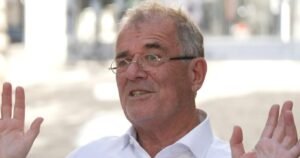
During President Donald Trump’s first term in office, David Murakami Wood didn’t cross the U.S.–Canada border once.
“I refused to go largely in solidarity with the countries who Trump targeted for visa exclusions,” said Murakami Wood, a criminology professor at the University of Ottawa. “This time … it’s even worse. It’s not specific countries [being targeted], but we’re seeing people being arbitrarily arrested and taken off the streets, deportations, people being arrested in transit.”
He’s not particularly concerned about his own physical safety, though as a scholar of critical surveillance and security, his work may not be viewed favorably by the current administration. Murakami Wood’s boycott is an ethical one—and he’s not alone. Discussion threads on Reddit and Bluesky are filled with dozens of scholars expressing similar concerns about traveling to the U.S. under Trump. And for academics, a U.S. travel boycott means skipping American conferences.
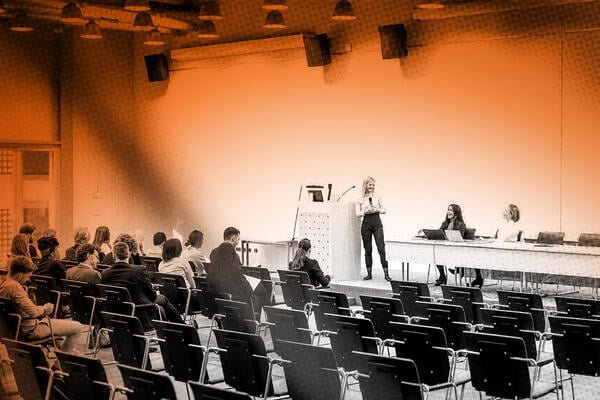
U.S. association conferences are oftentimes the largest annual gatherings of scholars in the field. For example, the Association of American Geographers, of which Murakami Wood is a part, says on its website that it brings together the “global community of geographers.” Its March annual meeting in San Francisco is “THE geography conference you don’t want to miss,” the website states. Skipping even one of these gatherings isn’t an easy career sacrifice, especially for young academics seeking to gain a foothold in their field.
“The big U.S. associations are effectively the world associations for those disciplines,” Murakami Wood said. “If you want to get on in your career as an early-career researcher in geography, for example, having a paper at the AAG is essential.”
Conference organizers typically put out a global call for submissions, asking scholars to send in their latest research. If selected, these scholars travel to present their research and sit on panels at the annual meeting; they’re also responsible for helping recruit other presenters and attendees. Nicolás Palacios, an academic based in Switzerland, said he’s seen many calls for submissions this year, and none have acknowledged the current political climate in the U.S.
“People [on LinkedIn] were sharing their calls, but nowhere did I see any comments on the ongoing situation in the United States related to the possibility of how massive events with people from other countries coming together can create the conditions for … ICE waiting outside,” Palacios said.
He chalked it up to a “lack of self-reflection in [American] academia at the moment.”
“People that have been very vocal regarding other horrible situations around the world—Russia and Ukraine, Israel and Palestine—now, when it comes to look inside and think about, ‘How are we dealing with the dissipation [of American democracy],’ they’re not really doing that,” he said.
Several conference organizers have already canceled their U.S. meetings or moved them outside the country. For example, the International Society for Research on Aggression announced in April that it would relocate its 2026 meeting from New Jersey to St. Catharines, in Ontario, Nature reported. The Northwest Cognition & Memory conference in May was relocated from Western Washington University in Bellingham to Victoria, British Columbia. And the 2026 Cities on Volcanoes conference planned for Bend, Ore., was canceled until 2030.
Still, many more annual meetings remain scheduled in U.S. cities. The American Historical Association annual meeting will take place in Chicago in January. The Society for Neuroscience will meet in San Diego this month.
‘ICE Is a Very Real Risk’
Born and raised in Chile, Palacios plans to skip academic conferences in the U.S. this fall and winter out of fear for his own safety. So will some of his colleagues.
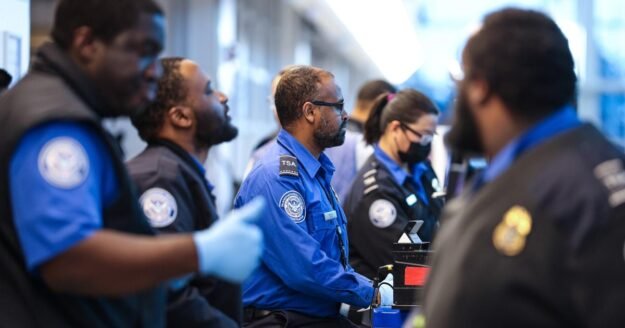
“For people that do not have a passport from [countries the U.S. favors]—like let’s say the global South—or people that are racialized to be targeted by policing institutions … ICE is a very real risk,” Palacios said.
Adrian Liston, a professor of pathology at the University of Cambridge, lived in Seattle while he completed his postdoc and has typically traveled to the U.S. for conferences two or three times a year. But now, he has opted out of all U.S. travel.
“That was a decision made after Trump won re-election. I had already been booked in on a couple of conferences, and the following week, I decided that I wasn’t going to be going to America under Trump,” Liston said. “So I canceled the conferences that I’d already been invited to and I’ve said no to any travel to America for professional or personal work since.”
He’s not concerned about his own safety in the States; like Murakami Wood, his boycott is a protest rooted in ethics.
“I don’t agree with the politicization of scientific funding, the destruction of data collection and openness, the violation of grant agreements, the dismantling of public health that’s been happening with Trump, and I feel like traveling to America at this point is a partial endorsement of what’s going on,” Liston said.
One Ph.D. student in Canada said her director told her entire lab group that he didn’t feel comfortable sending anyone to the U.S. unless absolutely necessary. She and her colleagues study environmental science, and she recently accepted a position at a U.S. university; she requested anonymity while she goes through the visa-approval process.
“There are tons of people who cross the border without issues, but just those few stories that came through kind of spooked us,” she said. “They spooked the university, too, because in a letter, even the university administration was like, ‘Be cautious. Don’t bring any valuable data or information. Let us know when you’re traveling.’”
The student felt torn about accepting a position in the U.S. under the current administration, especially given Trump’s cuts to funding for environmental science research at universities across the country. But, she said, “The job market is absolutely terrible right now, and it’s hard to find work in academia in Canada, because we don’t have that many universities. There’s so many more universities in the U.S.”
You may be interested
Meet one of the last true paparazzi
new admin - Mar 14, 2026Pascal Rostain, one of the last-standing "traditional" paparazzi photographers, talks to "CBS Saturday Morning" about how the industry has changed…
Trump confirms he will attend UFC Freedom 250 event at White House in June
new admin - Mar 14, 2026[ad_1] NEWYou can now listen to Fox News articles! President Donald Trump confirmed in a sit-down interview with boxer Jake…

SXSW Future of Music Showcase Recap
new admin - Mar 14, 2026[ad_1] Fuerza Regida had already made history as the first música mexicana band featured on the cover of Rolling Stone…