




California CCs Launch Private University Transfer Pathway

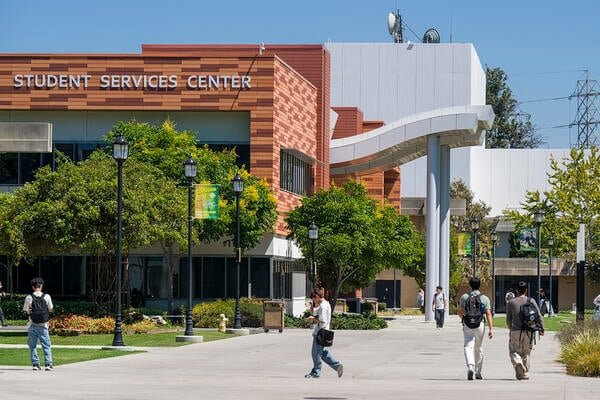
Golden West College is one of the 116 California Community Colleges.
Leonard Ortiz/MediaNews Group/Orange County Register/Getty Images
National University, a primarily online private institution based in California, has announced that it will establish its first statewide transfer pathway program with the California Community College system, the largest two-year college system in the country.
CCC has already established transfer pathways with the California State University and University of California systems, but CCC officials hope this new option will help even more students, they said in the announcement.
About three-quarters of CCC students aim to complete a bachelor’s degree, according to the release. But 2025 research from the Public Policy Institute of California shows that in practice, only 16 percent of students who start their studies at a CCC go on to earn a bachelor’s degree, compared to 72 percent of those who begin at a UC or CSU campus. The partnership with National University, which caters to veterans and other nontraditional learners, is part of the community college system’s plan to increase the number of students who complete a bachelor’s degree.
Mark Milliron, NU’s president, said he expects the arrangement to appeal to working students, student parents, veterans and anyone else who would benefit from a flexible education.
“We’re building this partnership with the California Community Colleges to say, ‘Hey, we see you, and we’re here to serve you, and if you’re a student who needs flexibility in your learning … you’ve got a home. You’ve got a place that will care about you and help you finish what you start,’” he said in an interview with Inside Higher Ed. “And that’s a big deal, because for a lot of these students, if they get into very structured environments that are focused on those right–from–high school students, it doesn’t fit.”
California isn’t the only state where relatively few community college students later earn a bachelor’s degree; it’s a nationwide problem that has persisted for years, according to John Fink, a senior research associate and program lead at the Community College Research Center at Columbia University. Pathway partnerships between community colleges and four-year universities aim to curb that problem by reducing some of the obstacles students face when transferring, such as credits not being accepted at the four-year institution.
Fink said there’s no research available on the prevalence of such partnerships or what they entail, but he noted that not all agreements are equal.
“Is it just sort of a signaling of a partnership? Or is it real dollars on the table for students—in terms of financial aid … but also dollars in terms of the four-year upping its investment in its transfer-articulation staff and admissions staff, in the coordination internally in the academic department to actually make the credit-transfer process work?” he said.
He noted that some of the partnerships recognized as the best in the nation are “end-to-end redesigns where students are starting at the community college with a bachelor’s degree in mind.”
Effective Agreements
NU’s agreement with CCC will allow any student who graduates with an associate degree for transfer—a unique degree offered by CCC institutions originally designed to create a transfer pathway to CSU institutions—guaranteed entry to NU, with a 25 percent discount on tuition. All previously earned course credits will be honored.
The CCRC’s research into community college transfers has shown that students who transfer to private and primarily online institutions tend to have worse outcomes than those who move to public universities. But that doesn’t mean those institutions can’t play an important role in the transfer ecosystem, Fink said. They should be investing in improving those outcomes so that older, working adults can benefit from the flexibility online schooling provides.
Researchers at the RP Group, a nonprofit that studies community college education in California, said that adding NU to the list of transfer options for CCC students will be beneficial for several reasons. First, any new options are helpful, as the CCC system enrolls about two million students—more than the two state university systems can handle. In addition, online courses can support rural students who don’t live close to a university.
“It’s not that these students lack transfer intentions or motivation, it’s that many of the students are place-bound,” said Alyssa Nguyen, senior director of research and innovation for the RP Group. “Having options like ones that are fully online is very beneficial for students who may not be able to just pick up and physically move themselves and/or their families.”
But Nguyen reiterated that colleges involved in these partnerships must be willing to invest in the resources that support transfer students’ retention once they arrive.
“I think until we can get at least closer to making comparable access to wraparound supports” for online students, she said, “we will likely still see the trailing of online programs in terms of completion relative to in-person.”
You may be interested

Sami Zayn eyes WWE championship at Night of Champions in Saudi Arabia
new admin - Jun 27, 2026[ad_1] NEWYou can now listen to Fox News articles! Sami Zayn is getting another chance to win a WWE championship…

The Uplift: The American Dream
new admin - Jun 27, 2026Watch CBS News We celebrate the United States ahead of its 250th anniversary with stories about American heroes and pastimes.…

Letlow, Fleming face off for Cassidy’s seat in Louisiana GOP Senate runoff
new admin - Jun 27, 2026Washington — Louisianans are voting Saturday in the state's Republican Senate runoff, as two candidates vie to replace Sen. Bill…