


California 2026 governor candidates discuss gas prices, environmental policy

As California voters prepare to choose their next governor in 2026, energy policy — particularly the future of oil production, refineries and gas prices — has remained a central and complex issue in the race.
California gas prices are the highest in the nation and are projected to rise as oil refineries leave the state. For years, state leaders accused oil companies of price gouging, but a two-year state investigation found no evidence of that. Meanwhile, the oil industry blames California’s progressive policies for driving them out.
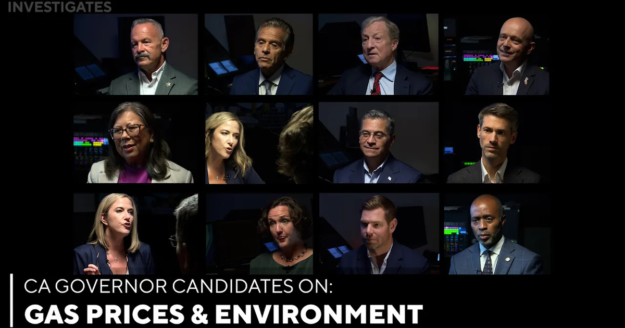
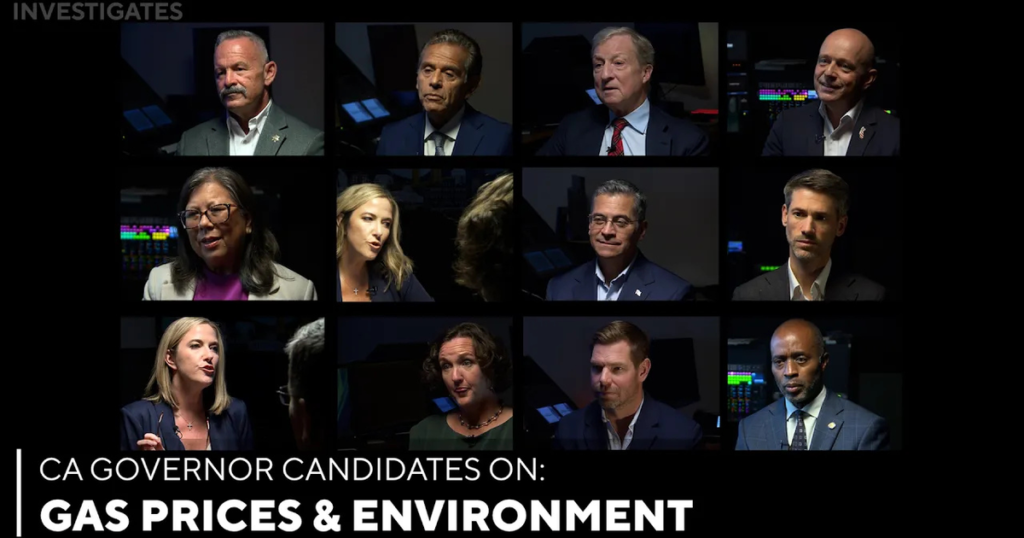
The 10 candidates in the governor’s race are Xavier Becerra, Chad Bianco, Steve Hilton, Matt Mahan, Katie Porter, Tom Steyer, Eric Swalwell, Tony Thurmond, Antonio Villaraigosa, and Betty Yee.
CBS News California Investigates correspondent Julie Watts sat down with candidates, who weighed in on the role of state policy, global supply risks, and refinery closures, and how each would address rising gas prices.
How should California balance environmental policy and gas prices?
Republican candidate Steve Hilton placed the blame for high gas prices squarely on state climate policies and regulations.
“The reason that we have the highest gas prices in the country… it is the direct result of what the Democrats call their climate agenda,” Hilton said.
He pointed to policies like the state’s gas tax, cap-and-trade and the low carbon fuel standard as key cost drivers.
“My plan is to repeal the low-carbon fuel standard, to change the way cap-and-trade taxes are levied, to change the refinery regulations, to open up oil and gas production in California,” Hilton said. “All of that together, instead of what we’ve got now, which is $5 gas heading to $6 or even higher, my plan is for $3 gas in California, and I can do that through changes to the regulatory environment without legislation.”
Hilton added he supports the oil and gas industry politically.
“Oh, as much as possible. I mean, I support that industry wholeheartedly,” he said when asked about campaign contributions from within the industry.
Riverside County Sheriff Chad Bianco, also a Republican, similarly argued that high gas prices are the primary driver of California’s overall cost of living and are largely policy-driven.
“The number one reason we have the highest cost of living is because of gas… No matter what we do, no matter what we buy, no matter what we consume, everything has to be transported in, Bianco said. “So the cost of transportation is the major driver of the costs of goods, and California suffers from the highest price of gasoline in the country by design.”
Bianco criticized environmental regulations as excessive and said they should be rolled back. On how he would immediately move to lower gas prices if he were elected governor, Bianco said, “Gasoline, the regulations that increase it almost $2 a gallon, that will be immediately reduced.”
The Southern California sheriff also called for expanding drilling and reducing reliance on imported oil.
“The regulations have to go away. We have to allow drilling to occur… We’re buying all of our oil from countries that couldn’t care less about saving the planet, and the whole carbon footprint of shipping all the oil into our country — it’s astronomical,” Bianco said. “It doesn’t make sense.”
The remaining candidates, all Democrats, acknowledged the need to balance environmental goals with affordability, while maintaining California’s long-term climate commitments.
Former U.S. Health and Human Services Secretary Xavier Becerra, who also served as California attorney general, emphasized stabilizing supply and avoiding price spikes.
“The most important thing we can do is stabilize… not just the price, but stabilize the supply and stabilize the distribution of gas,” Becerra said. “Because if you can provide some predictability, you won’t see the spikes in the price of gas the way you see now.”
He said California should maintain refinery capacity while continuing its transition to cleaner energy.
“We’re never going backwards when it comes to what we know we need to do,” Becerra said.
Congressman Eric Swalwell supported maintaining strong environmental standards while diversifying energy sources.
“I believe we can be a state with the highest environmental standards — not allow offshore drilling, as the president is trying to do — but also take an all-of-the-above energy approach,” Swalwell said.
If elected, Swalwell said his role would be focused on affordability.
“My job is to be the CEO of lowering costs,” he said. “And so that means having an all-of-the-above energy policy, and I’m going to work with the legislature.”
Businessman Tom Steyer focused on accelerating the shift away from fossil fuels and criticized oil companies’ pricing practices.
“They are overcharging us dramatically… The data is they’re charging us much more, and the issue is they are saying they need to charge us more because of short-term needs,” Steyer said.
Steyer argued that California should restructure the market and expand alternative fuel sources, including importing refined fuel if necessary.
“We need to develop alternative sources of gasoline in the state of California. We’ve had 10 years to do it,” he said. “That means we either get it shipped in from Asia, we get it from local states — that is where we have to go.”
Steyer emphasized that California looking to outside sources would resemble what much of the rest of the world already does and would be a short-term solution to lowering prices for the consumer.
When asked for any data points or projections on how this would affect the costs for consumers, Steyer said, “Oil and gas get shipped around the world every single day in huge size. This is not something that’s unheard of.”
San Jose Mayor Matt Mahan emphasized innovation and grid modernization as key to lowering costs.
“We have to be smart about the transition. We have a lot of big promises. We’re going to be carbon neutral by whatever date without a plan to do it or the math around what it will cost people,” Mahan said. “The transition we need has to be led by what we are best at in California, which is innovation.”
He pointed to technologies like energy storage and “virtual power plants” as ways to improve efficiency and reduce costs.
“The transition has to be driven by innovation and better alternatives… we should be using technology to have a smarter grid that better balances supply and demand,” Mahan said.
Rep. Katie Porter stressed a transitional approach, noting that California is not yet ready to fully move away from fossil fuels.
“California’s future is going to be green energy, but we also have to be realistic about where we are,” Porter said.
She added that the state must maintain refinery capacity while investing in renewables.
“We are creating a lot of good, high-paying jobs in renewables, but I think we’re going to have to kind of stay the course with regard to our existing refinery capacity, protecting those California jobs, keeping gas as low as we can for the foreseeable future while that transition occurs,” Porter said.
State Superintendent Tony Thurmond proposed “meaningful” financial relief for residents while continuing environmental progress.
“First thing we do is we give Californians a tax credit to help them pay for the higher cost,” Thurmond said.
He also emphasized the need to retain refineries while investing in cleaner technology.
“We can do a better job at balance… We have to find ways to balance climate change, but we also have to invest in technologies like carbon capture that allow refineries to get safer,” Thurmond said.
Former State Controller Betty Yee pointed to the need for a clearer transition plan toward carbon neutrality.
“I think we all want to live in a clean environment, but we really haven’t had a plan about how to get there,” Yee said. “And so the struggle has been: Do we shut down refineries now, or do we leave them open while we’re developing our path to become carbon neutral?”
She said refineries should remain open during that transition while investing in cleaner fuels.
“Don’t flip a switch to get to carbon neutrality by 2045. There has to be a transition,” Yee said. “And we’re seeing, actually, some really good models of how that’s being done. Some of the refineries here in the Bay Area, state and business took a financial hit while they’re still producing oil and gas, but also invested in developing alternative fuels. They’re gonna be much more carbon-friendly and continuing to refine that obviously to get to the goal of California… I think that’s the way to do it.”
Former Los Angeles Mayor Antonio Villaraigosa framed affordability as a long-standing issue and called for a balanced approach.
“The issue of gas prices and affordability is something I’ve been raising for a long time,” Villaraigosa said.
He criticized what he described as a lack of balance in more recent policies and warned against moving too quickly away from fossil fuels.
“We have to have an all of the above strategy,” Villaraigosa said.
Editor’s Note: These interviews were conducted over the course of six months, beginning in September 2025. Each candidate was given equal time to respond to questions related to more than a dozen different topics.
A central issue for voters
While candidates agree that gas prices are too high, they remain divided on the path forward — from rolling back environmental regulations and expanding drilling to accelerating clean energy investment and restructuring the energy market.
The debate underscores a broader challenge facing California: how to meet ambitious climate goals while addressing the immediate financial strain on consumers.
As the 2026 election approaches, that balance is likely to remain a defining issue for voters across the state.
Coming soon: CBS News California interactive governor’s race candidate guide
CBS News California Investigates conducted more than 20 hours of accountability interviews with the top-polling candidates for governor, covering more than a dozen issues suggested by viewers, policymakers, and community leaders. These segments are the backbone of our Interactive Candidate Guide, which helps you go beyond the campaign talking points to compare the candidates side by side on the issues that matter most to you.
You may be interested
Decorated F-16 fighter pilot describes what went into mission to rescue U.S. airmen from Iran
new admin - Apr 07, 2026President Trump is hailing the rescue of a downed weapons system officer as one of the most complex missions the…

Households warned to never put common bird food out or risk rats
new admin - Apr 07, 2026Rats may appear in your garden if you make this mistake (Stock Image) (Image: Getty)The last thing anyone wants in…

Artemis II loops far side of the moon, goes through planned communications blackout | Special Report
new admin - Apr 07, 2026Artemis II loops far side of the moon, goes through planned communications blackout | Special Report - CBS News Watch…