


Bypassing the Bachelor’s Degree

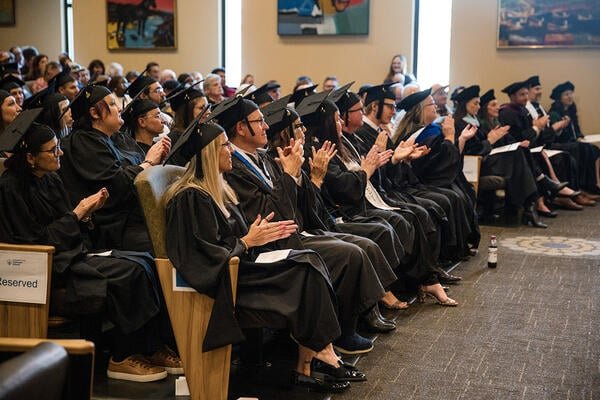
Alyssa Pecholt’s journey to her master’s degree was serendipitous.
In 2023, then a student finishing her associate degree at Minneapolis College, she was working an information table for her then-employer at an event at another university when she overheard Hazelden Betty Ford Graduate School employees at an adjacent booth talking about their fledgling Alternative Admissions Pathways program. The program, launched that year, allows students to enroll in a master’s program without first completing a bachelor’s degree.
Pecholt was stunned.
While she was near the finish line for an associate degree in human services, she was uncertain about the path ahead but knew from her internship experience with a re-entry program for formerly incarcerated individuals that she needed further education to reach her goals. She expected to go on to a bachelor’s program and then pursue a graduate degree.
Pecholt’s casual conversation soon turned into a recruiting pitch for Hazelden Betty Ford.
“It was the answer to all of my problems—it will be faster, end up costing less money than doing my four-year bachelor’s and then another two years for a master’s,” she said. “They were so friendly and welcoming, and they explained the program so well … So, I got the contact, and I literally applied that day.”
In her admissions essay, Pecholt wrote about how she grew up in a low-income family with substance use and mental health issues. She emphasized how her background inspired her to pursue a counseling degree, noting her work in the re-entry program and other experience.
Pecholt was one of eight students in the first cohort of the alternative admissions program. She graduated last year and was recently licensed as a drug and alcohol counselor in Minnesota.
Hazelden Betty Ford now has 67 students enrolled via the Alternative Admissions Pathway.
Inspired to Innovate
Kevin Doyle, president of Hazelden Betty Ford Graduate School, said the institution was inspired to launch the program to open doors for passionate students whose academic and career journeys weren’t a straight path and to fill gaps in the counseling workforce.
“We frequently got calls from people who badly wanted to come to our school, and in the initial screening, they would disclose that they didn’t have a bachelor’s degree,” Doyle said. “We often could feel the passion that they had and wanted to be helpful to these folks. But thinking narrowly—before we did more exploration of this concept, we just referred them to go back and finish their bachelor’s degree and call us, two years from now, four years from now, whatever.”
He noted that many of those prospective students were often inspired to pursue counseling due to their own personal journey, such as their own past substance use issues or familial experience. Many also brought some field experience despite lacking a bachelor’s degree.
“They’re working in this setting with people with substance use disorders, and yet they’re not able to advance into clinical roles because they don’t have the appropriate letters after their name. How I phrase it is we’re trading work experience for the traditional academic program,” Doyle said.
Doyle emphasized that despite not requiring a bachelor’s degree, not every applicant gets in. He noted that prospective students need to prove they can do the work. In reviewing applications, he said, Hazelden Betty Ford looks for applicants to demonstrate eligibility via work history and other credentials, such as a certificate in addiction counseling, participation in professional activities and experience volunteering in treatment programs, among other indicators.
While accreditors are often accused of thwarting innovation in higher education, Doyle credits Barbara Gellman-Danley of the Higher Learning Commission for inspiring the program’s launch. Doyle said that in a speech at an HLC conference, Gellman-Danley urged member institutions to think creatively. After the conference, he reached out to HLC, Hazelden Betty Ford’s accreditor, to determine if the graduate school could accept students without a bachelor’s degree and was told nothing in their standards barred such a move. From there, Doyle went to faculty and worked with them to begin laying the groundwork to launch the alternative admissions program.
Although Higher Learning Commission standards do not bar programs such as Hazelden Betty Ford’s, their existence is rare. HLC officials told Inside Higher Ed they do not track such efforts.
Tracking Outcomes
Robert Kelchen, a professor of education at the University of Tennessee at Knoxville, told Inside Higher Ed that Hazelden Betty Ford’s approach aligns with the broader industry push for higher education “to do things quicker, faster, better, and see what works.”
Kelchen pointed to competency-based education and the growing deployment of three-year bachelor’s degrees with reduced credit loads as similar examples of colleges innovating in ways that “can save students time and money” and “get people out in the workforce quicker.”
But, he warned, some students may need remediation and additional support to be successful.
He suggested that accreditor approval could also be an obstacle, though that wasn’t the case for Hazelden Betty Ford. As accreditors face mounting scrutiny from the Trump administration, which has accused such organizations of driving up costs and stifling innovation, Kelchen suspects they are likely to be more flexible.
“Accreditors are also being pushed to be more nimble and innovative, and I think where this will probably land is that accreditors will give institutions more leeway to try new things, but they’ll also need to act pretty quickly if things aren’t working and monitor closely,” Kelchen said.
Doyle underscored Kelchen’s point on outcomes.
“The last thing that we would ever want to do would be to exploit or take advantage of any group, so we’ve been tracking [outcomes] from the very beginning: grade point average, retention rate, graduation rate and some qualitative data, including interviews with faculty and the students themselves in the program about what their experience has been like,” Doyle said.
So far, Doyle is inspired by the early results, noting that alternative admissions program students show similar rates of success as their peers. However, he noted there is not yet enough data on licensure passage rates, which will help provide a clear sense of postgraduation outcomes.
Pecholt, an early success story, is putting her degree to work in a mental health counseling role. As a beneficiary of the alternative admissions program, she encouraged other institutions to think carefully about what qualifies students to take on graduate-level counseling work. Some of the most vital experiences, she argued, won’t show up in the form of an undergraduate degree.
She urged programs considering such pathways to do so with an open mind toward applicants.
“It’s going to be people who have struggled with addiction for a very long time and are in recovery, who have had really bad grades, who maybe spent time in jail or prison or had rough lives,” Pecholt said. “There’s a lot of stigma around that, and it doesn’t disqualify anybody from being a good counselor, a good therapist or deserving a good education, regardless.”
You may be interested

Almost Half of Colleges Haven’t Fully Submitted Student Data
new admin - Aug 19, 2026[ad_1] The Education Department’s Office of Federal Student Aid is warning hundreds of institutions that their access to federal grants…
Charlie Kirk was targeted for his politics, prosecutors say bullet engraving shows
new admin - Aug 19, 2026Salt Lake City — Prosecutors in Charlie Kirk 's killing pointed Tuesday to an engraved bullet, arguing that the inscription…
Students’ Choices Fueling Polarization in Higher Ed
new admin - Aug 19, 2026[ad_1] Every day, conservatives accuse universities of being too liberal—indoctrinating students rather than teaching them. Neil Gross, a Colby College…