




Biggest black hole flare ever discovered shines with the light of 10 trillion suns, scientists say


Scientists have spotted the brightest flare yet from a supermassive black hole that shines with the light of 10 trillion suns.
These bursts of light and energy can come from things like tangled-up magnetic fields or hiccups in the heated gas disks surrounding black holes. The flares help illuminate researchers’ understanding of the black holes within.
The flare came from a supermassive black hole that’s 10 billion light years away, making the flash the most distant one observed so far. It hails from a time when the universe was rather young. A light year is nearly 6 trillion miles.
The latest cosmic display was spotted in 2018 by a camera at the Palomar Observatory in California. It took about three months to shine at peak brightness and has been decaying in the years since.
It likely happened because a large star wandered too close to the black hole and got shredded to pieces.
“At first, we didn’t really believe the numbers about the energy,” said study author Matthew Graham with the California Institute of Technology, which operates Palomar.
Robert Hurt / AP 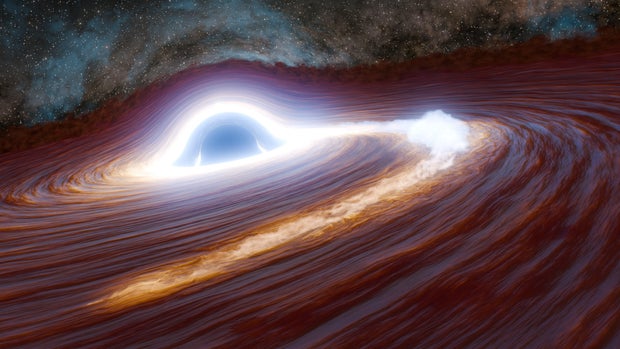
The new findings were published Tuesday in the journal Nature Astronomy.
Almost every large galaxy, including our Milky Way, has a supermassive black hole at its center. The immense pull of that black hole, which is surrounded by powerful magnetic fields, gives the Milky Way its characteristic swirl.
Scientists still aren’t sure how supermassive black holes form.
Studying such behemoths can help researchers better understand the stellar neighborhood surrounding supermassive black holes. The discovery also allows scientists “to probe the interaction of supermassive black holes with their environments early in the universe,” said Joseph Michail with Harvard-Smithsonian Center for Astrophysics, which didn’t have a role in the new study. Those early interactions created the cosmos humans now call home.
The oldest black hole yet discovered was spotted by scientists in March 2024. That supermassive black hole was formed when our 13.8 billion-year-old universe was just 430 million years old. The black hole is at the center of a distant galaxy and is vigorously growing, researchers said.
Another ancient supermassive black hole was discovered by NASA researchers in 2023. That one was formed about 13.2 billion years ago, making it about 40 million years older than the one found in 2024. It is about 10 times bigger than the Milky Way’s black hole.
Meanwhile, the nearest supermassive black hole is just about 1,600 light-years from Earth and is about 10 times the size of the sun.
You may be interested

NFL news: Ex-Patriots quarterback talks time with the organization
new admin - Feb 04, 2026[ad_1] NEWYou can now listen to Fox News articles! Dallas Cowboys quarterback Joe Milton III opened up about his short…

Rahmanullah Lakanwal, D.C. National Guard shooting suspect, pleads not guilty to federal charges
new admin - Feb 04, 2026Washington — The man accused of shooting two members of the National Guard in Washington, D.C., late last year pleaded…

Janet Jackson Celebrates ‘Control’ 40th Anniversary
new admin - Feb 04, 2026[ad_1] The musician shared a compilation of footage from throughout the album's era set to the monologue she delivers on…