

Before Deploying AI in Admissions, Ask Why

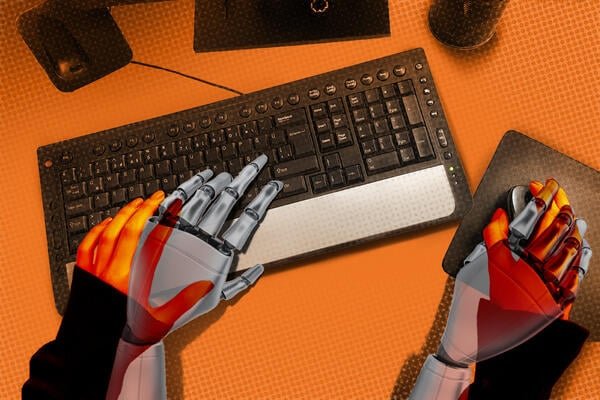
The use of AI carries potential risks and benefits for admissions offices.
Photo illustration by Justin Morrison/Inside Higher Ed | hiphotos35 and ismagilov/iStock/Getty Images
Despite more colleges and universities turning to artificial intelligence–powered tools to help review applications, most don’t have specific policies governing AI use in the admissions process. However, a new resource designed by a consumer protection group offers admissions offices a general framework for the responsible, ethical integration of the technology.
On Wednesday, the National Student Legal Defense Network published a list of 10 Dos and Don’ts of AI in College Application Evaluation as part of its Safeguarding Higher-Ed through AI Practices & Ethics (SHAPE AI) initiative.
“It is no secret that AI is moving very fast; it is changing. And it’s also no secret that admissions—whether we’re talking about college admissions or graduate school admissions—is a very high-stakes moment for students and their families,” Dan Zibel, vice president and chief counsel at Student Defense, said at a Tuesday news conference ahead of the framework’s release. “We want to make sure … that problems are really being short-circuited before they arise to the maximum extent possible.”
The Dos of AI-Powered Admissions
- Ask Why You Are Using AI
- Make a Person Responsible
- Be Transparent About AI Use
- Adopt Policies and Monitor Compliance
- Understand the AI Model
- Train Staff Thoroughly and Continuously
- Articulate Clear Expectations About Applicant AI Use
- Protect Student Data
- Monitor for Disparate Student Impact
- Keep Your Model Up-to-Date
The framework comes one month after the group’s AI advisory committee—composed of institutional leaders, policy experts and consumer advocates—unveiled the Student AI Bill of Rights, which asserts that students are “entitled to shape their own futures through transparency, fairness, human oversight, privacy, and safety.”
Designed in concert with those principles, Student Defense’s new AI admissions guidelines are also intended to shield colleges—no matter if their admissions are selective, open enrollment or somewhere in between—from the risks associated with the uninformed deployment of AI. While the group’s framework acknowledges AI’s “potential to improve the admissions process” as budgets shrink and application numbers grow, it also warns that “AI tools can introduce or amplify bias, erode applicant trust, and raise serious legal and ethical concerns.”
Being thoughtful and intentional about how AI is deployed in the admissions process is one of the biggest keys to avoiding those potential negative consequences, Madeline Wiseman, senior counsel at Student Defense, said at the news conference.
“[Institutions] need to think about what their goals are and how AI can serve those goals and be integrated into the process,” Wiseman added. “They shouldn’t do it just because other schools are doing it, or because they think that that’s the way the world is moving and they have to keep up.”
At highly selective institutions, AI can be “a really powerful tool” to help narrow down the candidate pool with sharper data analysis, “but it absolutely has to be used carefully, and it absolutely has to be disclosed that you’re using it,” said Sarah Zearfoss, dean of admissions at the University of Michigan Law School, which recently added an optional AI essay to give students a chance to showcase their AI-prompting skills.
And part of being careful will require adhering to one of the other principles in the framework—holding humans accountable for final admissions decisions, added Zearfoss, who also spoke at the news conference.
“AI increasingly can mimic human judgment, but that’s all it is doing,” she said. “Using AI exclusively is to absolutely forgo the human element of it—the sense of judgment—which is so key to what we do in admissions.”
However, the vast majority of colleges and universities admit most if not all students that apply. While AI-powered admissions tools aren’t all that common at such institutions right now, the implications of more widespread adoption will center on data use and protection, according to Michael Meotti, executive director of the Washington Student Achievement Council.
“It is possible that AI could be used to understand the patterns of success of students—particularly students of color and lower-income students—going from high schools to public colleges and universities,” Meotti said at the news conference. At the same time, “we want to protect the involvement of the students, because the students are putting all sorts of personal information into these [applications].”
At present, Meotti added that he’s most worried about institutions adopting AI-powered admissions tools without adequate information about how they work.
“You really do want to understand what others are doing and have some collective wisdom to help drive where you’re going,” he said. Otherwise, “you can get taken over the cliff by a vendor who probably will disappear in the near future” and put student data at risk in an “uncontrolled privacy environment.”
You may be interested
Has your license plate been tracked by Flock cameras? Here’s how to check.
new admin - Aug 17, 2026As privacy concerns swirl over Flock Safety's nationwide network of cameras, drivers may be curious whether their license plate information is being…

Tupac Shakur Murder Trial Opens Thirty Years After Rap Legend’s Death
new admin - Aug 17, 2026[ad_1] Three decades after the 1996 drive-by shooting of hip-hop legend Tupac Shakur in Las Vegas, a prosecutor gave jurors…

Trump’s border wall push is back — and it’s destroying national parks and 200-year-old trees
new admin - Aug 17, 2026About 22 miles south of the former mining town of Patagonia, Arizona, down a winding, unpaved mountain road that passes…