
Badly wounded U.S. Air Force officer climbed 7,000 foot Iranian ridgeline to hide after being shot down

When an American fighter jet was shot down over Iran this past April 2, not one, but two U.S. Air Force officers were left stranded, alone in a rugged mountain range, being pursued by Iranian forces. To prevent their capture — five weeks into a costly and unpopular war that has taken the lives of 18 U.S. service members — the U.S. military launched one of the largest search and rescue operations in its history.
Tonight, we begin our 59th season with how the mission unfolded. We’ll show you newly declassified footage and you’ll meet the colonel who lived through it all to tell us the story.
When the U.S. went to war with Iran this past February, it was by sea but mostly from the air.
ADM. BRAD COOPER: Broadly, we had flown about 13,000 missions up to this point. So we had air superiority, but clearly we weren’t flying over Kansas.
Adm. Brad Cooper is the American commander in charge of the war. We asked him what brought the fighter jet to a mountainous area south of the city of Isfahan, close to where Iran had been keeping much of its highly enriched nuclear material.
NORAH O’DONNELL: What were they doing in that area?
ADM. BRAD COOPER: Their mission that evening was to conduct a strike on industrial facilities related to both the drone and the missile program, not related to the Isfahan nuclear facility.
The plane’s mission call sign was DUDE 44. It was an F-15E, a type of two-seat fighter that’s been a workhorse of U.S. air combat operations for decades. The $30 million jet was brought down by a shoulder-fired missile that can cost around $100,000.
Evidence of the wreckage was shared online by Iranian media. Defense Secretary Pete Hegseth was woken up Thursday night with the news.
NORAH O’DONNELL: When you heard that an American fighter jet was down behind enemy lines in Iran, what went through your mind?
SECRETARY PETE HEGSETH: Probably, “You know, you always knew that was possible.” And so immediately it’s to the next steps, “Are they OK? Does Iran know that?” And, you know, whether they’re alive or not, we’re gonna go get ’em.
CBS News 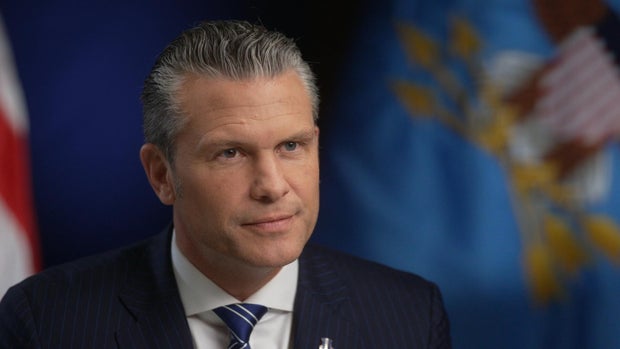
BRAVO: That day was just another day in the war for us, until the moment where we got hit by an Iranian weapon.
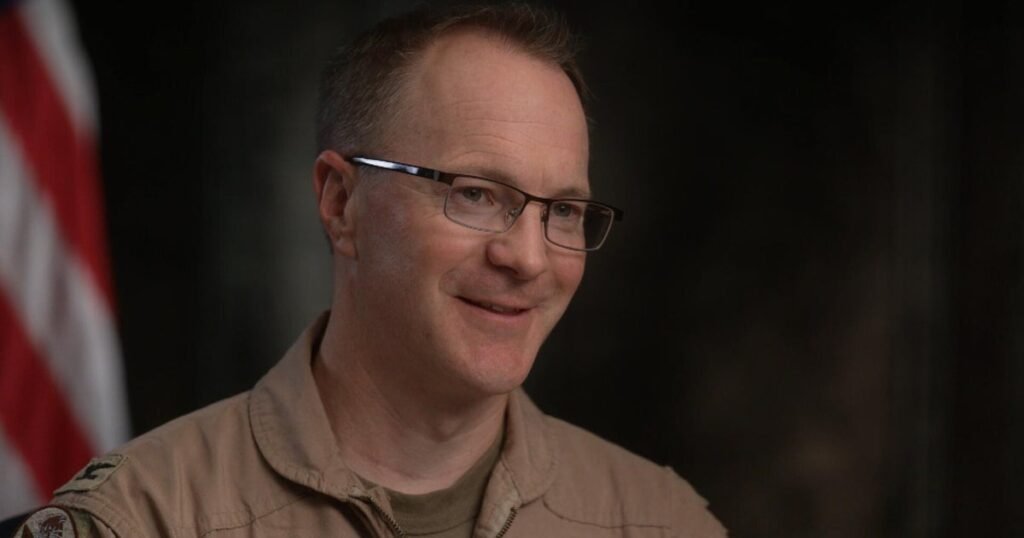
This is Bravo, one of the two officers shot down over Iran. Neither has spoken publicly until now.
BRAVO: I think the best way I’ve been able to describe that moment was getting hit by a freight train.
We’ve agreed to call the weapon systems officer by his mission call sign, Bravo, due to security threats from Iran.
BRAVO: We do all we can to try to save the aircraft. It was evident that that wasn’t possible. And soon thereafter, we ejected and found ourselves floating over the heart of Iran.
NORAH O’DONNELL: So within seconds, you’re ejecting? That’s how quick the decision is?
BRAVO: It is. I will be thankful, to my dying day, for my pilot and crewmate, Alpha, for saving our lives and ejecting us.
After they ejected, Alpha and Bravo found themselves 5 miles apart, separated and alone on the ground in the rugged Iranian desert. Alpha landed safely. Bravo was lucky to be alive.
BRAVO: My parachute was damaged in the initial attack. At one point when I looked up and saw no parachute, that was the most terrifying thing I’ve ever seen. So I paused, right then. And I prayed, “Lord, your will be done. But if I’m getting through this, I need help.”
NORAH O’DONNELL: While you’re in the air.
BRAVO: Yeah.
NORAH O’DONNELL: Is that almost like free-falling or how would you describe that?
BRAVO: Free-falling is a good way to put it. I wasn’t focused on the speed at which I was falling. I was instead focused on trying to correct the problems that were in front of me and doing anything I could to unfurl or pull pieces of the parachute loose.
We’ll never know just how fast Bravo was falling, but we do know the military trains to survive hard landings.
NORAH O’DONNELL: So how fast do you think you were going, when you hit the ground?
BRAVO: Based on my description and the injuries that I had, the professionals think I hit the ground, going somewhere between 70 and 100 mph.
NORAH O’DONNELL: How did you survive that?
BRAVO: A modern-day miracle. I believe that it’s a testament to God’s provision in my life to bring me through that moment in a way that didn’t prevent injuries, but prevented any catastrophic injuries that would have affected my ability to survive.
The fall broke Bravo’s back. He also sustained a broken arm, broken shoulder, sprained ankle and was bleeding from cuts and scrapes to his head and face.
BRAVO: I had injuries, but we all train to adapt and overcome the things that are– that we’re faced with. I moved as quickly as I could, despite the injuries, away from the place that I landed.
NORAH O’DONNELL: It’s dark, right? And can you tell me what you see around you?
BRAVO: It is dark. But much like early morning hunting trips, you know, the sun starts to come up and you can start to perceive elements of the environment around you. Iran is the size of Alaska. And in the heart of Iran, where we were,
there are high desert valleys, but also amazing craggly cliffs. And so I find myself in one of those valleys with cliffs on either side.
Bravo told us the safest place for him to go was up, so he quickly made the decision, despite his broken bones, to hike and climb up a 7,000-foot ridgeline.
NORAH O’DONNELL: Given your injuries, how did you find the strength to make it up the mountain?
BRAVO: Never let a lack of motivation put you on Iranian TV.
NORAH O’DONNELL: You were thinking that?
BRAVO: Absolutely.
Soon after the crash, an Iranian news anchor announced a bounty for the capture of the Americans.
Videos emerged on the internet of armed groups hunting for the downed crew.
BRAVO: I can tell you, for a fact, that they were looking for me.
According to U.S. military sources, Iranian forces got to within a few hundred meters of Bravo.
GEN. CAINE: There was clear intent out of the Iranian ground force to come find those two guys.
Gen. Dan Caine is chairman of the Joint Chiefs of Staff and a former fighter pilot himself.
GEN. CAINE: When you think about the risk of them being potentially trotted through someplace downtown in Tehran on TV, that’s not a fun thing for anybody.
CBS News 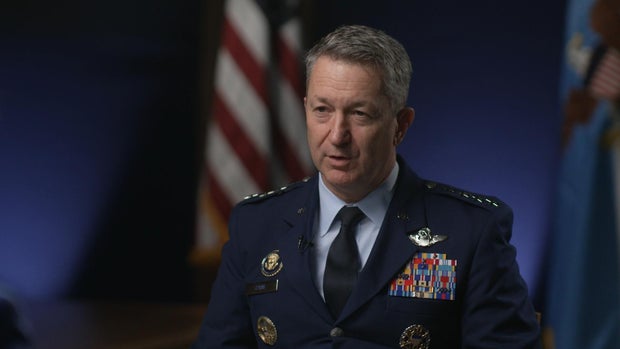
ADM. BRAD COOPER: We were tracking Iranian forces like BBs. There were about 1,500 within a 10-mile radius, and we were watching them very closely.
Six hours in, the U.S. had its eye on Alpha, the pilot. This is declassified video of the risky daytime raid to pick him up, two helicopters of the 21 aircraft deployed.
Videos posted on social media showed American helicopters taking fire.
SECRETARY PETE HEGSETH: It was a gun fight all the way in and all the way out. But they got Alpha back. And then we began to– immediately, I mean you’re celebrating that Alpha’s back, but you realize there’s– the job’s only half done.
Bravo was still missing. Alpha’s rescue force attempted to also locate him but was unsuccessful and eventually withdrew.
Then, as night fell on that first day in Iran, a message from Bravo …
NORAH O’DONNELL: When were you first able to send a signal?
BRAVO: As soon as I found a spot that I felt provided some concealment, I started working on– toward communication.
NORAH O’DONNELL: What did you say in that message?
BRAVO: When I got to the moment where I could review and think about all that I’d gone through, I sent, “God is good,” as a recognition of all that he had brought me through.
ADM. BRAD COOPER: There was a “I’m hurt, I’m moving,” and there was a “God is good” message that came in there. Now we knew he was alive. He’s moving. OK, let’s keep planning.
CBS News 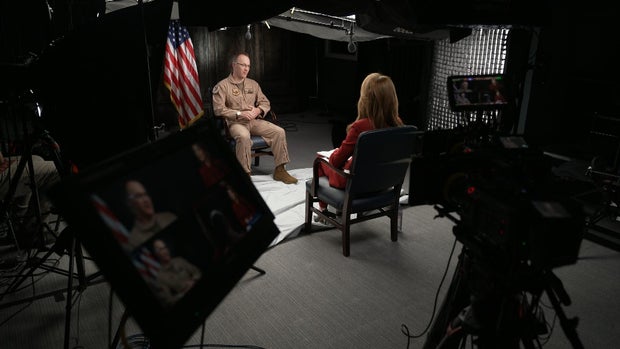
SECRETARY PETE HEGSETH: There was the thought of maybe going on Friday night first. But there just– it just didn’t line up. That was a really tough decision. I’ll never forget being in the situation room and saying, “OK, I guess we’re gonna roll 24, which means, “Hey, Bravo’s gonna be out there for basically 24 hours more.”
Bravo would have to survive with almost no water and no food, in the wind and the cold of the high mountain desert, for another full day. In the end, it was the CIA that played a pivotal role, launching a multipronged campaign, which included deception to confuse Iranian forces and top-secret technology to pinpoint Bravo’s exact location.
To clear the way for his rescue, American bombers and drones hit Iran’s Revolutionary Guard forces nearby, as seen in this newly declassified video. Nearly two days after Dude 44 went down, it was time to go in for Bravo.
NORAH O’DONNELL: And how many special operators did that involve?
ADM. BRAD COOPER: That second operation had about 92 people on the ground. This would be the first U.S. boots on the ground in 46 years–
NORAH O’DONNELL: In Iran?
ADM. BRAD COOPER: In Iran. We had about several hundred in the air, and there were probably 3,000 to 5,000 supporting overall. It was an operation inside an operation.
NORAH O’DONNELL: So in order to get out one, there were close to 100 other service members involved in risking their lives on the ground?
GEN. CAINE: Norah, I think what you need to know is we would have sent more to go get the back-seater.
BRAVO: I don’t know the specifics of what they sent, but I’m glad they sent it.
The force came in on two large search and rescue planes and landed on a makeshift desert airstrip. They then unloaded small “Little Bird” helicopters capable of reaching Bravo on the ridgeline several miles away.
This is Bravo on the ridgeline waiting to be picked up. The Pentagon declassified this video of the rescue. We asked Gen. Caine to take us through it.
CBS News 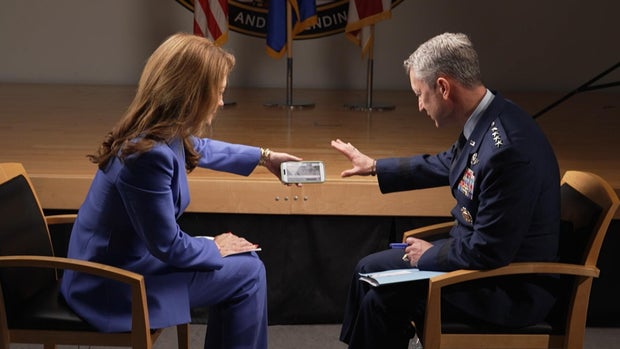
GEN. CAINE: Well, we’re looking at a feed from a intelligence surveillance and reconnaissance asset. That’s 44 Bravo up there. I’m quite sure. And we’ve got two special forces folks coming forward and it looks like they’re bringing him out.
The two service members on either side of Bravo were elite Air Force pararescue operators known in the military as PJs.
BRAVO: The moment a PJ showed up to me on that ridgeline was one of the greatest moments of my life. And I don’t know how to say it any more clearly than that. Thank you for all that they did.
NORAH O’DONNELL: What did your rescuers say, when they got to you?
BRAVO: The specific conversation, I think, I’ll leave for another time, as I don’t want to release anything that’s not just my story to tell.
NORAH O’DONNELL: What did you say to them?
BRAVO: “Let’s go.”
Bravo was in American hands but not out of danger. Back at the makeshift airstrip, the rescue plane’s landing gear was stuck in the desert sand, and the planes could not take off.
NORAH O’DONNELL: You had more than 90 service members on the ground that then needed to be rescued.
ADM. BRAD COOPER: We had more than 90 of America’s most elite service members on the ground. And our focus at that point was to make sure we got them safely out.
It took a clandestine unit of the U.S. Air Force to get Bravo and the 90-plus special operators out of Iran. The U.S. then bombed its own marooned aircraft, so no technology fell into Iranian hands.
Fifty hours after being shot down, Bravo was safe, rescued as the sun rose on Easter Sunday. Back home in the U.S., his wife waited for a call.
NORAH O’DONNELL: What was that call like?
BRAVO: I was really proud of her and grateful for the strength that she showed.
NORAH O’DONNELL: What do you want the American people to know about this rescue mission?
BRAVO: This is not a story about what I went through. Instead, it’s a story of the teamwork, the training, of the faith, of the decisions and the leadership to do something that will live in history as an example of what America’s willing to do in order to uphold our promise and leave no man behind.
Editor’s note: Alpha, who’s already back flying for the Air Force, declined 60 Minutes’ request for an interview due to security considerations. He expressed his gratitude for the rescue of both himself and Bravo.
“I am still in awe of the professionalism and tactical prowess of the Combat Search and Rescue specialists and the Joint Force who executed the rescue missions of me and DUDE 44 Bravo, both those in theater and behind the scenes,” Alpha said in a statement. “Words cannot capture how thankful my family and I are and how proud I am to serve alongside each and every one of them.”
Produced by Keith Sharman. Associate producers, Roxanne Feitel and Julie Morse Goff. Edited by Thomas Xenakis.
Read the full story of Bravo’s escape from behind enemy lines in Iran.
You may be interested
In the Venezuelan stronghold of Doral, some voters discouraged by Trump’s policies ahead of midterms: “I feel, in a way, betrayed.”
new admin - Oct 25, 2026Latinos voted in record numbers for President Trump in 2024, but polling shows that voting bloc is up for grabs…

Alabama man says he found wife with a self-inflicted gunshot to the head. Security cameras tell another story.
new admin - Oct 25, 2026It was Tuesday, Nov. 15, 2022, and a small strip mall in Huntsville, Alabama, was teeming with police activity. The…

New memorial honors Gulf War veterans
new admin - Oct 25, 2026A new memorial honors veterans of the Gulf War who liberated Kuwait from Saddam Hussein. Eleanor Watson has the story.…