


At White House, College Leaders Plead for Federal Action

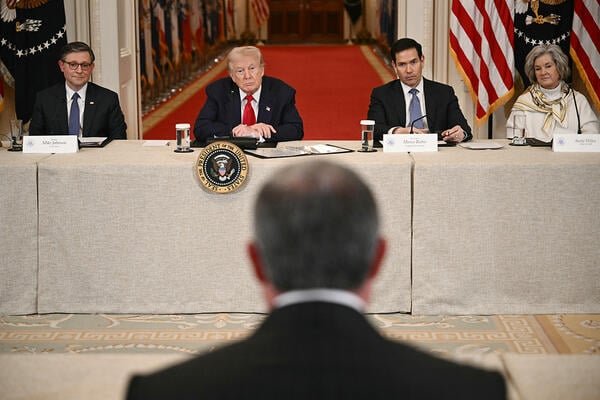
Declaring that “a lot of really bad things are happening” in college athletics, President Donald Trump said Friday he’s planning to draft an executive order to overhaul the system.
What would be in the order is unclear, but Trump said at the end of a two-hour roundtable about the future of college athletics that he would like to return to a system where student athletes are compensated primarily via athletic scholarships.
He acknowledged that any executive order would likely face a court challenge.
Trump repeatedly warned that without significant changes, college athletics threatens to bankrupt institutions. “Many are going to go down the tubes,” he said of colleges.
Several court rulings and settlements have upended college athletics in recent years. In 2021, judges declared the NCAA restrictions on compensation a violation of federal antitrust laws, paving the way for student athletes to profit from use of their name, image and likeness as well as to share in revenue generated from their sports. Colleges that opted in to a recent settlement, which took effect last July, agreed to pay at least $20 million per institution in revenue-sharing payments to athletes each year.
Those changes have driven up the cost of running an athletics program and led to increasingly dire warnings about the sustainability of the model. Some athletic departments are running up larger deficits and taking on debt, while others are looking to private equity or Middle Eastern investors for capital. And college officials say program cuts are likely.
“The time for incremental tinkering has passed,” three senior University of Louisville administrators wrote in an open letter last week. “College athletics needs structural reform, and it needs it now.”
In the letter, Louisville president Gerry Bradley as well as the university’s athletic director and board chairman detailed the athletics department’s expenses, explained how sports contribute to the university and its surrounding community, and offered some policy recommendations.
Two of the university’s 23 sports are running in the black; the overall department is facing a $12.5 deficit. Cash reserves have dropped from $34 million to $3.4 million and the university is using a “$12 million institutional subsidy, a $200-per-student athletic fee and a $25 million line of credit” to bridge the gap, they noted.
“Louisville’s situation is not the exception—it is the rule,” they wrote. “Across the country, from the wealthiest programs in the nation to those fighting simply to stay afloat, the financial picture is remarkably and alarmingly similar.”

The Louisville women’s basketball team is running a $4 million deficit, according to college administrators.
A Plea for Federal Action
Speakers at Friday’s roundtable reiterated that point and emphasized the need for urgent action from federal leaders.
“College football has become a runaway financial train,” said Pete Bevacqua, the athletic director of the University of Notre Dame. “We need regulations, financial transparency and repercussions.”
More than 50 people, including college administrators, professional sports executives and former coaches, attended the discussion, which was held at the White House as the Trump administration continued its war on Iran. No athletes participated, and aside from Sarah Hirshland, executive director of the United States Olympic and Paralympic Committee, no one else at the table specifically represented women’s or Olympic sports. Experts have warned those sports are likely to be cut as colleges focus on revenue-generating sports such as basketball and football.
“The people he has in the room today will not solve the problem of college athletics; they have such a narrow viewpoint,” Karen Weaver, an adjunct assistant education professor at the University of Pennsylvania and former athletic director, told Inside Higher Ed. She wasn’t optimistic that the roundtable would lead to substantial progress on an issue that Congress has been trying to tackle for years.
But Tim Walsh, managing director of strategy and operations at the consultancy Huron, said that when the president is involved, “all bets are off.”
“So we’ll all be kind of watching with bated breath for what may emerge publicly or in reality around some of these issues from that conversation,” he said. “These problems aren’t new and have been evolving for many years. They’ve just gotten dramatically worse in the last couple of years, so everybody’s desperate for action.”
For years, the NCAA, athletic conferences and universities have seen federal reform as necessary to any larger overhaul that makes the system more sustainable. The NCAA wants Congress to grant it an antitrust exemption, create a national set of rules related to NIL instead of the state-by-state patchwork that governs it now and prohibit student athletes from being recognized as university employees.
But while lawmakers have held numerous hearings about the state of college athletics, potential reforms and proposed legislation, no bill has passed the House or Senate. House leaders are hoping to change that.
Speaker Mike Johnson, the Louisiana Republican who sat next to Trump at the roundtable, said he thinks he has the votes to pass the Student Compensation and Opportunity through Rights and Endorsements (SCORE) Act, which would replace state NIL laws with a federal standard and grant the NCAA a limited antitrust exemption. The House was supposed to vote on the SCORE Act in December, but it was pulled from consideration after some Republicans objected to it.
Johnson expects to schedule another vote on the SCORE Act in the next few weeks. He hopes that legislation can serve as the foundation for talks with the Senate.
Sen. Ted Cruz, a Texas Republican who has been a leader on this issue in the upper chamber, said at the roundtable that while the SCORE Act has “many good elements,” no Senate Democrats support it and they need at least seven Democrats to vote for it.
“There’s a number of senate Democrats who care about this but haven’t quite gotten to the point of saying yes,” he said.
He called on those in the room and at universities to call their senator and explain that programs could disappear and students could lose scholarships.
“If Congress doesn’t act, we are very quickly gonna be in a world of 30 to 50 college football teams that are basically a mini NFL, and the Division II and Division III schools are gonna be left behind,” Cruz said. “And the millions of college athletes for whom scholarships provide an avenue for them to get an education that they never would have had, that’ll go away. That would be an absolute travesty if we let that happen.”
‘Financial Death Spiral’
The drumbeat for reform has been getting louder as colleges prepare for the second year of revenue sharing, when the cap rises from $20.5 million to just over $21 million, said Weaver, who hosts a podcast for university leaders about athletics and has a book coming out in the fall on the issue. The cap on revenue-sharing payments will grow to $32 million over the next decade.
“You weren’t a cool kid unless you opted in [to the revenue-sharing agreement],” Weaver said. “Now the rubber hits the road because they realize how hard it was to raise the money this year … Now they’ve got to do the same thing next year and the year after that and the year after that. Their donors are going to be exhausted, if they’re not already.”
Walsh from Huron said that the first year of revenue sharing has shown that the cap is more of a floor and institutions are spending beyond the initial $20 million or so. The growing bill for revenue sharing as well as varying NIL rules and inconsistent enforcement has created “this financial death spiral where they’re just going to have to spend more and more money to try to keep up,” he said. Some institutions are also facing other headwinds from enrollment declines to research funding disruptions, compounding the pressure on administrators.
Still, Walsh noted that none of the big players in college athletics has yet backed out of the arms race. He thinks that’s because they are holding out for the next round of contracts with entertainment companies for TV rights, which could provide a significant financial boost. The current media deals expire starting in 2029, he said, though that timeline could change.
“Everybody’s just trying to survive until then and make sure they’re as well positioned as possible,” he said. “Those media deals are really the trigger for the next phase of intercollegiate athletics.”
But that’s an expensive waiting game, he said, and only a small segment of higher ed will benefit from the potential windfall that the new media deals could provide. “Everybody else is just holding on for dear life,” he added.
Weaver agrees that the media deals are the current light at the end of the tunnel for some colleges and universities. For many others, running a D1 athletics program is becoming nearly financially prohibitive. She expects the current landscape to prompt college leaders to make some overdue decisions about their approach to athletics.
“What has not helped us in this situation is too often we viewed athletics as a third rail rather than having informed discussions about how the landscape is shifting, and part of that was because of the passion the trustees and others have had about athletics,” she said. “But it was very unrealistic [for them] to imagine, ‘We were going to be a top 10 team and all we have to do is find a new football coach and pay him more.’”
You may be interested

Stocks down as oil prices soar amid war with Iran, hit four-year high
new admin - Mar 09, 2026Oil prices have soared as the war against Iran continues on its 10th day, hitting $100 per barrel for the…
Avicii’s Former Manager’s Lawsuit Against DJ’s Estate Dismissed
new admin - Mar 09, 2026[ad_1] The District Court in Sweden ruled to dismiss a lawsuit Avicii‘s former manager, Arash “Ash” Pournouri, filed against the…

Monty Don names ‘most useful thing you can have in your garden’
new admin - Mar 09, 2026Monty Don has told people 'don't try and save money' on one important tool every gardener needs. The Gardeners' World…