



At Wenzhou-Kean, Faculty Say Leaders “Keep Things Hidden”

Robert Stark is on a mission. The assistant professor of English at Wenzhou-Kean University in China has made 19 public records requests to New Jersey–based Kean University, his university’s parent-slash-sibling institution, and two complaints to its accreditor, the Middle States Commission on Higher Education. He’s seeking answers to basic employment questions and governance inconsistencies that he said Wenzhou-Kean officials have failed to sufficiently address. For example, why isn’t social insurance—the Chinese equivalent of Social Security deductions that American employers are required to withhold—coming out of his paychecks? And why hasn’t the institution ever established a full-fledged academic senate, as dictated by its founding documents?
These questions and others have been met with noncommittal answers and redirects, but most of all, silence, said Stark.
“We’re dealing with the most artful constructive ambiguity that I’ve encountered. It’s astonishing how effective and how useful this prevarication is,” Stark said. “Kean can always blame everything on WKU, and WKU can always blame everything in Kean.”
Wenzhou-Kean is one of roughly 20 American-Chinese joint ventures established during a rapprochement of Sino-American relations in the 2000s and 2010s. Eight of the partnerships—including one between Tsinghua University and the University of California, Berkeley, and another between Georgia Tech and Tianjin University—have ended in recent years amid pressure from U.S. lawmakers concerned about suppressed academic freedom and national security risks.
Chinese President Xi Jinping, then-secretary of Zhejiang Province, where Wenzhou-Kean is based, was present when Kean and Wenzhou University inked their deal in 2006. Dawood Farahi, president of Kean at the time, told The New York Times that the decision to open the university was a financial one.
“Education is really a commodity,” Farahi told the Times. “It’s a commodity that can be sold and marketed, so why don’t we take advantage of what we have and market that to China since they want it?”
The working name then was Kean University–Wenzhou, and the institution would grant Kean degrees, teach the public university’s curriculum exclusively in English, follow its admissions standards and uphold American ideals of academic freedom and integrity. If any of those ideals changed—no matter how small—the university would walk away, Farahi said.
But according to the current and former faculty members who spoke with Inside Higher Ed about their experience working at the university—many of whom requested anonymity out of fear of retaliation from university officials—the Wenzhou-Kean of today bears little resemblance to the picture Farahi painted in the press 20 years ago. Since the university opened its doors in 2014—eight years after the initial deal was reached—faculty members have complained of insecure and obfuscatory employment agreements, a lack of shared governance, wrongful termination, discrimination, retaliation and a slow but steady push to strip the university of its Americanness.
In an emailed statement to Inside Higher Ed, a Kean spokesperson called Wenzhou-Kean “an extraordinary Sino-American educational partnership.”
“Each year, many Kean University students, including first-generation college students and those traveling abroad for the first time, have life-changing academic experiences studying at WKU. Those experiences are made possible by nearly 300 accomplished international faculty members representing 43 countries and regions who are employees of WKU,” they wrote. “Individual personnel matters arise at colleges and universities around the world. At WKU, those matters do not change the university’s focus on delivering outstanding teaching, advancing research and preparing students to succeed in a global society.”

Former Kean president Dawood Farahi (far left) with Xi Jinping (center) at Kean University in 2006.
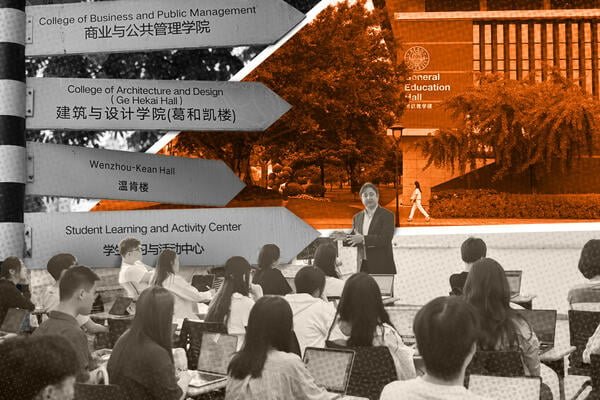
The nine Wenzhou-Kean faculty members Inside Higher Ed spoke to disagree. Their stories share a similar thread: confusion about their employment rights at the university, which is neither fully American nor fully Chinese. When it opened, Wenzhou-Kean faculty members were employed and paid by Kean, but that changed in 2018 when the university shifted their employment to Wenzhou-Kean directly—a system shared by other American-Chinese institutions like Duke Kunshan University and New York University Shanghai, officials said at the time. The change troubled Kean’s faculty union, which argued that academic freedom and tenure protections might no longer be upheld under the new regime. A handful of academic leaders, including the vice chancellor of academic affairs and college deans, remained Kean employees, and to this day Kean retains the final say on faculty hiring decisions.
Each American-Chinese university operates slightly differently and with its own set of rules and standards, but the situation at Wenzhou-Kean illustrates the perils that can befall faculty working in a system where it’s not clear who is in charge.
Trust ‘Broken Irreparably’
Earlier this year, a rumor started circulating among the faculty: Non-tenure-track professors over 60—which was, until 2025, the legal retirement age for men in China—were no longer eligible for a visa, and therefore their contracts would be terminated or left to expire without renewal. One faculty member said their supervisor assured them Wenzhou-Kean officials “had no knowledge” of such a rule.
Months later, faculty learned the rumor was true. At a May 12 staff meeting, Kristen Hartman, director of Wenzhou-Kean’s Learning English for Academic Purposes program, announced that professors older than 60—who make up about a quarter of the program’s 50-odd faculty, several professors estimated—would be let go. A week later, the human resources office sent all faculty a formal email, obtained by Inside Higher Ed, stating that China’s foreign experts bureau would no longer approve work permits for applicants over 60. The rule wouldn’t be enforced for a year, officials wrote, and the bureau specified one exception: faculty classified as “Category A” talent would not be subject to the age limit.
To be considered Category A, a faculty member must hold the rank of associate professor or higher, be the first or corresponding author on at least three articles published in “high-impact international scientific journals,” or have won a Nobel prize, among other potential qualifications, according to the guidance shared with faculty. Most tenured or tenure-track faculty would fall into Category A. Lecturers—who make up nearly half of the faculty body at Wenzhou-Kean—likely would not.
When you go to somebody, like in HR, they pass the buck to somebody else.”
—Wenzhou-Kean lecturer
The professors panicked. In WeChat group messages shared with Inside Higher Ed, several faculty members expressed concern that documentation about performance and reappointment criteria has never been made available to them; it’s “as elusive as Melville’s white whale,” one person wrote. Another faculty member said that trust in Wenzhou-Kean’s leadership “has been broken irreparably.” Other professors said they were confused about who their employer actually was—Kean, which signs off on their hiring and reappointments, or Wenzhou-Kean, which doesn’t “seem to have any say in our employment conditions apart from firing us,” one person wrote.
Lecturers at Wenzhou-Kean had never been required to publish, one faculty member who has worked at the university for about six years told Inside Higher Ed. “Suddenly now, if we can manage to publish, or have published, three articles in [top journals], we may not be fired,” they said.
Affected faculty were invited to contact human resources, but the department is notoriously difficult to get ahold of, several faculty members said.
“It’s just a mess,” the same lecturer said. “I’m talking to the faculty who are affected on a fairly regular basis, and we’re concerned, but we don’t really get much support or feedback. Just a lot of silence … When you go to somebody, like in HR, they pass the buck to somebody else.”
Kean University officials were apparently unaware of the new policy, another lecturer said. During an annual all-faculty meeting at Wenzhou-Kean after the announcement was made, Kean Provost David Birdsell was asked whether he’d heard about the 60-plus age limit; he said he had not, according to several faculty members who were present.
A few days later, professors over 60 were asked to set up a meeting with Vice President for Academic Affairs Eric Yang and several other Wenzhou-Kean administrators to discuss their situation. Some faculty referred to the meetings as “the murder board,” believing they “would be judged as savable or not,” another lecturer told Inside Higher Ed.
It’s unclear how many of these meetings have taken place so far. None of the over-60 lecturers that Inside Higher Ed spoke to had attended a meeting as of late July. One said she sent potential dates and times but never heard back. Others guessed that maybe six or eight meetings had occurred before the end of the semester in June. Right now, they are stuck in uncertainty about whether their contracts will be terminated, and how soon.
No Explanations, No Severance
Chinese employment law leaves Wenzhou-Kean professors over the retirement age particularly vulnerable. Chinese employers use two types of employment contracts: labor contracts, which are given to employees under retirement age and which guarantee a host of employment rights—including mandatory severance—and service contracts, which are issued to workers over retirement age and do not carry such benefits.
Kean officials never specified which type of contract they were asking faculty members—many of whom are not from China and are unfamiliar with the law—to sign. In documents Kean provided to MSCHE in December in response to Stark’s initial complaint, which Inside Higher Ed obtained via a public records request, university officials said that faculty members are not subject to the mandatory retirement age and that the university does not treat older professors any differently.
“WKU appoints or reappoints all faculty members based on the same process and performance evaluation, regardless of age and will continue to do so,” they wrote. “Retirement-age faculty members are hired with no salary differential from other faculty and are provided the same university benefits (health insurance, retirement supplement, etc.) If they reach the retirement age during their time at WKU, they maintain their full salary and benefits.”
Officials also told MSCHE that “moving forward, all new contracts will explicitly state whether the employee is on a labor or service contract.” It’s unclear whether that change has been implemented.
I’ve seen deportations before. I’ve seen faculty kidnapped, but I’ve never seen this disregard for forming contracts and total failure to engage with faculty governance.”
—Robert Stark, assistant professor of English at WKU
Mark Lawson, who worked as a lecturer at Wenzhou-Kean from 2022 to 2025, said he felt blindsided after learning he was on a service contract. He didn’t know there was a difference until he spoke to a lawyer in the spring of 2025.
That March, Lawson’s dean recommended him for a one-year, conditional appointment—rather than the standard three-year renewal—because he failed to “follow policy regarding absences” after he was out sick for several days and did not complete his performance review by the deadline, according to the reappointment-recommendation letter he shared with Inside Higher Ed. The letter was sent to Kean Provost Birdsell, who recommended to Kean President Lamont Repollet that Lawson not be reappointed at all. In a May 1, 2025, letter to Lawson, Repollet agreed. Neither specified why they departed from the Wenzhou-Kean recommendation.
Afterwards, Lawson had trouble reaching any Wenzhou-Kean officials, including Hartman, his program manager. “They just avoided me after that,” he said. “They just hid from me.”
In Kean’s statement to Inside Higher Ed, the spokesperson wrote that “WKU maintains a rigorous, equitable, achievement-based process for faculty appointment, tenure and promotion that reflects its commitment to academic excellence and student success. As is true across higher education, not every faculty member advances at each stage of the process.”
Another faculty member who spoke with Inside Higher Ed but asked to remain anonymous had a similar experience to Lawson. She was also recommended for a one-year reappointment by Wenzhou-Kean officials after her dean “indicated to me that [it was] because people in the department did not like me,” she said. “I asked him for details; he never provided any details whatsoever.” Again, Kean officials denied the reappointment altogether, with no explanation, she said.
She was under the retirement age, sued Wenzhou-Kean for wrongful termination and won a severance payment in Chinese court, she said. While talking to her lawyer, she learned about China’s mandatory severance law.
“One of my colleagues was terminated the year before. He reached out to me, and he … actually did the same thing that I did, which was to hire a lawyer to try to get his money,” she said. “He only had three more days before the [one-year mark] passed, and that would have nullified his ability to make this claim. And [Wenzhou-Kean] immediately paid him his money. They immediately settled with him.”
Lawson, who was over the retirement age when he started, has not received any severance payment since his contract expired last August, and he doesn’t have the money to chase it down, he said. Though the possibility of severance came up immediately when the university announced that non–Category A faculty over 60 would be terminated, several professors said they heard severance was off the table. Some of them have hired lawyers.
“Since we are being fired, we want our severance pay for every year that we have been contracted to work. Apparently, unless we take legal action, WKU will not compensate us,” one lecturer said.
In their December response to MSCHE, Kean officials stated that Wenzhou-Kean has the “discretion to decide whether to pay severance upon termination for those above retirement age. To date, no faculty member above retirement age whose contract was not renewed has requested a severance package from the university and been denied.”
‘No Shared Governance’
MSCHE ultimately determined that Kean “satisfactorily demonstrated compliance with MSCHE’s standards” and closed Stark’s case, according to a letter the accreditor sent him on Feb. 4. Along with two former Wenzhou-Kean faculty members, he submitted a second complaint in June, which is still under investigation.
Before coming to Wenzhou-Kean, Stark, who is from Scotland, taught at universities all over the world, including Oklahoma State University, Marquette University and the American University of Paris. He said he knows he’s a thorn in the side of Wenzhou-Kean administrators. Some of his colleagues also disagree with his efforts to challenge the university and consider him a rabble-rouser, he said.
Stark—and the lawyers he’s spoken to—believe that he and many other foreign faculty are also on service contracts despite being under the Chinese retirement age. One reason he points to is the missing social insurance payments, which are necessary for a valid labor contract, he said. He has asked Wenzhou-Kean to produce documents that would prove it’s a labor contract, but hasn’t received anything.
“I told the university that since they can’t provide the Chinese labor contract, since they can’t demonstrate that they’re my actual employer, I’m not going to recognize them as my employer,” he said.
In protest, Stark submitted a “formal notice of absent work authority” and did not teach any of his classes this past spring. The university initiated disciplinary proceedings against him in March, but shortly after they “seemed to sort of disappear,” he said.
“I thought they didn’t have the appetite for it,” he said. “Because obviously going into a disciplinary [action] would require them to produce some documents.”
But Wenzhou-Kean officials reupped the proceedings in June after the spring semester ended, according to emails Stark shared with Inside Higher Ed. Stark has refused to participate in the proceedings unless the university hands over the employment documentation he’s been requesting for months.
Everybody knows … if you get on the bad side of an administrator, you won’t be coming back. They’ll just cancel your contract.”
—Jason Homer, Wenzhou-Kean lecturer
He will likely lose his job, but he doesn’t have regrets, he said. He’s passionate about prompting change at Wenzhou-Kean; his concerns about the university began on his first day on campus in 2023.
“I shared an office with these two older guys—one English guy and one Irish guy—and they were both over the retirement age. They were terrified of their contract not being renewed, and they were being asked to go through this annual reappointment process,” Stark said. “This was within my first hours at the institution. I was like, ‘What the hell is this?’ … and I began to look into some of the irregularities there.”
Later, at his first faculty meeting, “every single member of the faculty kind of bowed their head and just let whoever’s running the meeting say what they wanted to say,” he said. “At that point, I made a conscious decision that I was going to change the culture at the institution and began speaking up.”
The culture that Stark described was echoed by several other faculty members who spoke to Inside Higher Ed. Several alleged racial discrimination, harassment and bullying by leadership. One faculty member said that those who were reappointed for future years were discouraged from speaking to the professors who were not.
“People just avoid eye contact in the hallway, because everybody knows, if you don’t toe the line, if you raise issues, if you get on the bad side of an administrator, you won’t be coming back. They’ll just cancel your contract,” said Jason Homer, a composition lecturer who co-signed the most recent MSCHE complaint with Stark. “That’s the culture of fear.”
In addition to calling attention to the university’s use of service contracts, Stark has focused on the lack of shared governance at Wenzhou-Kean. The Articles of Association—essentially Wenzhou-Kean’s founding charter, last updated in 2016—state that the university “shall establish academic organizations such as an academic senate and degree appraisal committee,” as well as a “union and other democratic organizations, and hold a Congress of Representatives of Employees to facilitate democratic management and monitoring.”
The university established a three-member Senate Faculty Committee in 2017 to “enhance internal communication within WKU and external communication between WKU and Kean University,” according to Kean’s December response to MSCHE. In addition, the committee provided input on WKU’s “calendar, curriculum, faculty development, university operations, and quality of life.”
In 2019, that committee was dissolved and the university instead sent one representative to participate in Kean University Senate committees. That changed again in 2022, when the representative left Wenzhou-Kean and the university piloted an Academic Affairs Advisory Board made up of eight elected faculty members and three staff representatives. The board was never made permanent.
“While found to be a useful effort, given the young nature of the institution, the feedback suggested that other advancing opportunities for shared governance were more valuable uses of limited faculty time,” Kean officials wrote to MSCHE. Work to “further advance faculty participation in shared governance” is ongoing, they added.
The professors who spoke with Inside Higher Ed said that shared governance at Wenzhou-Kean is nonexistent. “There’s no shared governance, no faculty senate,” one lecturer said. “The Communist Party is in control, and that’s what they do best: control and keep things quiet and keep things hidden.”
Despite their experiences working for the university, many of the professors haven’t written off Wenzhou-Kean entirely. They value teaching at an American university in China and hope to see improvements in the future; one noted that he’d lived in China for almost 10 years and emphasized that the problems at Wenzhou-Kean “aren’t Chinese issues, they are [Wenzhou-Kean] issues.”
Stark is presently in Thailand, where he feels safer, awaiting the outcome of the disciplinary action. The deadline to appeal the termination was July 20, but he declined to do so. He will continue to push for answers from the university and its American accreditor.
“I worked in Kuwait. I worked in Lebanon. I’ve worked in Mexico, Korea, England, Paris, [Scandinavian] countries, North America and in America as well. I’ve seen deportations before. I’ve seen faculty kidnapped, but I’ve never seen this disregard for forming contracts and this total failure to engage with faculty governance like that,” he said. “I’ve never encountered it anywhere.”
You may be interested

Diesel prices push to new all-time high as oil prices jump after key Saudi pipeline shut
new admin - Sep 14, 2026The price of oil jumped Monday after Saudi Arabia shut a critical pipeline and talks about the future of the…

Why We Haven’t Measured College-Level Learning (column)
new admin - Sep 14, 2026[ad_1] Two weeks ago in this space, I made a case that this vulnerable moment for higher education—of diminishing public…

Israeli official calls for directors of “NAZA” documentary alleging use of AI in Gaza to have nationality revoked
new admin - Sep 14, 2026Israel's culture minister said he would act to revoke the citizenship of the creators of the "NAZA" documentary after it…