
Appeals Court Rules Against Florida’s Stop WOKE Act

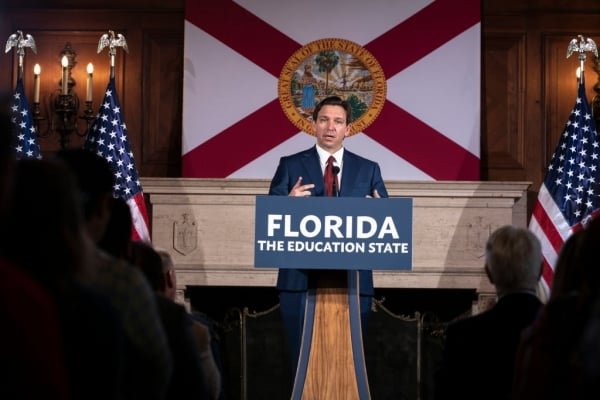
DeSantis signed the legislation into law in 2022, but parts were blocked in November of that year.
The Washington Post/Contributor/Getty Images
A 2022 Florida law that limits how professors can discuss race and gender in the classroom violates the First Amendment, a federal appeals court ruled Tuesday.
In a 2-to-1 decision, the Court of the Appeals for the 11th Circuit upheld a lower court’s decision blocking the law. Free speech advocates had warned that the lawsuit against the law, known as the Stop WOKE Act, could demolish the tradition of academic freedom in American higher education if the judges sided with the state.
Florida’s lawyers argued, essentially, that professors’ speech in the classroom is government speech, so the state can restrict what they say. Other states have made similar arguments as they enacted bans on diversity, equity and inclusion. An Alabama district judge ruled last August that professors aren’t protected by the First Amendment because their “in-class instruction constitutes government speech.” Those plaintiffs appealed to the 11th Circuit, and their case is still pending.
Judge Britt C. Grant, appointed by Trump in his first term, wrote that Florida’s argument, that it has total control of classroom speech because it pays the professor’s salary, was a “a breathtaking assertion of power to ban unpopular ideas from public discourse in the very places the State’s own statutes recognize as centers of inquiry.”
Grant added that “though the government has plenty of ways to promote its own viewpoint, puppeteering every university professor in the state is not one of them.”
Free speech advocates and Florida faculty celebrated the ruling as a clear victory that strengthens academic freedom protections. The Foundation for Individual Rights and Expression noted in a news release that six other appellate circuits have also held that the First Amendment protects faculty when they are teaching and researching.
“We are glad to see the ruling by the court to deem parts of Florida’s classroom censorship unconstitutional,” Andrew Spar, president of the Florida Education Association, said in a release. “For too long, ideas and concepts that encouraged critical thinking were blocked simply because some Florida leaders didn’t agree. This ruling is clear—you cannot limit the rights of others just because you don’t like what they say.”
You may be interested

Clarks' £89 trainers with 'soft cushioning' have price drop in six colours with deal
new admin - Sep 13, 2026A money-saving offer means shoppers can save on the Clarks Code C Lace trainers Source link

Can you pass the official UK citizenship test? You need 18 out of 24 to pass
new admin - Sep 13, 2026The questions are taken from the official Life in the United Kingdom handbook - and they're harder than you think.…

Search underway after Indonesian passenger ship carrying more than 240 people loses contact
new admin - Sep 13, 2026Indonesian rescuers launched a search operation Sunday local time after authorities lost contact with a passenger ship carrying more than…