

A Seminary Where Queer Students Belong

Tyrone Davis grew up in a Christian family in Miami, spending Sundays at church listening to sermons that explicitly condemned homosexuality. As a Black, queer immigrant, he said navigating religious spaces often felt fraught and isolating.
After moving to New York City, Davis immersed himself in the theater community and eventually reconnected with his faith through Unitarian Universalism, a progressive, nondenominational tradition inclusive of LGBTQ+ people.
“One of the saddest things about being a queer person who has gone through a religious experience where we’re getting these messages of not belonging is that we do the thing that is natural for a human to do: ‘This place doesn’t accept me, so I’m going to reject the church. I’m going to reject spirituality completely,’” Davis said.
“But queer people find spiritual experiences in so many different spaces,” he added. “So it’s crucial that queer and trans people are in these religious spaces because that’s how we transform them.”
Today, Davis is pursuing a master’s of clinical social work at Hunter College while also earning a master’s of divinity at Union Theological Seminary, a 190-year-old seminary known for advancing progressive values. He hopes to combine both fields as a therapist and sexuality educator, helping clients explore how religion and sexuality intersect in their lives and heal from religious trauma.
“A lot of my peers are doing amazing religion-centered work and going into clergy,” Davis said. “But I’m very much interested in the cleanup. I’m interested in the ways religion has harmed queer communities mentally, spiritually, emotionally and physically.”
“Whether it’s homelessness among queer youth or substance abuse—which is a huge issue among gay men, particularly in New York City—we need forms of therapy and intervention that don’t ask clients to choose between spirituality and sexuality, but instead help them engage with both,” he added.
An inclusive seminary: For Davis, Union offered something he had long searched for: a faith-based academic community where queer identity was not merely tolerated, but embraced. Nearly half the students in the seminary’s most recent entering class identify as LGBTQ+, said Su Yon Pak, vice president of academic affairs and dean at Union.
That sense of affirmation extends to Union’s leadership. Many administrators and faculty members are openly queer and/or vocal advocates for LGBTQ+ rights. Pak said her own experiences as a queer Asian American theologian shape how she supports students navigating spirituality and belonging.
“Union has always been a haven for people who felt excluded in religious spaces,” Pak said. “Our radical welcome to queer people is not a new thing. It is in our belief and our core value that inclusivity and radical welcome are actually at the heart of the Christian gospel.”
Pak said Union was founded as a Protestant Christian seminary but has since embraced interreligious engagement, with students and faculty coming from a variety of Christian traditions as well as Buddhist, Muslim, Hindu and Sikh communities, alongside those who identify as atheist or spiritual but not religious.
“Our umbrella is very large, and within that we have various groups joining us and seeing it as a place where they can truly and authentically be themselves,” Pak said. “You cannot fully learn and explore all the ways education can shape you if you’re shutting out part of yourself. So we always say, ‘Come as you are. Bring the whole of yourself to the work of study, education and formation.’”
In practice, Pak said that radical welcome begins in the classroom. Union offers courses on queer theology and sexual ethics, including one taught by a Union alum focused on ballroom culture—an underground queer subculture created by Black and Latino communities in Harlem that centers on drag, voguing and performance competitions known as balls.
Pak said the seminary also prioritizes support systems for LGBTQ+ students, pointing to Union’s history of housing queer people during the AIDS epidemic in the 1980s.
“During the AIDS crisis, gay men with AIDS were excluded, marginalized and made invisible, so Union housed them,” Pak said. “Within a single semester, you might have three or four men dying, and these were all residents in our residence halls at a time when society was essentially pushing them out of sight.”
“We started providing spiritual care for people with AIDS, and we have a long track record of doing that,” she added. “So we’re quite familiar with what it means to take seriously the experiences of queer and LGBTQ+ people as students.”
Redefining religious spaces: Pak said the political and cultural climate surrounding LGBTQ+ rights has become increasingly polarized, including within many Christian communities. Students and faculty alike, she said, are worried about issues ranging from ICE raids in immigrant communities to attacks on transgender people’s access to health care.
“It’s a direct hit for our students as much as it is for staff and faculty who are also part of those communities,” Pak said. “We could remain scared, but this is a time where we actually need to step in, step up and recognize that we need to support each other.”
Pak argued that far-right conservative theology has become increasingly politicized and said progressive faith leaders have a responsibility to offer alternative perspectives.
“It’s important that progressive Christians and people from other religious traditions speak from their deep convictions and perspectives,” she said.
For Pak, that means publicly championing faith communities where queer people are not excluded, but embraced.
“We have the responsibility to teach that, to speak it and to write about it,” Pak said. “Modeling a different vision of what faith communities can be and speaking to the dominant narrative that queer identity and faith don’t go together. We say no—that is simply not true. They are absolutely essential to each other.”
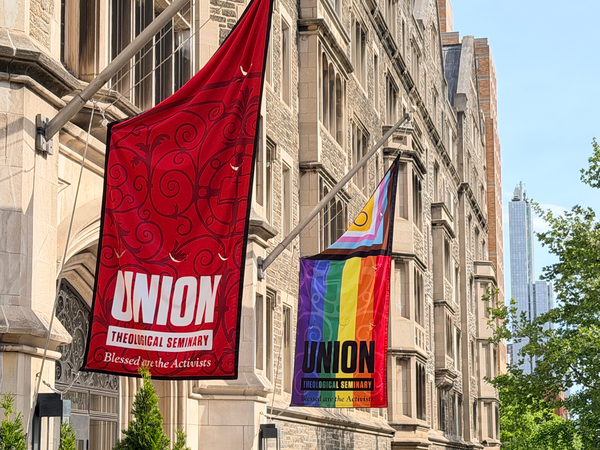
Davis agreed, noting that Union’s large pride flag hanging prominently outside its main building symbolizes a sense of belonging for many students.
“There are a lot of people who don’t find a lot of power in symbols like that, but I am certainly one that does,” Davis said. “If you come from a marginalized community, if you’ve consistently been in spaces where you feel alone, sometimes just having that visual representation is all you need to know, ‘I am safe here.’”
Get more content like this directly to your inbox. Subscribe here.
You may be interested
Extended interview: Becky G on her music, her rise to fame and more
new admin - Aug 17, 2026Becky G speaks with Gayle King about the latest developments in her career, her new music, the intersection of advocacy…
Taylor Swift Praises Phoebe Bridgers’ New Album in Birthday Post
new admin - Aug 17, 2026[ad_1] Taylor Swift can’t stop listening to Phoebe Bridgers‘ new album Lost Weekend. Same, Taylor, same. In a social media…
School vaccination rates inch down again to record low as exemptions reach new high
new admin - Aug 17, 2026U.S. kindergarten vaccination rates inched down again last year and the share of children with exemptions rose to an all-time…