

A New Indigenous President, an Ongoing Reconciliation

Seven years ago, a Native American professor and alumna of Fort Lewis College, Joslynn Lee, called on college leaders to get rid of panels on the campus clock tower that commemorated the institution’s past as a federal Indian boarding school. They included the quote “The children are well-clothed and happy”—a depiction that she considered at odds with the history of federal Indian boarding schools, known for isolating Indigenous students from their families and seeking to rid them of Native American culture and language.
Because of Lee’s advocacy, the panels came down in 2021 in a widely attended ceremony on campus. But the move was just the start of a years-long, multipronged reconciliation process between the Durango-based college and Colorado tribes.
Fort Lewis has since published research on the abuses students suffered at the boarding school on its site, held listening sessions with tribal leaders and ramped up supports and services for Native American students, who make up more than a quarter of total undergraduate and graduate enrollment. This month, Fort Lewis officially welcomed its first Indigenous president, Heather J. Shotton, who previously served as the college’s vice president of diversity affairs and has been heavily involved in its reconciliation work.
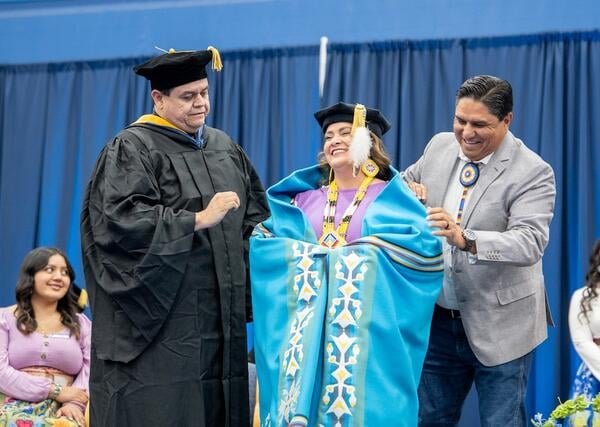
“I stand before you, a Wichita, Kiowa, Cheyenne woman, a descendant myself of boarding school survivors, leading this institution,” Shotton said at her investiture ceremony.
The event opened with a blessing from a Cheyenne peace chief, followed by presentations and performances by the Kiowa Black Leggings Warrior Society and the Otoe‑Missouria Singers.
Shotton told Inside Higher Ed the reconciliation process has been, and continues to be, “the most meaningful work I have done throughout my career.”
“It really has been a collaborative process that has focused on responsibility and healing and keeping that at the center,” she said. The goal has been “not just confronting the history, but how do we move forward?”
Wrestling With the Past
The first step the college took to reckon with its history was to fully uncover it.
Fort Lewis, in partnership with two Colorado Ute tribes, pushed successfully for legislation to embark on a research project about the boarding school, conducted by History Colorado, a division of the Colorado Department of Higher Education.
The report, which came out in 2023, shook campus. It found that children at Fort Lewis Indian Boarding School, which operated from 1892 to 1910, were subjected to poor living conditions, suffered health problems as a result and faced physical and sexual abuse by staff.
“That was such a painful moment when the final report came out … for our campus community, for our students, for anyone on this campus who is a descendant of boarding school survivors,” said Shotton. Her grandparents and other family members attended other federal Indian boarding schools, so she’s seen the effects of the institutions in her own relatives.
“Those intergenerational impacts carry forward,” she said.
Matthew Schaeffer, now the college’s tribal nations coordinator, said that when the report came out his senior year, it weighed on him. He’d seen the clock tower panels removed and knew the college’s history, but reading it in “brutal terms” on paper hit especially hard.
“That can be retraumatizing,” he said, adding that the college offered opportunities for students to read and discuss the findings together, which helped him and other students process the information.
Moved by Fort Lewis’s reflection process, Schaeffer changed his senior research project to focus on how faculty and staff understood their role in the college’s four-pronged reconciliation framework, which focused on tribal nation building, language reclamation, health and wellness, and Indigenous culture and knowledge. His work led him to his current full-time role in the college’s reconciliation department.
“It’s been amazing to see how much we’ve grown,” he said, noting that his team has quadrupled just in the last year. “I think it also just shows that this work is a process. It’s not something we’re going to have all figured out in one year or two years or even five … It’s something that’s continual.”
Making Amends
Since the clock tower panels came down, the college has sought to make reconciliation work a campuswide effort.
A group of faculty, staff and students devised the framework now driving Fort Lewis’s efforts to teach its history, build ties with tribes and support Native American students. The Board of Trustees adopted reconciliation as a priority in its five-year strategic plan. Students now learn about and discuss the college’s past, starting in their first-year experience classes. The campus holds tribal leader convenings, exhibits Native American art and has grown its academic offerings to teach and sustain Native languages—including by training community members as certified Ute language instructors and opening an audio studio, funded by Apple, to preserve Indigenous language and storytelling traditions.

Students and community members gathered in 2021 at Fort Lewis’s clock tower to mark the removal of panels that inaccurately depicted the college’s federal Indian boarding school history.
Last year, the college secured a three-year, nearly $1 million grant from the Program for Leadership and Character at Wake Forest University to launch its Reconciliation Center, a hub for reconciliation efforts, including professional development and curriculum support for faculty and staff members who want to incorporate Indigenous knowledge and topics into their work. This academic year, the college also launched its first Indigenous Policy Institute, an opportunity for students to learn about policy issues relevant to Native communities through research, speakers and a trip to the State Legislature in Denver. Next month, Fort Lewis will break ground on an indigenous garden that will serve as a reflection space on campus and a place to grow culturally significant plants and foods.
The ripple effects of reconciliation are felt across campus, Native students say.
Sunflower Huskie, a Fort Lewis senior, said she didn’t know about the college’s history when she first enrolled. But over the last two years, she’s had multiple opportunities to wrestle with its past and further connect to her Navajo roots.
Last semester, she was chosen as a note taker for listening sessions with local tribe members about the History Colorado report, where she got to hear community members’ lived experiences of the boarding school. She was also asked to share her thoughts on campus climate for Indigenous students.
“Just being able to be there in that space and help and just listen and get a feel of what it had been like, it made me feel really connected,” Huskie said.
She’s also taking a Navajo language course, in which students work one on one with a speaker of the language on a project of their choice. Huskie, a public health major and certified medical assistant, said she partnered with her grandmother to translate a hospital appointment reminder into Navajo because it’s a community resource “that doesn’t currently exist.” She said she learned little of the language growing up, and she and her grandmother never spoke it to each other, but it’s become “really important” to her to learn.
“The language will die out if it doesn’t continue through generations,” she said. Now, “we’ve been enjoying it together.”
Huskie also participated in the first Indigenous Policy Institute, where—inspired by a class on high rates of disappearance and violence against Native Americans—she lobbied state lawmakers to improve alert systems for missing Indigenous people.
She said Indigenous students and people “deserve their voices to be heard, especially in these higher spaces,” and that’s partly why Shotton’s presidency feels empowering to her.
“People think that we don’t exist anymore” and that Native Americans are a relic of the past, she said. “It’s important that we have those higher roles” to show otherwise.
Confronting Challenges
Fort Lewis’s reconciliation work continues to ramp up at a time when education about and supports for historically marginalized groups are under political attack.
While Native American communities have emphasized that tribal identity is not racial but political, grounded in citizenship in specific sovereign nations, they’ve still gotten caught in the crosshairs of the Trump administration’s war against diversity, equity and inclusion. For example, the U.S. Department of Education axed federal dollars to many minority-serving institutions last year, including Native American–serving nontribal institutions like Fort Lewis, which lost $2.27 million in grant funding that historically supported peer tutors, summer bridge programs and other academic supports.
But the college’s reconciliation process has continued, and will continue, through whatever political phases come, Shotton said, because part of the mission of higher education institutions is to engage in “difficult dialogues.”
“We understand the students and communities that we serve and the responsibilities that we have to those communities,” she said. “There are certainly challenges that come with that, whether they are external pressures or just the challenges of dealing with this really painful history. But it is the right thing to do, and we have remained committed to that,” and in doing so, “we are shaping a better future for all of our students.”
She hopes Fort Lewis’s reconciliation work can serve as a model for other colleges and universities looking to collaborate with and make amends to local tribes, including colleges built on Native lands and land-grant universities that have benefited from trust lands, tracts taken from tribes and managed by states to produce income for the universities.
“We really hope that this can be a beacon for other institutions and an invitation for them to engage in the hard work, but the important work, of reconciliation at whatever level is appropriate for them,” she said, “and that we can inspire others to uphold our responsibilities as institutions of higher education to Indigenous communities and tribal nations.”
You may be interested
Flesh-eating screwworm fly is reemerging in Texas after decades, threatening livestock
new admin - Jun 05, 2026A flesh-eating parasite called the screwworm fly has reemerged in Texas. It's the first time in decades the parasite, which…

Martina Navratilova leads athlete coalition to stop Iran execution of boxer
new admin - Jun 05, 2026[ad_1] Outrage over Iran hanging young wrestling star sparks international condemnation Trace Gallagher discusses the execution of a 19-year-old wrestling…

Retro kitchenware brand worth thousands found in charity shops — not Le Creuset
new admin - Jun 05, 2026It's worth scouring the shelves for these dishes (Image: Swathi Chirra via Getty Images)When it comes to kitchenware, nothing compares…