


A New Home for Nontraditional Students

As his high school graduation approached, Jack Eaton knew getting into a college that matched his ambitions wouldn’t be the biggest obstacle. Paying for it would be.
Determined not to let the cost stand in his way, Eaton enlisted in the U.S. Army with a plan: Serve three years, qualify for educational benefits through the GI Bill and use that assistance to pay for college.
Now 23, Eaton is a third-year political science major and enrolled at the Columbia University School of General Studies, which serves students pursuing nontraditional paths to a college degree. He’s adjusting not only to life as a college student after serving in the military but also to being far from his home state of Texas.
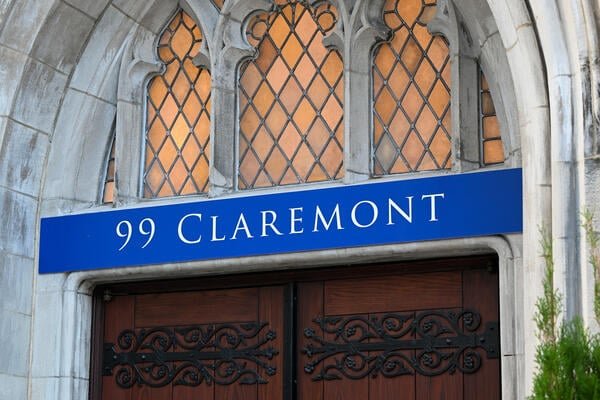
Along the way, Eaton has taken on another role: resident adviser at 99 Claremont, Columbia’s new residence hall dedicated to nontraditional students like himself.
“If I were to live off campus, I wouldn’t have known where to go. I didn’t have any friends yet in the area,” Eaton said. “Living in Columbia’s housing brought me closer to the community.”

Columbia University political science major Jack Eaton (right) attends the grand opening ceremony for 99 Claremont.
Diane Bondareff/Columbia University
More than housing: Eaton is among more than 300 students who can live at 99 Claremont, designed specifically for undergraduates at Columbia’s School of General Studies whose paths to college have included military service, professional careers or time away from school. The facility represents the university’s latest effort to strengthen community among students whose needs may differ from those of traditional undergraduates.
Curtis Rodgers, vice dean of the School of General Studies, said fostering a stronger sense of belonging among nontraditional students was central to the university’s investment in the residence. One misconception about these students, he said, is that because they tend to be older and often have responsibilities outside the classroom, they have little interest in participating in campus life.
“Every corner of this building was designed with [General Studies] students in mind—how they live and build community together while also understanding what their needs are as nontraditional students,” Rodgers said. “There’s opportunities for students to cook and study together and gather together in the event spaces on the roof and in the lounge … all conceived around supporting this specific undergraduate population.”

The exterior of 99 Claremont, which originally served as a residence hall for Union Theological Seminary.
Diane Bondareff/Columbia University
Originally built in 1931 as a residence for nearby Union Theological Seminary, the building underwent a multimillion-dollar renovation supported in part by a multiyear investment from the university and its Arts and Sciences division. The investment helped establish a matching fund for the residence and financial aid for its students. As of March, the school had secured nearly $4 million in donor commitments, including a $2.5 million gift from Bob Hammer, a technology entrepreneur and General Studies alumnus.
The renovation preserved the building’s historic architectural features while introducing amenities intended to support student life, including a fitness center, rooftop lounge, communal kitchen and shared study and gathering spaces on every residential floor.
Rodgers said the residence also helped ease a long-standing shortage of university housing for General Studies students. While some students, particularly those with families, have established homes outside Manhattan, the university has historically struggled to accommodate those who want to live closer to campus.

The interior of 99 Claremont features shared study and gathering spaces, including a ping-pong table.
Diane Bondareff/Columbia University
“Our goal has been for those who do want to live closer to campus, can we provide enough housing to be able to support that demand? And unfortunately, for the last few years, for the last number of decades, we haven’t quite been there,” Rodgers said.
“The opening of this building really represents an evolution of that process,” he added. “How can we expand the number of available apartments and beds that we have for [General Studies] students, and how can we create community while we do that?”

The interior of 99 Claremont includes a communal kitchen where students can cook and gather.
Diane Bondareff/Columbia University
The residence can also play a role in alleviating housing insecurity, which remains a widespread challenge among college students nationwide. According to Trellis Strategies’ most recent Student Financial Wellness Survey, 35 percent of undergraduates surveyed experienced housing insecurity in the previous year.
Rodgers said living closer to campus also provides more opportunities for students to participate in university life, which he believes can contribute to their academic success.
“There’s a connection between student success and participation in the broader community, especially when you have students who want to live closer,” he said.
A sense of home: The opening of 99 Claremont marks a significant expansion of the university’s efforts to house nontraditional students, Rodgers said, noting that previous initiatives added accommodations for only about 50 students at a time.
“We really believe and have undertaken this effort with the idea that this will improve belonging because we’re able to build community at a scale that we’ve never been able to do before for [General Studies] students,” Rodgers said.
For Eaton, the new residence hall offers a sense of comfort and familiarity after his experience living in military barracks. Surrounded by students who have taken similarly unconventional paths to college, he said the transition to residential life at Columbia has felt natural.
“It feels homey to me,” Eaton said. “Everyone has that shared identity in common, albeit we are all from different backgrounds … so naturally residents will become friends and bond over that.”
Get more content like this directly to your inbox. Subscribe here.
You may be interested

I reviewed the iPhone Duo, ask me anything
new admin - Oct 21, 2026I’m The Verge’s senior smartphone reviewer and I’ve been using the iPhone Duo for the past week. I’ve unfolded it,…
Xavier to Open Nation’s 5th HBCU Medical School
new admin - Oct 21, 2026[ad_1] For decades, Xavier University of Louisiana has served as a key pipeline for Black students who want to study…

Russia frees American Stephen Hubbard
new admin - Oct 21, 2026Russia has freed Stephen Hubbard, an American who the U.S. Department of State says was wrongfully detained after he was…