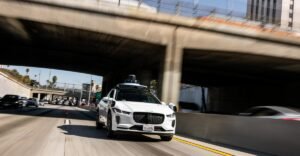




Waymo conquered city streets — why does it keep stumbling on freeways?

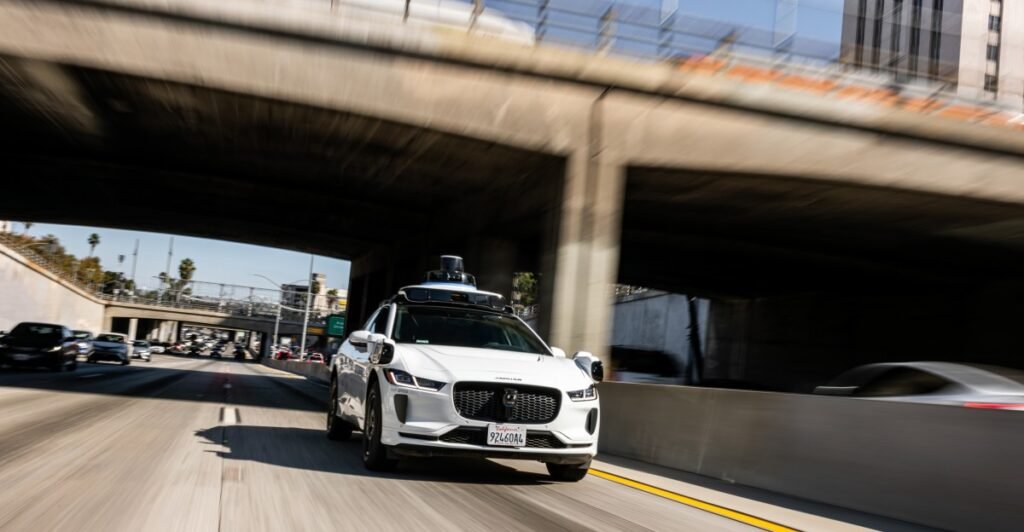
Most people know not to try to pass highway patrol cars while performing a traffic break on a freeway. But on November 6th, a driverless Waymo on Interstate 280 failed that test.
Video shows the robotaxi attempting to overtake two California Highway Patrol cruisers during a traffic break, a moving violation that could get a human driver’s license suspended. For Waymo, it was the latest in a series of freeway blunders that eventually led to the California DMV last week banning its vehicles from all state interstates.
Construction zones have also posed a challenge. Between October and November 2026, the company reported a total of 11 instances in which its vehicles failed to recognize that a freeway lane was closed because of construction and drove into the restricted area anyway, according to a recently filed recall.
With all these violations piling up, Waymo decided last week to pause commercial freeway rides across all of its US markets. It was a bruising setback for the global leader of autonomous driving, exposing how easily its multibillion-dollar technology can still be tripped up by basic road rules.
For years, the autonomous vehicle industry assumed freeways would be the easy part — no jaywalkers, no unprotected left turns — while dense cities were seen as the ultimate battle. Yet Waymo has flipped that script, racking up millions of urban miles while repeatedly stumbling on the interstate.
It was a bruising setback for the global leader of autonomous driving, exposing how easily its multibillion-dollar technology can still be tripped up by basic road rules
This was neither the first time Waymo was forced to pause freeway operations nor the first time it had been caught blundering into construction sites. Earlier this year, the company temporarily halted freeway rides after its robotaxis entered active construction zones in Arizona and California. It issued a recall in June and gradually resumed freeway operations starting in late July after updating its software.
But experts note that the recall didn’t work, as evidenced by the subsequent violations.
”The most concerning part about this is now we have a pattern for Waymo: They issue a recall, it doesn’t fix the problem, but they keep scaling up anyway,” says Phil Koopman, emeritus professor in electrical and computer engineering at Carnegie Mellon University and a researcher specializing in autonomous vehicle safety.
In an interview, Koopman says Waymo is using recalls as “Band-Aids,” which he argues doesn’t really address the root of the problem. In addition to the freeway snafus, Waymo also filed a recall related to the intersection crash where its vehicle failed to detect a police officer directing traffic. In short, the car followed the officer’s orders until passing traffic blocked its view, at which point its software lost track of the “stop” command and drove into the intersection on its own, the company said in the recall report filed with the National Highway Traffic Safety Administration. Waymo later updated its software across its entire fleet so the vehicles remember manual traffic signals even when an officer is temporarily blocked from view.
There have been other recalls related to Waymo passing stopped school buses and driving through flooded roadways. This has led Koopman to theorize that rather than solving the underlying perception and reasoning flaws, Waymo is using “dynamic geofencing” to route around known flood zones or using real-time GPS feeds of school buses until a car encounters an unmapped situation.
“The most concerning part about this is now we have a pattern for Waymo: They issue a recall, it doesn’t fix the problem, but they keep scaling up anyway.”
— Phil Koopman, Carnegie Mellon University
“It felt to me like they were really not being able to fix these problems,” he says. “They’re putting Band-Aids on and getting on with scaling.”
In response to the California DMV order, Waymo said it’s working closely with regulators on a solution, noting that its vehicles haven’t crashed or injured anyone while driving through restricted areas on the freeway.
“Our ridehailing service continues to operate safely on surface streets, serving over half a million trips each week,” Waymo spokesperson Chris Pappas said last week. “We are working with the California DMV and other state officials diligently and responsibly to resume freeway operations.”
Since its inception, Waymo has typically avoided highways, opting instead for longer routes that stick to local roads when ferrying passengers. This has not gone unnoticed by the company’s customers, who often complain their trips can take longer because the vehicles are prohibited from using routes that travel on highways. But in late 2025, Waymo said it was ready to hit the highway.
“Freeway driving is one of those things that’s very easy to learn, but very hard to master when we’re talking about full autonomy without a human driver as a backup,” Dmitri Dolgov, co-CEO of Waymo, said in a November 2025 briefing with reporters. “And at scale. So it took time to do it properly with a strong focus on system safety and reliability.”
“Freeway driving is one of those things that’s very easy to learn, but very hard to master.”
— Waymo Co-CEO Dmitry Dolgov
Now it seems as if Waymo may have jumped the gun. The company’s decision to pull back from the freeway, twice in one year, reflects the enormous stakes of operating driverless vehicles at high speeds. At 10 to 25 mph on a city street, applying the brakes solves almost any confusion, and crash lethality is drastically lower. At 60 or 70 mph, stopping distances stretch out, and any mistake involving a roadside worker or stranded motorist is nearly 100 percent fatal. And if the vehicle gets confused and needs to ping a remote operator for assistance, the latency of that connection and the time it takes to receive a reply becomes a major liability.
Koopman thinks that subtle edge cases — like a gap in construction cones or a cop’s hand gesture — are tripping Waymo up right after its transition to end-to-end machine learning. Unlike older modular systems where engineers could write explicit rules, statistical models struggle when familiar objects appear in unfamiliar contexts.
“If you’ve trained on the individual elements, their combination presents a special meaning that is different than usual,” he says. “A stop sign folded out on a school bus is completely different from a stop sign on a post… Everything I’ve seen is consistent with the hypothesis that it’s having trouble with subtle contextual clues.”
For Waymo, solving for the freeway is essential if the company wants to continue expanding its service area to include popular ridehailing destinations, like airports. Waymo’s future reliability will depend on it. While safety engineers want to do the right thing, executives face massive market pressure to ship “good enough” fixes and apologize later, Koopman argues. And because traffic tickets and standard fines don’t deter well-capitalized tech giants like Alphabet, regulators need mandatory public transparency — not quiet software patches via recalls.
“If DMV gets a neutral look without political pressure, they’re going to say, ‘Fool me once, shame on you,’” Koopman says. “They can’t just accept Waymo saying, ‘Trust us, bro, we fixed it this time for sure.’”
You may be interested
Ukraine says it has intercepted a Russian jet-powered drone with a laser for the first time
new admin - Nov 26, 2026Ukraine has used a laser weapon to shoot down a Russian jet-powered attack drone for the first time, a senior…
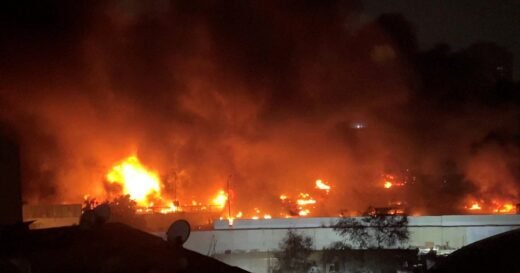
Egypt tanker explosion kills 31 people as driver crashes into fuel truck in fiery highway crash
new admin - Nov 26, 2026Cairo — A massive fire on an Egyptian highway killed 31 people and injured 21 others after a car slammed…

What’s open and closed today on Thanksgiving Day 2026? Hours for stores, restaurants, banks and more
new admin - Nov 26, 2026Thanksgiving is here, giving Americans a chance to gather around the table, overdose on rich foods and renew family squabbles.…