



The Priority? Student Success. The Challenge? Capacity.

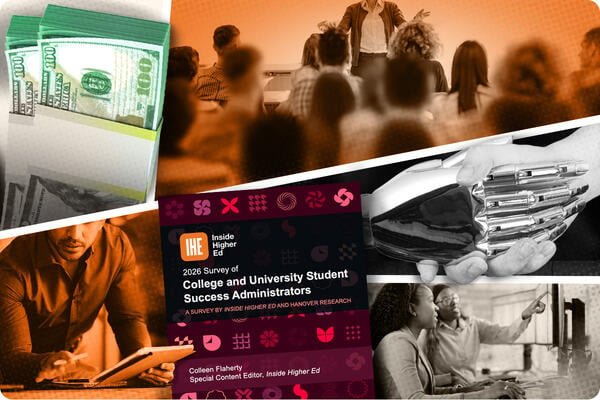
Most institutions are embracing student success. But many are struggling with some of the fundamentals needed to advance it, from collecting and using student data to finding the money and staff capacity to hone new approaches. And while student success leaders remain generally confident in the education their institution is delivering to undergraduates, they continue to flag financial and other barriers to success, along with experiential career-readiness gaps.
Leaders also trend bullish on the potential of artificial intelligence to meaningfully transform the student experience—even as many haven’t seen any AI-related student gains yet.
These are among the key findings of Inside Higher Ed’s third annual Survey of College and University Student Success Administrators with Hanover Research. The survey of 271 administrators, most of whom work in student affairs at the executive level, also reveals some improvement in campus climate and in efforts to help students understand appropriate use of generative AI.
Institutional Limitations
Nearly all student success administrators rate the quality of undergraduate education at their institution as good (48 percent) or excellent (46 percent), and 92 percent at least somewhat agree that students trust the institution and believe that it’s reliable, cares about them and acts with integrity. Leaders are also largely confident in their institution’s career-readiness value: 89 percent agree that employers generally trust that their institution’s graduates have the skills needed for immediate workforce success, for example. Fewer agree that their institution actively invests in building long-term trust with faculty and staff (55 percent), however. And private nonprofit institution respondents are much less likely than their public peers to express high confidence in their institution’s affordability efforts (45 percent versus 81 percent, respectively).
More on the Survey
On Wednesday, Dec. 9, at 2 p.m. Eastern, Inside Higher Ed will present a free webcast discussion on the 2026 Survey of College and University Student Success Administrators. Please register here—and plan on bringing your questions about student success going into 2027.
This survey was conducted Aug. 22–Oct. 5 with Hanover Research. Respondents number 271 student success leaders, most of whom work in student affairs at the executive level at public and private nonprofit institutions. The survey’s margin of error is plus or minus six percentage points. Download a free copy of the report here.
Our independent editorial survey was made possible by support from Studiosity and the Gates Foundation.
Digging deeper, nearly two-thirds of respondents (64 percent) say their institution is very or extremely effective at making student success a priority. Some 77 percent agree that their president effectively advocates for student success and helps allocate necessary resources, and 69 percent say their provost actively prioritizes student success within the academic infrastructure.
At the same time, fewer than half (48 percent) say their institution is very or extremely effective at collecting student success data, and just 39 percent say the same about using it to inform decisions and initiatives. Only 35 percent rate their institution highly on building a culture of data around student success. Most of these numbers remain relatively unchanged from 2024 and 2025.
Elliot Felix, a student success consultant and author of The Connected College: Leadership Strategies for Student Success, said the data gap can reflect a culture or a capacity issue, or both.
“Technology is getting better and better at sharing data, but people are not,” he said, adding that working across institutional silos remains a challenge: Collaboration may be an institutional aspiration, but sharing data and decision-making authority can prove difficult, or at least be perceived to slow things down.
Capacity compounds the problem, Felix explained, since some institutions have staff members specifically responsible for coordinating people and data or building communities of practice, while others can’t afford those positions. Still, he said, “maybe the better question is can they afford not to?”
Write-in responses to a survey question about the biggest internal barriers to innovating for student success underscore the capacity issue: Among the 233 administrators who described what’s limiting their team’s ability to solve challenges without external mandates, funding emerged in about half of their responses, while staffing and personnel constraints appeared in roughly a third. Respondents frequently described budget limitations that prevent hiring and understaffed teams that lack the bandwidth to strategize and otherwise develop new approaches.
Organizational barriers arose as another theme, so even when people have new ideas, leadership, decision-making structures, competing priorities and silos often limit execution. Technology is described as both a tool and a barrier, with some respondents pointing to inadequate systems, fragmented data or cumbersome software—even as some note that well-implemented tools could help.
“Siloed data and systems; inconsistent policies and processes; the investments needed to innovate; the human resources needed to get things done effectively and consistently; outdated thinking,” one respondent cited as barriers. “Successive years of planning that doesn’t seem to go anywhere, a lot of administrative change, eroded trust,” said another. Wrote a third, “Lack of shared vision and a decentralized approach to student success efforts. Budget, people resources (meaning number of staff), student success framework not well understood by the campus as a whole (only understood in pockets).”
For Felix, overcoming capacity challenges—which appeared across Inside Higher Ed’s leadership surveys this year, from those of chief technology officers to provosts—means being clearer about what to pursue, based on the specific institution’s mission.
“The goal shouldn’t be do more with less, it should be to focus so you can do less with more,” he said. Focus also comes from auditing technology systems, student support services and academic programs to identify duplication and opportunities for better coordination. And institutions “need to look at and sort everything in terms of what they can sunset, start, sustain or scale,” he said. Every start should have a parallel sunset, he added.
The Student Experience
As for what’s holding individual students back, insufficient financial aid and/or needing to work long hours to cover living expenses is the leading challenge to academic success and persistence, cited by 72 percent of administrators. This is consistent with other research identifying finances as a top barrier to success. Administrators ranked mental and behavioral health challenges second, at 55 percent, followed by gaps in academic preparation (47 percent) and basic needs insecurity (33 percent). For community college respondents, basic needs insecurity is nearly as prominent as financial constraints, cited by 65 percent and 67 percent, respectively. In Inside Higher Ed’s survey of provosts this year, community college leaders named basic needs security as a top campus safety issue.
Undergraduates themselves identify mental health challenges and financial pressure, in that order, as the top two barriers to academic success, according to preliminary data from the 2026–27 Student Voice survey by Inside Higher Ed and Generation Lab. Six in 10 undergraduates also indicate they’ve gone without at least one of the following in the last year because they couldn’t afford it: food, medical care, mental health care, transportation and sleep or rest (due to needing to work for pay).
One opportunity area, based on the student success leader survey: helping students better understand the financial support available to them. Although 75 percent of leaders say their institution offers emergency financial aid, just 35 percent say students are aware of and regularly use it. And only 16 percent say students understand the total cost of attendance—including tuition, fees and living expenses—very or extremely clearly. This is virtually unchanged from last year, despite growing national attention to the issue of cost transparency.
On the issue of basic needs support—and as some institutions link access to this support to academic milestones—the majority of student success administrators (54 percent) say most or all support is offered unconditionally, regardless of academic performance. Another 9 percent say support is unconditional initially at their institution, but subsequent rounds of aid should depend on meeting academic milestones.
Mental health remains another persistent concern. While 81 percent rate their institution’s efforts to promote general undergraduate well-being as good or excellent, 77 percent agree that mental health challenges continue to be a primary driver of academic difficulties and student stop-outs.
One bright spot: More than three-fourths (78 percent) say students are increasingly seeking mental health resources earlier, before reaching a crisis. But just 9 percent agree that the clinical severity and complexity of students’ struggles have decreased over the past year, despite other evidence of reductions in student self-reports of severe mental health issues nationwide. Some 69 percent agree that their campus mental health infrastructure, including telehealth, counselors and peer-support models, is adequately equipped to meet student demand.
Financial literacy is another concern on the wellness matrix: Just 38 percent of administrators rate their institution’s efforts to promote it as good or excellent. And most aren’t monitoring digital wagering on their campus.
Regarding overall campus climate, 30 percent say their institution is doing an excellent job promoting a positive atmosphere, up from 19 percent in 2024. Most also say their institution is at least somewhat effective at fostering an environment where students can explore diverse perspectives, with 26 percent rating those efforts as very effective, up from 14 percent in 2025.
Nearly all administrators estimate that most undergraduates have at least one or two people on campus who know them in a way that signals they truly matter. Regarding diversity, equity and inclusion, 46 percent say that recent regulatory or legislative changes have negatively affected undergraduate students’ sense of belonging at their institution. Similar shares of administrators report negative effects on staff workload and capacity (46 percent) and on staff budgets and funding flexibility (43 percent). Nearly half (45 percent) also report significant federal policy-related declines to international applications or enrollment, up from 29 percent in 2025. And most indicate that the One Big Beautiful Bill Act is limiting undergraduate access to their institution to some degree—21 percent say significantly.
Here is the full list of what student success leaders cite as the biggest barriers to students’ academic success and persistence at their institution, selecting up to three options:
- Financial constraints: Insufficient financial aid or needing to work excessive hours to cover living costs: 72%
- Mental and behavioral health challenges: Acute or chronic psychological distress (e.g., anxiety, depression or severe stress) that disrupts classroom focus or academic performance: 55%
- Academic preparation gaps: Underpreparedness in foundational skills (e.g., math, reading and writing) stemming from prior structural learning disruptions/lack of adequate academic preparation before college: 47%
- Basic needs insecurity: Chronic housing instability, food insecurity, lack of reliable transportation or more: 33%
- Perceived lack of relevance: Students struggling to see/be shown the long-term value or practical connection between required coursework and their personal or career goals: 22%
- Disengagement and/or low attendance: Elevated rates of chronic absenteeism, digital fatigue or a detached approach to course completion: 20%
- Navigational friction: Complicated college processes (e.g., registration roadblocks, financial aid verification or confusing advising handoffs): 19%
- Pedagogical disconnection: Instructional methods or course designs that fail to actively engage contemporary learners/low-quality instruction or teaching practices: 12%
- Other: 3%
- They don’t see any significant barriers to academic success: 1%
A Design Opportunity?
Mark Milliron, president of National University, which serves many nontraditional students who balance college with employment, caregiving and even military service, said the survey’s findings point to an opportunity for institutions to reconsider how they organize their services and deliver educational experiences. Calling many of his university’s students “ANDers” for the different life roles they hold, Milliron said that enterprise data systems aren’t always designed for the kind of flexible educational models and modalities they need.
“Without the right systems, we cannot produce the data and insights that guide decision-making, reduce friction in operations and inform personalized student support,” he said. He added that AI has the potential to help students navigate their individual educational journeys through more personalized guidance, but that potential depends on having accurate, comprehensive data that reflects the full range of student experiences.”
On AI, nearly three-quarters of respondents (74 percent) say their institution is at least somewhat effective at helping students understand how, when and whether to use generative AI in academic settings, up from 57 percent in 2025. Administrators also report AI-related productivity gains for faculty and staff, particularly in drafting and editing communications and, separately, summarizing information: 86 percent say AI has at least somewhat increased efficiency or impact in both areas.
But when it comes to the student experience, nearly a third of administrators (32 percent) say they have not yet detected measurable or demonstrable improvements from AI, and 27 percent aren’t sure if they have. The clearest reported student gains are in retention and early intervention and in career services, both cited by 21 percent of respondents.
Looking ahead three years, however, administrators are much more optimistic: Some 69 percent see significant or transformative potential for AI to improve students’ interactions with general administrative and campus services. Other promising areas include career services, financial aid and enrollment, academic advising, and teaching and learning.
Felix said he’s also enthusiastic about AI’s possibilities, including expanding access to advising, tutoring, coaching and career development while freeing up faculty and staff members to spend more time with students. AI could also help students connect with organizations, mentors and experiential learning opportunities that might otherwise be difficult to discover, he said.
According to the survey, administrators estimate that 35 percent of their institution’s students participate in zero extra- or co-curricular activities, on average, increasing to 55 percent among community college respondents. Those numbers are down somewhat from last year, though still speak to disengagement from campus life. Asked what would help, 69 percent of administrators endorse tying participation to financial compensation, stipends or tuition credits; the same share endorse demonstrating the value of participation, such as direct career skills learned, networking opportunities or personal milestones.
The biggest AI unknown is around academics and assessment, Felix said, again urging deliberate experimentation that scales up what works and sunsets what doesn’t. Institutions need to be strategic across domains, he added, cautioning against adopting so many tools that the technology sprawl overwhelms students, faculty and staff.
Survey respondents also emphasize the importance of purposeful integration. In 148 write-in responses about what will distinguish institutions that successfully integrate AI into the student experience, administrators repeatedly highlighted the need for a clear institutional strategy, meaningful applications and approaches that preserve or even strengthen human relationships.
An overarching theme is that adoption alone is not enough. In the words of one leader, “AI is a tool and not a crutch.” Wrote another, “To me, successful institutions [will] use AI to reduce barriers, personalize support, identify student needs earlier and make it easier for students to navigate complex processes while maintaining meaningful human relationships and appropriate oversight. They will also invest in AI literacy for students and employees and establish clear expectations for responsible use. Institutions that view AI primarily as a technology initiative rather than as an opportunity to redesign the student experience will be more likely to struggle.”
Wrote yet another leader, “Organizational readiness and willingness to redesign existing systems rather than simply layering AI onto current practices.” Said another, “Resources. Vision. AI can do so many things, there must [be] a vision and a focus to implement its use effectively.”
When evaluating AI-enabled student support solutions, respondents most prioritize demonstrated evidence of improved student outcomes (56 percent), total cost (55 percent) and data privacy and security (53 percent).
These are the top factors that students themselves prioritize for responsible use, according to the recent Student Voice survey: helping students learn, rather than simply doing work for them (65 percent); being transparent about when and how AI is being used (60 percent); protecting students’ privacy and personal information (54 percent); keeping humans involved in decisions about students (53 percent); and giving students clear guidance about when and how they can use AI (53 percent).
The administrator survey also finds that leaders are more confident in some aspects of career preparation than others. Some 83 percent agree that students at their institution earn the degrees and certificates needed to enter their chosen fields. But fewer express confidence in students’ access to experiential learning opportunities (69 percent) or their ability to articulate specific skills to employers (61 percent). Embedding experiential learning into coursework is the most frequently cited career-readiness priority (58 percent), followed by helping students articulate their skills (46 percent) and expanding industry partnerships for internships and direct-hire opportunities (45 percent).
And while institutions increasingly emphasize career outcomes, just 31 percent of administrators say postgraduate outcomes information is easily accessible and clearly communicated through official channels.
In a set of 157 write-in responses about the single most effective change their institution could make to measurably boost undergraduate success, leaders frequently called for more need-based financial aid and additional staff to support students—echoing responses to the question on what’s most limiting their team’s ability to innovate around student success. Another recurring theme is connecting students with assistance before they encounter academic or personal difficulties.
Ultimately, Milliron said, institutions need to reconsider where responsibility for student success sits, as it’s not with individual learners or offices navigating institutional complexity when problems arise.
“It needs to be reflected in how the university designs learning, builds relationships and organizes support from the beginning.”
You may be interested

The Reality of College Tuition Sticker Shock | Money Moves with Jill Schlesinger
new admin - Nov 12, 2026Is in-state college tuition worth $50,000 a year? In today's episode, Jill and Mark are questioning the skyrocketing cost of…

Manhattan Targets Mellon for Funding Left-Leaning Ed Orgs
new admin - Nov 12, 2026[ad_1] When former Delta College President Mike Gavin unveiled the Alliance for Higher Education in January, he didn’t publicly reveal…

Boy found alive after 6 days lost in Australian wilderness: “He’s grounded for life”
new admin - Nov 12, 2026A 17-year-old boy with autism was found alive Thursday after six days lost in eastern Australian woodlands. The boy, whom…