



Chris Stapleton on the Overlooked Album That Changed His Life

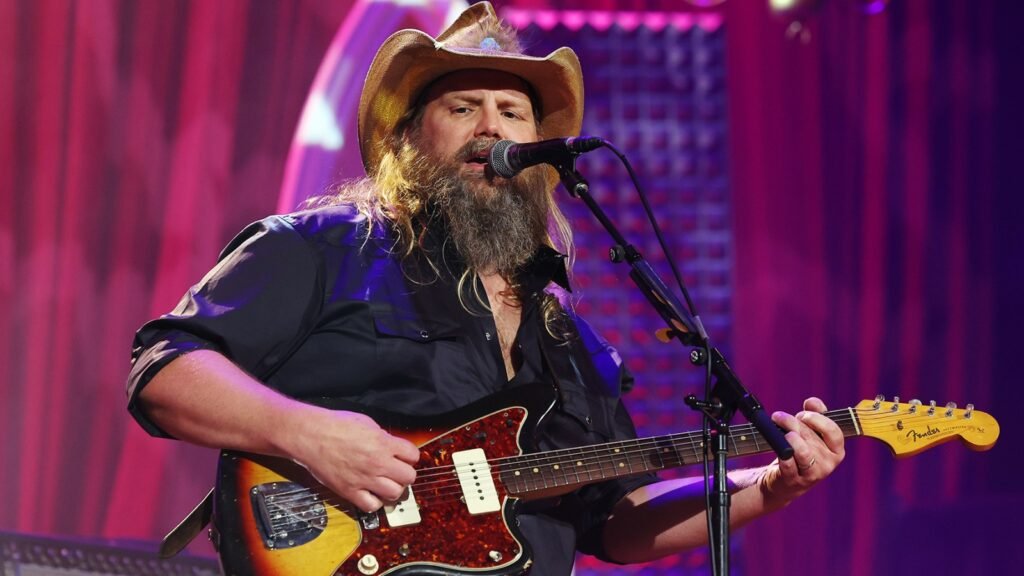
Chris Stapleton was born and raised in east Kentucky, but growing up, he never really listened to the style of music that his state helped create and make famous: bluegrass. It was around, for sure, but just not playing in his house, where outlaw country and old R&B dominated the stereo.
It wasn’t until Stapleton was in his early twenties, still living in Kentucky and driving an ice truck, that he got his first proper introduction to bluegrass and roots music. The album that did it was 2000’s Real Time, recorded by Darrell Scott and Tim O’Brien, two established Nashville songwriters and session players. And as Stapleton writes in this excerpt from On the Records: 80 Musicians on Beloved and Overlooked Albums, a new book about underrated and overlooked albums, Real Time “expanded my vocabulary as to what was possible in music” and “became part of my bloodstream instantaneously.”
In the exclusive excerpt below, Stapleton digs into the various musical rabbit holes that Real Time sent him down, and why he still keeps the album on regular rotation. “Even though it’s just two guys playing instruments, on any given track, I’ll find something new to latch on to, something I didn’t realize before, and try to get inside songs in a different way,” he writes.
On the Records, which will be published Nov. 17, features essays by, or conversations with, 80 musicians about the lesser-known albums that had a huge influence on them. Along with Stapleton, the book boasts contribution from Dolly Parton, Billie Eilish, Karne O, Earl Sweatshirt, Bon Iver’s Justin Vernon, the Roots’ Black Thought, and Willie Colón.
I credit this album for getting me into acoustic and bluegrass/roots-based music. I was in my early twenties when someone put Real Time in front of me, and I was completely enamored with the fact that it’s just two guys sitting in a room playing, so full and big and lively and moving. The technical ability on display — both singing and playing — was unlike anything I’d ever heard before (or since). Not only are all those things on display, but the songs from top to bottom take you on a journey. I like albums that do that.
At the time, I was listening to a lot of country and older R&B, and the kind of outlaw country things my dad was listening to. Even though I’m from east Kentucky, I didn’t grow up in a bluegrass family or a family band situation that a lot of people in my part of the country had. As odd as that sounds, I never really crossed paths with that music. There was a lot of it around there, but it was just not part of my household.
I was probably 21 or 22 years old when I first heard this, still living in Kentucky and driving an ice truck. I’m guessing it was probably in 1999 or 2000, somewhere in there. I’m not sure how old the record was at that point. But I am pretty sure it was Jesse Wells who played it for me. He plays fiddle and is kind of a utility guy with Tyler Childers’ band now, but at the time, we were roommates. He provided my introduction to a lot of that music. Jesse was the opposite of me in that he did grow up with old-time and bluegrass music, had a wealth of knowledge, and was generous enough to share some of that with me. And listening to Real Time expanded my vocabulary as to what was possible in music.
It became part of my bloodstream instantaneously. I think that’s what happens when you hear something truly moving. You are not the same after you hear it, if you really dive into whatever it is — whether it’s a film or music or even meeting a person — you’re forever changed by those first moments. The minute I got to the end of Real Time, I started it over, and probably annoyed everyone around me with it for a good few months, because it became something I would listen to every day.
It certainly made me dive into acoustic music in ways that I never had. I was introduced to things like New Grass Revival, John Cohen and Béla Fleck, Tony Rice and Skaggs and Rice. I was familiar with Ricky Skaggs from his country stuff, but not necessarily his bluegrass side, that he used to play with Bill Monroe. And then from there, I went into Flatt and Scruggs. The list goes on. You open that can of worms, and all of a sudden you’re listening to Del McCoury and Mac Wiseman, all kinds of stuff. You’re trying to figure out who these guys’ influences are and what created this. The truth is, it’s their influences mixed with their own unique talents and perspectives and experiences. You want to try to understand it more than you do, ’cause you feel it so much.

And the influences are so broad. When you get to something like track three, “Weary Blues from Waitin’,” a Hank Williams song, it’s these two guys sitting in a room, but playing a very blues version on acoustic instruments. All these things are coming up. But to hear it done in a real kind of . . . naked is not the word, but it’s out there, right in your face, like you’re in the room. I could hear that maybe those influences were some of the same ones I had. I think that drew me to it almost immediately.
At the same time, to my knowledge, I’d never heard of a bouzouki until I heard Tim playing it on this record. I had to figure that out: What instrument is he playing? Obviously Tim also has lots of Irish music influences, and when you hear those, you start to dig into fiddle tunes and old-time music, which becomes another rabbit hole of acoustic music separate from bluegrass. All those things are in there. I think Jesse knew that when he handed me this album it was gonna expand my mind in ways that I probably didn’t see.
There’s great storytelling in some spots on this record, and there are great solos that I could sing you every note of. I love it as a body of work. Every nuance and breath is important to the love I have for it. It’s an experience to listen to the whole thing. I can only ever think of it as a body of work, because if I ever hear individual songs off it, I immediately want to hear the next song that I know is on the record; it’s a kind of Pavlovian conditioning. The sequencing does that.
When I do have time to listen to full albums, when I’m driving, I still put it on. Some days, I just need to hear it, to remind myself. It’s very grounding to hear music that’s been a formative part of your life. I feel the same way about Tom Petty’s Wildflowers, which I mark as another one of my favorites. These two records are stuck in me in ways that a lot of other things aren’t. I’ll always go back to ’em, always enjoy them, and I still find something new in them. Even though it’s just two guys playing instruments, on any given track, I’ll find something new to latch on to, something I didn’t realize before, and try to get inside songs in a different way. If I’m really attached to something, I can listen to the same song over and over for three or four hours, just listening to one part at a time. I can dwell on, for example, a bass line for an hour, if I really want to get to know a record. And that’s what I do with Real Time.
I don’t know how many takes Tim and Darrell did with Real Time, but I imagine it’s not that many. I’ve never asked them to tell me about recording this record. (I don’t know why, actually; I’ve been around them enough that I should have, because I love this record so much.) To me, part of making records is capturing the moment. And sometimes that moment is imperfect. I’m sure Tim and Darrell might listen to this record and find moments of it imperfect, even though it feels perfect to me. That’s the beauty of getting to be a listener and not always somebody trying to make something. The things that seem like imperfections also bring humanity to music and records. That’s something else I hear on this record, the human element of it.
I know I’ve told scores of people about Real Time. I’ve certainly given it to a lot of people. Back when hard copies were still a thing, I would always be without a copy of whatever my favorite album was because I would hand mine to somebody. “Hey, you have to hear this, take it. And if you like it, buy another one and give it to somebody.” And I’d go buy another one. That’s the way I used to like to pass the music forward, in whatever small way, building it up. I’m so thankful for this record. I think maybe I should express gratitude to Tim and Darrell and this record for its influence on me as a person and as a musician, because it’s left quite a mark.
Excerpted from On the Records: 80 Musicians on Beloved and Overlooked Albums by Brian Beck. Copyright © 2026 by Brian Beck. Published in the United States by Clarkson Potter/Publishers, an imprint of the Crown Publishing Group, a division of Penguin Random House LLC.
You may be interested
Giants Reportedly Pursued Trade For Falcons Superstar RB Bijan Robinson
new admin - Nov 11, 2026[ad_1] NEWYou can now listen to Fox News articles! This would've been something!Among other trades they pursued, the New York…

Childcare Center Closures Spark Backlash on Campus
new admin - Nov 11, 2026[ad_1] On a Monday night in October, Smith College sent a notice that alarmed many employees: The college’s on-campus childcare…
Beyonce and the Chicks’ 2016 CMA Awards Performance: Lasting Impact
new admin - Nov 11, 2026[ad_1] A decade ago this month, the 50th CMA Awards booked one of the most talked about, and arguably one…