


3 Lessons on How to Support Student Veterans

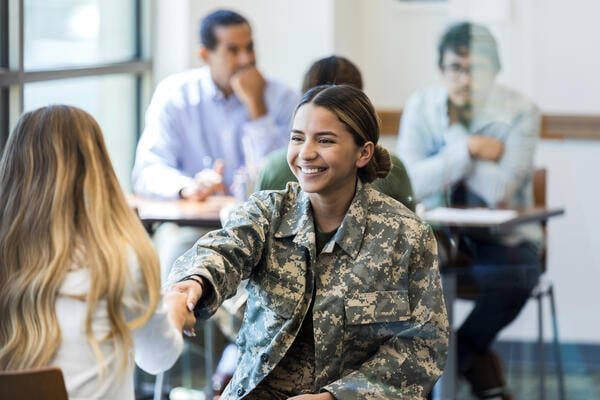
For students who are veterans, the transition from military service to college life can present a unique set of challenges, from navigating academic expectations and campus resources to building connections and a sense of belonging. For colleges and universities investing in programs and services for military-connected students, understanding their experiences and needs is essential to supporting their success.
Recent research sheds light on how veterans perceive the value of their college experiences, providing guideposts for institutions seeking to ease their transition to higher education and foster personal growth and community.
Here are three lessons from recent Inside Higher Ed student success coverage on supporting veteran students in higher education.
- Veterans report the highest perceived college value.
Veteran students reported the highest perceptions of college value among the student populations surveyed in a recent report from Qualtrics and Buro Happold, which found that students tend to assess the value of their college experience through a broader lens than financial returns and career preparation.
Based on a spring 2026 survey of 1,007 U.S. college students, researchers found that 74.2 percent of respondents reported receiving high or exceptional value from finding purpose and experiencing personal growth in college, the highest among nine dimensions of the college experience. Economic return ranked lowest at 66.2 percent.
Evaluating their overall college experience, 66 percent of all respondents reported high or exceptional value, but veterans reported the highest rating among the student populations examined, at 74.4 percent. Meanwhile, 79.3 percent of veteran students reported being somewhat or very satisfied with their college experience, compared with 84 percent of all respondents.
“If you think about college, it’s a time for students to find their place, their people and their purpose,” said Elliot Felix, a partner at Buro Happold and co-author of the report. “Students are looking for value, and at the same time, they don’t want to measure it purely in terms of dollars and cents.”
- Tailored orientation can support the transition to college.
To help student veterans transition to college life, William & Mary has developed a targeted pre-orientation program that centers their values and strengths.
In August 2025, the business school’s Center for Military Transition piloted a weeklong pre-orientation session focused on helping students with military experience identify their values, interests and strengths as they clarify the professional skills, career goals and sense of belonging they hope to build on campus.
Jonathan Due, executive director of the Center for Military Transition at William & Mary, said nearly 20 students participated in the pilot, including about six who were still on active duty. He noted that what makes the pre-orientation distinct is its emphasis on “reflection, preparation and connection.”
“Instead of jumping right into helping students seek a new professional identity or a new career, we want them to reflect first,” Due said. “From there, we focus explicitly on their professional strengths and use that self-reflection as a foundation to help them connect. That provides additional insight into the specific preparation for what comes next, and only then are we ready to really dive deep into career search and application strategies.”
- Storytelling helps veterans find their voice.
New York Film Academy’s Division of Veteran Services supports veterans’ transition from military service to civilian life by helping students turn their lived experiences into plays and films, using storytelling to process their experiences and shape identities beyond the uniform.
The institution has served roughly 3,000 veteran and military-dependent students across its two campuses, in New York City and Los Angeles. Both campuses participate in the Yellow Ribbon Program, which helps eligible veterans and their dependents cover tuition costs.
Christopher Moore, the college’s director of veteran services and a retired command sergeant major, said his military background shapes how he mentors student veterans as they navigate the transition to civilian life.
“[For] veterans like myself—I’m a retired veteran who served more than 30 years in the United States Army—being able to tell your story helps in the healing process,” Moore said. He noted that students recently participated in a workshop where they produced two short films about their military experiences, helping them reflect on and process their service.
Get more content like this directly to your inbox. Subscribe here.
You may be interested

Giants Reportedly Pursued Trade For Falcons Superstar RB Bijan Robinson
new admin - Nov 11, 2026[ad_1] NEWYou can now listen to Fox News articles! This would've been something!Among other trades they pursued, the New York…

Childcare Center Closures Spark Backlash on Campus
new admin - Nov 11, 2026[ad_1] On a Monday night in October, Smith College sent a notice that alarmed many employees: The college’s on-campus childcare…
Beyonce and the Chicks’ 2016 CMA Awards Performance: Lasting Impact
new admin - Nov 11, 2026[ad_1] A decade ago this month, the 50th CMA Awards booked one of the most talked about, and arguably one…