



Institutional Decay Compelled a Reckoning

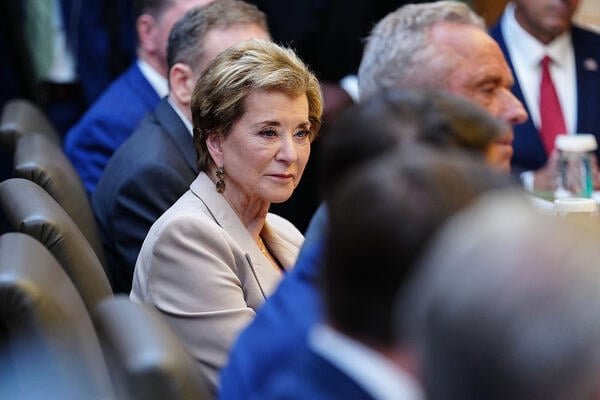
Education Secretary Linda McMahon declared President Donald Trump’s 2024 election “a turning point for higher education” during a speech at Vanderbilt University Wednesday, the fourth and final talk in her series entitled “The Next 250: American Education.”
“Violent riots erupted across campuses,” McMahon said, referring to the wave of pro-Palestinian student encampments that sprang up in the spring of 2024. But those protests, combined with dramatic declines in academic rigor, caught Americans’ attention, she said, and now, “a tide of reform is finally washing over our campuses—powered by some institutional leaders who have boldly acknowledged the need to rebuild public trust, restore sanity and revive a culture of excellence and accountability.”
“The most vivid examples of institutional decay rising to the surface compelled a reckoning,” she later said.
Two years later, with Trump in office, colleges and universities are returning to “the basic standards that powered centuries of academic vitality,” she said: protecting free speech and open inquiry, setting rigorous merit-based academic standards, and committing to putting Americans first.
Just as she did a week ago when she gave a similar speech on college affordability at Arizona State University, McMahon touted her host institution, Vanderbilt, for being a prime example of such renewal. She also pointed to Yale and Washington Universities, which, like Vanderbilt, have released reports acknowledging their role in politicizing academic research and eroding public trust in higher education.
She also praised the “more than 300 colleges” that have rolled back “discriminatory DEI mandates” and institutions including Ohio State, the University of Iowa and the University of North Carolina that have expanded or opened new civil discourse centers.
She effusively thanked Vanderbilt’s chancellor, Daniel Diermeier, for his leadership, calling the Nashville, Tenn., institution “a model of courage and clarity” that “lighted the way for the nation.”
“At a time when universities everywhere are being pushed, prodded and publicly pressured to issue statements on every social or geopolitical controversy, Vanderbilt refused to be swept along by the winds of the moment,” McMahon said.
Instead, it chose institutional neutrality.
And by “choosing this harder path, Vanderbilt is clearing the ground for the return of the pathbreaking research and intellectual vitality that make our campuses national treasures,” she said.
As she did in last week’s speech, McMahon started by inviting listeners to recall a time when higher education was at its best, “forging the ideas that would give birth to the American republic” and driving scientific innovation. Then she pivoted, drawing attention to the “stark” contrast between what once was and what students experience today. She accused many institutions of “succumbing to the idea that merit and excellence should be sacrificed to equity and ideology” and blamed federal grant makers who “fueled this campaign against intellectual rigor” by funding “intellectually hollow projects,” such as a Ph.D. dissertation that focused on “transgender Thai Buddhist artists.”
Finally, she turned her attention to how the Trump administration’s actions—particularly the seven “landmark” agreements it reached with institutions including Columbia and the University of Pennsylvania—are bringing “much‑needed scrutiny” to issues that went unaddressed for years.
McMahon did not mention her department’s proposed “Compact for Academic Excellence in Higher Education,” which would have required institutions to make sweeping changes or risk losing federal funds—a move that spurred widespread condemnation. Nor did she mention the “Call to Action” letter she sent to colleges in August, which many experts describe as a significantly watered-down version of the compact.
The secretary noted that while Trump’s approach to this new era of higher ed has been cast as “heavy‑handed,” she’s surprised by how often she hears institutional leaders express “a quiet appreciation for the Trump administration’s approach” and how it “provides the air cover … to pursue the reforms they long knew were needed.”
McMahon did not say which institutional leaders have made such remarks.
She closed by urging institutions to promote the “good of the country.”
“They must reclaim the principles, the seriousness and the sense of mission that once made their institutions indispensable to the American project,” she said.
You may be interested

Zazie Beetz on how she prepared for her role in "Nocturne"
new admin - Oct 29, 2026Zazie Beetz sits down with "CBS Mornings" to discuss her starring role in Apple TV's "Nocturne." Source link

‘Hello, Honky Tonk,’ Ella Langley, TikTok
new admin - Oct 29, 2026[ad_1] K aitlin Butts has a question. “Have you ever heard ‘Rockstar’ by Nickelback?” she asks between bites of a…

There’s one week left to preorder the Ocarina of Time remake for $10 off
new admin - Oct 29, 2026The long-awaited remake of The Legend of Zelda: Ocarina of Time for Nintendo Switch 2 launches next Thursday, November 5th.…